

Audio By Carbonatix
For many students at the University of Skills Training and Entrepreneurial Development (USTED) in Asante Mampong, breast cancer was a disease often linked with fear and uncertainty.
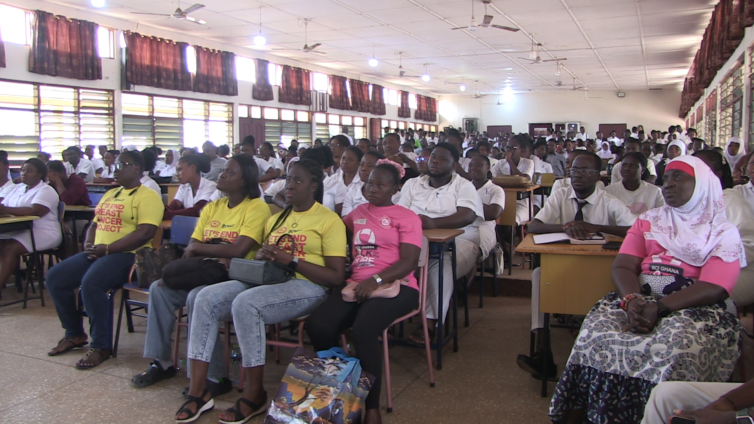
But after a breast cancer awareness programme, many said they had gained a better understanding of the disease, the importance of early detection and the need to support people living with breast cancer.
The programme was organised by Peace and Love Hospital and Breast Care International (BCI) to educate students on breast cancer prevention, screening and the need to reduce stigma surrounding the disease.
The session brought together students from USTED’s public health and disease control programmes, who were encouraged to become advocates for breast cancer awareness in their communities.
Holiness Pokuaa Boakye said the programme helped her understand that breast cancer can affect anyone, including younger people and men.
"I learnt that even children and younger people can also get breast cancer. Men can also get breast cancer as well," she said.
She said although the exact cause of breast cancer is not known, awareness and early checks remain important in helping people detect the disease early.
For Gyekye Obenewaa Sandra, the programme highlighted the importance of screening.
"There is no actual cause of breast cancer, so there should be screening so that we will be able to know whether we have the disease or not in order to save lives," she said.
Mensah Mavis said the awareness session changed her understanding of what a breast cancer diagnosis means for patients.
She said she previously thought that losing a breast through surgery could mean the end of a person's life, but she now understands that survivors can continue to live meaningful lives.
"Breast cancer is not the end of someone's life. Life still goes on," she said.
She added that the programme encouraged her to take breast screening more seriously because early checks can help identify problems before they become severe.
Ampofo Christiana said the training helped her understand that breast cancer should not be seen as a death sentence.
"Early detection saves lives. If your breast is cut off, it does not mean that is the end. You can still be a complete woman with the effective support put in place," she said.
President of Breast Care International, Dr Beatrice Wiafe Addai, said educating students in health-related fields was important because they would play a key role in taking accurate breast cancer information to communities.
She said misinformation, including the belief that breast cancer is caused by witchcraft or spiritual forces, continues to create fear and delay people from seeking help.
"Breast cancer is not caused by witchcraft and it's not a spiritual disease," Dr Wiafe Addai said.
She said improving awareness and preventing late detection would help reduce deaths from breast cancer.
"If we are able to prevent late-stage disease, we are at the same time preventing deaths from breast cancer," she said.
A student from the University Medical Center Groningen in the Netherlands, Frossini Totska, said her work on breast cancer research in Ghana had highlighted the need for more attention to differences in breast cancer among populations.
She said African populations remain underrepresented in breast cancer research, despite evidence that women in these populations may develop the disease at younger ages compared with women in Western countries.
"I've seen how underrepresented the African population is on breast cancer and how earlier the cancers develop in these populations," she said.
Ms Totska said research must continue to examine these differences to ensure women receive the most appropriate care.
"It is really important we look at the differences and are able to provide the best care for all of the women," she said.
Dr Wiafe Addai thanked Teva Pharmaceuticals for supporting the outreach programme, which aims to educate communities, reduce stigma and encourage more people to seek early screening.
She said the response from the students showed the importance of equipping young health professionals with the knowledge and skills needed to support breast cancer awareness.
The students will also receive practical training on clinical breast screening so they can help promote early detection and provide support, especially in rural communities.
The outreach forms part of ongoing efforts by Peace and Love Hospital and Breast Care International to improve breast cancer awareness, encourage early detection and help more people survive the disease.
Latest Stories
-
GRA forms 9-member committee to probe alleged missing containers at Tema Port
11 minutes -
Foreign Minister inspects VFS Global Visa Centre, highlights commitment to service quality standards
25 minutes -
Declan Rice close to agreeing new Arsenal deal
40 minutes -
‘Draining’ few days for Gauff after online racist abuse
49 minutes -
Media worker, journalist remanded over alleged GH¢800,000 fraud
58 minutes -
PAC sends Ghana Water hearing back, demands Minister and MD appear over financial status
1 hour -
Foreign Affairs Minister inspects 20+ visa centres, demands better conditions for Ghanaian applicants
1 hour -
Guardiola set to attend Man City v PSG next week
2 hours -
GACL to hold full-scale emergency simulation exercise on October 15
2 hours -
327 entries submitted for 30th GJA Media Awards
2 hours -
Mahama proposes rent-to-own scheme for unfinished houses
2 hours -
Mahama wants banks to introduce affordable housing loans within six months
2 hours -
Photos from National Conference on Housing Finance
2 hours -
Italy, Ghana unite 40 artists for ‘Beyond Creation’ exhibition at Accra Art Centre
2 hours -
Premature to call for Sports Minister’s removal while CID probe is ongoing – Ernest Norgbey
3 hours