

Audio By Carbonatix
The Minister for Works, Housing, and Water Resources, Kenneth Gilbert Adjei, has commended Ghana Water Limited (GWL) for its efforts in expanding urban water supply and improving service delivery.
Following his working visit to the Ghana Water Limited (GWL) head office in Accra, he reaffirmed the government’s commitment to ensuring universal access to potable water.
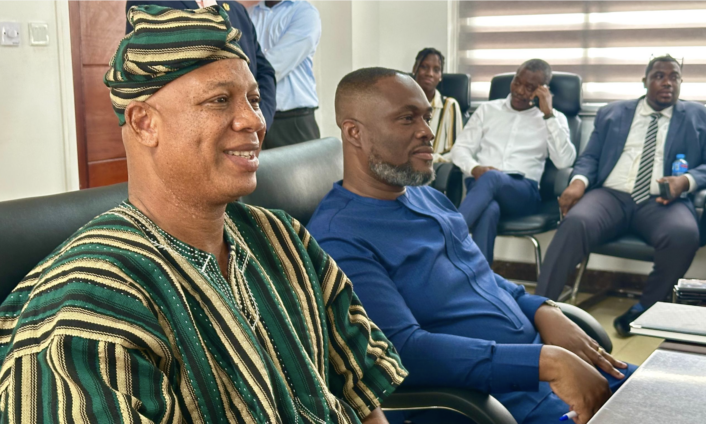
Mr Adjei engaged with GWL's management, led by the company’s Managing Director, Mr Adam Mutawakilu, to assess the company’s operations, challenges, and strategic initiatives aimed at improving water supply across urban Ghana.
Government’s Commitment to Water Sector Development
Speaking during the engagement, the Minister, who assured of the government’s dedication to ensuring all Ghanaians had access to safe and affordable water, said the government was committed to providing the necessary resources and policy interventions to ensure GWL succeeded in its mandate.
The Minister said, “Access to clean water is a fundamental right, and we will work closely with stakeholders to improve infrastructure, address operational challenges, and enhance service delivery.
He further noted that water sector development remained a priority for the Government, adding that funding for infrastructure projects aimed at expanding water supply networks across the country was key.
Mr Adjei acknowledged the crucial role GWL played in urban water supply and reiterated his pledged support to enhance the company’s efficiency.
He stressed the Government’s determination to support the efforts to address issues such as Non-Revenue Water (NRW) losses, infrastructure rehabilitation, and sustainable water management.
He said the Government also recognized the challenges GWL faced and would work together with management to overcome them through policy interventions and strategic investments.
GWL’s Governance Structure, Vision, and Operations
Providing an overview of the company’s operations, Mr Mutawakilu outlined GWL’s governance framework and structures to ensure efficiency and accountability, said the company operated under a Board of Directors and had multiple divisions, including Water Treatment and Quality Management, Finance and Accounting, Business Development, and Regional Operations covering 15 operational regions.
GWL, he noted, currently oversees 92 water systems, serving an estimated 17 million people to continuously improve service delivery, enhance efficiency, and ensure financial sustainability.
Key Projects and Infrastructure Investments
In its quest to improve urban water supply, Mr Mutawakilu said the GWL had undertaken significant projects, including the expansion of transmission lines to improve primary transmission networks from Kpong to Tema to enhance supply reliability.
In infrastructure rehabilitation, the MD mentioned, among others, the replacement of ageing pumps, installation of Automatic Voltage Regulators (AVRs), and dredging of water intake points at Sekyere Hemang, Owabi, Winneba, and Nsawam.
Non-Revenue Water and Operational Constraints
Mr Mutawakilu indicated that Non-Revenue Water (NRW), thus water lost through leaks, theft, and metering inaccuracies, was one of the major challenges facing the company.
Currently, NRW accounts for significant losses in the company’s revenue, impacting its ability to invest in system improvements.
To mitigate that, the MD stated that the GWL was in the process of implementing several initiatives, including the upgrading of metering systems to improve accuracy, reducing billing errors, using technology such as drones and GIS mapping to detect and fix leaks promptly while encouraging responsible water usage and prompt bill payments.
Mr Mutawakilu said to ensure sustainable water delivery, the GWL planned to reduce NRW by one to two per cent annually.
Also, he said scaling up e-business solutions, including electronic payments and digital monitoring of operations, and strengthening collaborations with government agencies to combat water source pollution, were some strategies the company was embarking on.
On the breakdown of water treatment plants, pumps, and distribution pipelines which also posed maintenance challenges, Mr. Mutawakilu disclosed that investments were being made to reduce downtime and improve operational efficiency through a Performance Improvement Programme (PIP).
Mr Adjei, in response, reiterated the Government’s readiness to support those strategies and prioritize water accessibility as part of a broader infrastructure development agenda.
He further affirmed that the Ministry would work closely with GWL to ensure that urban water supply met growing demand while ensuring affordability.
Latest Stories
-
Kwahu Business Forum 2026: Corporate citizenship, sustaining African businesses take centre stage with KGL as the case study
37 minutes -
Trump seeks $152m to reopen notorious Alcatraz prison
3 hours -
Ex-Chelsea player Oscar retires with heart issue
3 hours -
CA Foundation drives constitutional literacy in Kpone Katamanso municipality
3 hours -
GPRTU to hold talks with Transport Ministry over rising fuel costs
3 hours -
CUTS International urges gov’t to halt sachet water price hike pending cost review
3 hours -
Chief Justice: Efficient Judiciary essential to reducing business costs
3 hours -
Bayern grabs 99th-minute winner to cap superb fightback
3 hours -
Ahmed Ibrahim urges Ghanaians to reflect Easter values in nation-building
3 hours -
ECG inefficiencies undermining power supply -Mahama outlines reforms
3 hours -
Lewandowski scores as Barca fight back to defeat Atletico
3 hours -
Lack of private sector consultation undermining economic growth – Jerry Ahmed Shaib
3 hours -
Real Madrid seven points adrift after Muriqi’s late Mallorca winner
3 hours -
Ghana must lead AfCFTA implementation by example – Trade Minister Ofosu-Adjare
3 hours -
Strong Judiciary key to business confidence – Chief Justice Baffoe-Bonnie
4 hours