

Audio By Carbonatix
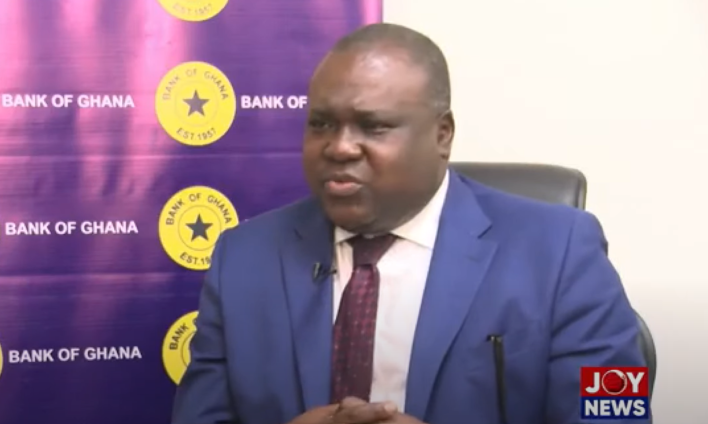
The Director of Research at the Bank of Ghana, Dr Philip Abradu-Otoo, is enforcing a zero financing policy where they are no longer lending money to the government to finance its operations.
Speaking on PM Express on JoyNews, he stated that this policy is one of the measures being implemented to help recover the ¢60.8 billion loss they recorded in 2022 and put the bank in a strong position.
According to him, seven months into 2023, the central bank has respected that zero financing policy noting “we are enforcing it to the letter and that is going to continue for the next three years under the IMF program."
Dr Abradu-Otoo said that “I don't think our hands are going to be bent again. Those steps that are put in place will ensure that we get out of this situation quickly. And if you read the forward in our annual report (BoG’s Annual Report and Financial Statements), four steps have been outlined.”
“One is trying as much as possible not to lend to government again, which in the IMF program we have logged that in as zero financing because it's part of the problem,” he added.
Dr Abradu-Otoo explained that failure to commit to their position could have implications for the IMF programme's implementations, among others.
According to him, going against zero financing for the government “might create all sorts of problems for us regarding the triggering of other flows associated with the completion of each IMF review. We would miss that critical target. It will become big news. It could flip into other things as we move along.”
The BoG’s Director of Research stated that knowing the implications involved they will not go back on their word to support the government even when asked.
This comes nearly a week after the Bank of Ghana revealed it recorded a loss of ¢60.8 Billion Ghana cedis in 2022, in its Annual Report and Financial Statements.
The Central Bank’s record loss is coming after it posted a ¢1.2 billion profit in 2021.
Reasons behind loss position
This was due to the impairment of the Government of Ghana securities holdings of ¢48.45 billion, impairment of loans and advances granted to quasi-government and financial institutions amounting to ¢6.12 billion and the depreciation of the local currency resulting in net exchange loss of ¢5.27 billion.
It was occasioned by the Government of Ghana Domestic Debt Exchange Programme.
Watch the full show below:
Latest Stories
-
Gender Ministry launches National Shock-Responsive Social Protection Strategy to strengthen Ghana’s protection system
13 seconds -
Photos: Zimbabwean President Mnangagwa departs Ghana after state visit
20 minutes -
Gov’t procures over 24,000 medical equipment to support free primary healthcare rollout
30 minutes -
“President has failed; his fight against galamsey a disgrace” – Kofi Tonto
38 minutes -
Nine dead in fatal road traffic collision at Sronoase
46 minutes -
Seven injured in Okanta road crash at Suhum
47 minutes -
Bulk diesel tanker overturns at Gyesewobre
47 minutes -
Continued collection of galamsey levies will amount to defiance – Edudzi Tamakloe
1 hour -
Prof. Osae-Kwapong calls for decisive action on galamsey crisis amid growing demands for accountability
2 hours -
‘Tax for Galamsey’: Prosecute illegal mining enablers – Ken Ashigbey urges Mahama
2 hours -
Sole-sourcing: Osae-Kwapong urges political consensus on procurement practices
3 hours -
‘Soldier, sit down, I’m safe here’ – President Mahama’s surprise moment at Easter gathering [Video]
3 hours -
Investigating sole-sourcing claim is an indictment on Roads Minister – Tonto
3 hours -
Sole-sourcing: Mahama has reneged on his promise to amend Public Procurement Act – Tonto
3 hours -
Kobina Atta-Bedi criticises government’s sole-sourced contracts, calls for reform
4 hours