

Audio By Carbonatix
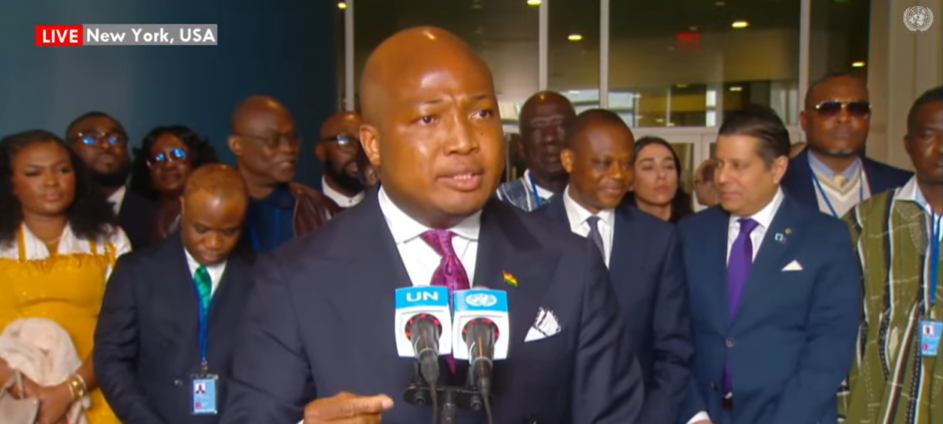
Ghana’s Minister for Foreign Affairs, Samuel Okudzeto Ablakwa, has said the global community must rethink how it remembers the transatlantic slave trade, following the adoption of a landmark United Nations resolution led by Ghana.
Speaking after the declaration of votes on the resolution, which recognises slavery as a crime against humanity, he said that while the past cannot be altered, the way it is acknowledged can shape the future.
“We cannot change history, but we can change how we remember it. And in doing so, we can change what we carry forward,” he said.
He added that the decision by the United Nations signals a deliberate shift towards justice and meaningful reflection.
“Today, the world has chosen to remember with purpose, justice, and equity. Let that purpose guide us toward a future that is more just, more inclusive, and more profoundly human,” he stated.
Mr Ablakwa explained that beyond recognition, the resolution creates space for deeper global discussions on reparatory justice.
“The resolution also opens the door for continued global engagement on reparatory justice, not as a narrow or transactional concept, but as a broader framework for healing, restoration, and partnership,” he said.
He urged member states to take concrete steps at the national level to support this process.
“We therefore urge every member state to consider carefully the actions it must take to ensure inclusive and good faith dialogue on reparatory justice,” he added.
According to him, the pursuit of justice must go beyond remembrance to address systems that continue to shape inequalities today.
“The work of justice does not end with remembrance. The racialised systems that have shaped our world must yield to a system that does not distinguish between our common humanity,” he said.
The Foreign Affairs Minister also used the opportunity to acknowledge the role of Ghana’s leadership in driving the resolution.
He praised President John Mahama for what he described as decisive leadership in pushing the initiative at the global level.
“I would like to thank especially our President… for his vision, his dynamism and his effectiveness,” he said, noting that his leadership had been key to achieving the outcome.
He further commended Ghana’s diplomatic teams in New York, Geneva and Addis Ababa, as well as officials at the Ministry of Foreign Affairs, for their contribution to what he described as a historic milestone.
“Ghana, Africa, and all people of African descent… will be eternally grateful to President Mahama for his leadership at this defining hour in global history,” he said.
Latest Stories
-
No withdrawal of MPs from committees – Majority Chief Whip clarifies
59 seconds -
Divine Mission Academy, Supreme Montessori School secure semifinal spots in 2026 Luv FM VitaMilk Primary Schools Quiz
8 minutes -
IGP Special Operations Team deployed to combat crime in Kumasi
14 minutes -
UN slavery resolution opens door for global reparatory justice – Ablakwa
15 minutes -
The world has affirmed that trafficking of enslaved Africans is the gravest crime against humanity – Ablakwa
31 minutes -
Gold reserves not being sold off, funds reinvested for returns – Sammy Gyamfi
45 minutes -
Three killed, burnt beyond recognition in Nkwanta South conflict
45 minutes -
Claims of disruption in Parliament business false – Dafeamekpor
48 minutes -
GoldBod Jewellery sponsoring ‘Women of Valour’ London programme false – Sammy Gyamfi
48 minutes -
This is an emphatic victory for justice – Ablakwa hails UN slavery resolution
51 minutes -
Communications Minister champions fintech-led growth at 3i Africa Summit 2026 launch
54 minutes -
National AI Masterclass Cohort 2 begins to boost public sector digital skills
59 minutes -
Ghanaian journalists receive advanced science training at Imperial College London
1 hour -
The world has spoken the truth through UN slavery resolution – Ablakwa
1 hour -
We can’t change history but we can change how we remember it – Ablakwa on UN slavery resolution
1 hour