

Audio By Carbonatix
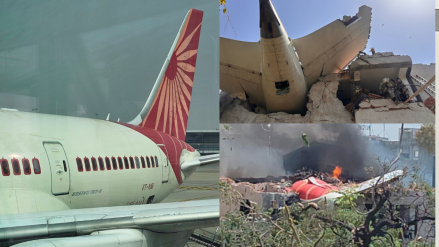
The Indian plane disaster shocked the world yesterday, as Boeing 787-8 Dreamliner crashed into a residential area in Meghaninagar shortly after takeoff from Ahmedabad in India.
The aircraft, bound for London’s Gatwick Airport, was carrying 242 people, which comprised 230 passengers, 10 crew members, and 2 pilots.
The crash has raised several questions. One of them was how a modern aircraft, flown by experienced pilots, could crash within minutes of takeoff. Well, we tried to find some possible answers.
Tata Group owns Boeing 787-8 Dreamliner
JoyNews check reveals that the flight operated by Air India is now owned by the Tata Group after a takeover in 2022 and has over 30 Dreamliners that include the Boeing 787-8 and 787-9 versions. The aircraft is a wide-body known for fuel efficiency, comfort, and advanced safety features. It has never crashed before until now.
The aircraft carried passengers of different nationalities, including 53 British citizens, 1 Canadian, 7 Portuguese and 169 Indians.
The plane took off from Ahmedabad at 1:38 p.m. Indian time. It climbed to 625 feet, then lost altitude quickly and crashed into a residential area in Meghaninagar.
Initial information confirms that a "Mayday" distress call was sent to the Air Traffic Controller (ATC) moments after takeoff. But after that, the aircraft went silent, possibly due to a loss of signal before the crash occurred.
The aircraft made its first flight in December 2013 and was delivered to Air India in January 2014, making it only 11 years old. Most aircraft can safely operate for up to 30 years, so age was not a problem.
The flight was led by Captain Sumeet Sabharwal, who had 8,200 flight hours, and First Officer Clive Kundar, who had 1,100 flight hours. Both had adequate experience, and therefore lack of experience wasn’t the challenge.
But why and how did the crash happen?
Experts and aviation analysts in India say air travel remains the safest mode of transportation. And yet, even the safest planes can face emergencies.
A video circulating on social media shows the aircraft struggling to gain altitude. If you had watched it closely, you could see the nose of the plane was pointing up, but the rear end was dropping, indicating a serious loss of lift.
Lift is the force that pushes an aircraft upwards. It helps the plane take off and stay in the air. When a plane gains enough lift, it can rise and fly normally. But if lift is not enough, the aircraft can stall and crash.
According to the National Aeronautics and Space Administration (NASA)’s website, lift is the force that directly opposes the weight of an airplane and holds the airplane in the air. Lift is generated by every part of the airplane, but most of the lift on a normal airliner is generated by the wings.
It also says lift is a mechanical aerodynamic force produced by the motion of the airplane through the air. Because lift is a force, it is a vector quantity, having both a magnitude and a direction associated with it.
“Lift acts through the centre of pressure of the object and is directed perpendicular to the flow direction. There are several factors which affect the magnitude of lift,” it said.
How is lift generated?
We checked on NASA’s website again. Here, NASA explains that lift happens when moving air is pushed or turned by a solid object like an airplane wing. When the air is turned in one direction, lift is created in the opposite direction.
It follows Newton’s Third Law of Motion, which says that for every action, there is an equal and opposite reaction. Because air is a gas and its molecules can move freely, any solid surface like a wing can push or deflect the air and create lift.
“For an aircraft wing, both the upper and lower surfaces contribute to the flow turning. Neglecting the upper surface’s part in turning the flow leads to an incorrect theory of lift,” NASA says on its website.
For lift to happen, a solid object (like an airplane wing) must be in contact with a fluid (like air). If there is no air, there is no lift. That is why the Space Shuttle does not stay in space because of its wings. It stays in orbit due to its high speed and orbital mechanics, not lift. Space is almost a vacuum, meaning there’s no air and without air, wings cannot produce lift.
Experts also explain that lift is created when there is a difference in speed between the object and the air. In other words, there must be movement between the object and the fluid. If the plane is moving through still air, or if the air is moving past a still object (like a wing), lift can be produced either way, as long as there is motion. Lift always pushes upward at a right angle (90 degrees) to the direction of motion. Drag, on the other hand, is the force that pushes against the direction of motion and slows the object down.
But why did the plane not gain lift?
Here is what confuses many experts. In fact, it is the biggest mystery at the moment. Hundreds of planes take off every day using the same type of aircraft without issues. So what went wrong here?
The black box has been recovered.
The box records important flight data that helps investigators understand what happened. It is also key to tracking the flight path and learning why the plane failed to take off properly.
Indian-based commercial pilot Nagarjun Dwarkanath, who spoke on India Today TV monitored by JoyNews Mahmud Mohammed-Nurudeen, said the black box shows the crash sequence and confirms what happened in the final moments.
Asked how crucial it is, he said it helps experts check for past problems or missed repairs in the aircraft’s history. The flight data can reveal the pilots’ last actions before the crash. It records altitude, airspeed, and direction during the flight.
“Now we have a headway. It will give us a headway of what actually happened just moments before the crash. All this crucial data or evidence that they are looking for will come out of the DVR,” Nagarjun stated.
Several possible causes have been suggested, such as engine failure, bird strike, or a hit, and even a wrong takeoff configuration. However, none of these theories have been confirmed. Air India and aviation authorities are waiting for the black box data before making any official statements.
But according to Nagarjun, the video being shared shows that there was clearly a “loss of power”, and the aircraft began to stall, meaning it could not stay in the air.
The pilot tried to avoid crashing into a building, but the plane continued to lose lift and eventually stalled completely. As a result, the aircraft crashed into the residential area.
Experts advise against speculations
Experts say plane crash investigations are highly technical and sensitive, require time and must be done without rushing to conclusions. Aviation authorities in India and the aircraft’s manufacturer are working together to understand the root cause.
What we do know is that flying remains one of the safest modes of transport. However, when a tragedy like the Air India crash happens, it reminds the world of the importance of constant checks, crew readiness, and technological safeguards.
Until investigators release official findings, it is important not to speculate. The crash has already caused pain for many families across several countries.
As the investigation continues, JoyNews stands in solidarity with the families and loved ones of the victims. We will keep you updated on the latest about the crash.
Latest Stories
-
Why set up an anti-corruption agency while shielding GoldBod at the same time? – IERPP queries the government
1 hour -
Big Push for Infrastructure, Small Push for People
1 hour -
KsTU marks 70th anniversary, rallies partners for AI-driven future as gov’t pledges support
2 hours -
Ghana missing out on billion-dollar Carnival Industry — WCC CEO urges urgent investment
2 hours -
MP Akurugu cuts sod for 8.2 km Ashongman road project
3 hours -
No certificate, no entry – IFMA Ghana demands strict enforcement of occupancy permits to halt building collapses
3 hours -
Schools under trees: Gov’t targets 400 new schools, 1m desks this year – Mahama
3 hours -
Mövenpick Accra Business Forum 2026: A platform for shaping Ghana’s economic future
3 hours -
‘Not our jurisdiction’ — Mahama breaks silence on Ofori-Atta case
3 hours -
Mahama pushes for return of civic education to tackle indiscipline, sanitation challenges
3 hours -
Ghana’s Black Stars fall again as Germany snatch late victory
3 hours -
Mahama praises Volta Region’s cleanliness, urges national replicati
4 hours -
Ghana Medical Trust Fund set for launch as Board finalises key systems
4 hours -
Ghana restores investor confidence through economic reform – Deputy Finance Minister
4 hours -
We never promised to end sole sourcing, only its abuse – Sammy Gyamfi
4 hours