

Audio By Carbonatix
The World Health Organization (WHO) has warned that Africa risks losing decades of progress in tackling major health challenges unless governments increase domestic financing to strengthen health systems.
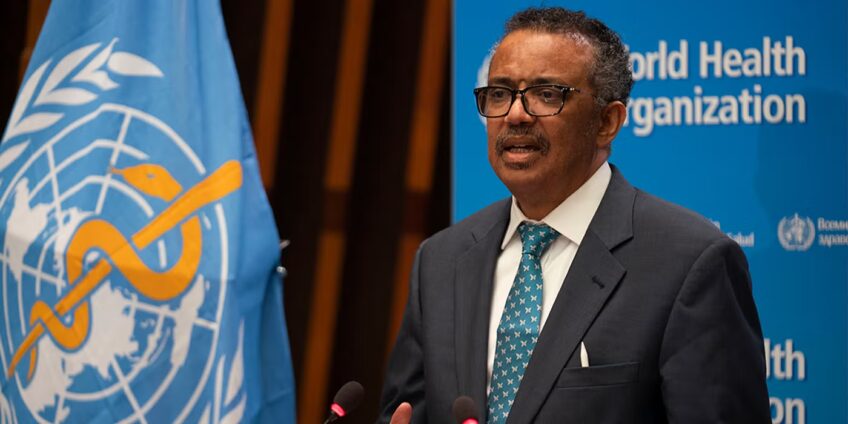
WHO Director-General Dr. Tedros Adhanom Ghebreyesus issued the warning at the African Union’s first Extraordinary Summit dedicated to health, held in Accra, where he urged African leaders to make health sovereignty a key political priority.
According to Dr. Tedros, while the continent has recorded significant gains in the fight against diseases such as HIV, tuberculosis and malaria, declining external support threatens to reverse those achievements.
“Africa has made extraordinary progress against HIV, with new infections down 40% since 2010. But Africa still carries the heaviest burden, and as external funding declines, we risk losing ground,” he said.
He noted that the challenge extends beyond HIV, affecting maternal health, tuberculosis, malaria, neglected tropical diseases and the growing burden of non-communicable diseases.
“These are not separate crises. They are one crisis, and systems are not yet strong enough to protect every person on this continent,” Dr. Tedros said.
The WHO Director-General also highlighted the impact of conflicts on public health, citing the Ebola outbreak in Bunia, Ituri Province, where insecurity has slowed contact tracing efforts and limited health workers’ access to affected communities.
He stressed that addressing Africa’s health challenges requires tackling underlying social and economic factors, including poverty, poor education, unsafe water and gender inequality.
“Beating disease alone is not enough. We must also tackle what drives it: conflict, poverty, poor education, unsafe water and gender inequality,” he added.
Dr. Tedros called on African governments to prioritise domestic resources for healthcare, invest in primary healthcare systems, promote local manufacturing of medical products and use scientific innovations to improve health outcomes.
“Only Africa’s leaders can deliver the political will and domestic investment this moment requires,” he said.
He assured African leaders of WHO’s continued partnership through technical support and guidance, but urged governments to take ownership of the continent’s health future.
The Accra summit is expected to produce a roadmap aimed at improving health financing, strengthening healthcare systems and reducing Africa’s dependence on external support.
Latest Stories
-
We have been scammed by NDC, government is only doing PR – Abanga Fuseini
2 minutes -
Republic Bank–JoyNews Habitat Fair opens in Ho today
3 minutes -
BoG pledges stability to attract investment, urges stronger Africa–Asia partnerships
7 minutes -
Amin Adam warns treasury bill dependence could expose Ghana to refinancing risks
7 minutes -
Ghana better placed to withstand commodity price shocks – IMF
10 minutes -
GAPTE intensifies efforts to increase bus availability for Aayalolo contra-flow
12 minutes -
Amin Adam warns cedi depreciation could reverse Ghana’s debt relief gains
16 minutes -
Fiscal discipline crucial for pension fund investments – Finance Minister
16 minutes -
BoG Governor rallies IMF to back Africa’s digital sovereignty
21 minutes -
Amin Adam questions government bond pricing as short-term yields fall below inflation
27 minutes -
Five new telephony cell sites to be activated in October 2026 – Sam George
32 minutes -
Amin Adam raises sovereign-bank nexus concerns as banks hold GH¢190bn in government debt
37 minutes -
Government to increase Free SHS feeding allowance in 2027 Budget – Haruna Iddrisu
42 minutes -
Nadowli-Kaleo NCCE engages women’s groups on rule of law, corruption fight
43 minutes -
Mahama visits factories in Afienya/Tema
48 minutes