

Audio By Carbonatix
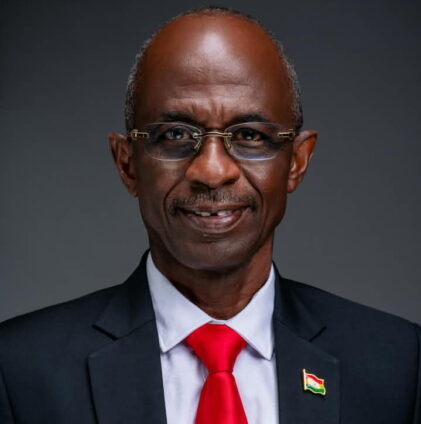
National Chairman of the National Democratic Congress (NDC), Johnson Asiedu Nketia, has called for fundamental reforms within political parties and the judiciary, arguing that the two institutions cannot protect African democracy if they lack credibility, accountability and public trust.
According to him, political parties must move beyond functioning as electoral machines and become permanent democratic institutions, while the judiciary must remain independent and provide justice that is accessible, impartial, timely and credible.
Mr Asiedu Nketia made the call on Tuesday, August 11, 2026, when he participated in the 2026 Goodluck Jonathan Foundation Democracy Dialogue in Bauchi, Nigeria.
The dialogue was held on the theme: "Beyond Elections: Can Political Parties and the Judiciary Save African Democracy?"
Speaking on the panel on political parties and the judiciary and the need to rebuild trust in democratic institutions, Mr Asiedu Nketia said neither political parties nor the courts could save democracy merely by existing.
"Political parties cannot save democracy when they function only as electoral machines, instruments of patronage or vehicles for individual ambition," he said.
"Courts cannot save democracy when they are inaccessible, slow, inconsistent or perceived to be subject to political influence. Both institutions can defend democracy only when they are themselves credible, accountable, competent and trusted."
Democracy goes beyond elections
Mr Asiedu Nketia said elections only determine who receives the authority to govern and do not, on their own, guarantee that political power will subsequently be exercised lawfully.
He said democracy must also be measured by whether constitutional limits are respected, opposition parties are allowed to operate legitimately and governments remain accountable to citizens between elections.
"Elections determine who receives the authority to govern. They do not, by themselves, determine whether that authority will be exercised lawfully, whether constitutional limits will be respected, whether the opposition will remain legitimate or whether government will improve the lives of the people," he said.
"Democracy is therefore tested not only on election day, but in every decision taken between one election and the next."
Ghana's democratic record
Mr Asiedu Nketia cited Ghana's Fourth Republic as an example of democratic institutionalisation, although he cautioned against complacency.
He noted that Ghana had held nine consecutive general elections since 1992, with four elections—in 2000, 2008, 2016 and 2024—resulting in the transfer of power from one political party to another.
He said the peaceful alternation of power demonstrated that an African governing party could lose an election, hand over power peacefully and subsequently return to government through the ballot box rather than force.
He cited the 2008 presidential election as a particularly important example.
Professor John Evans Atta Mills won the election with 50.23 per cent of the vote against 49.77 per cent for Nana Addo Dankwa Akufo-Addo, a margin of less than one percentage point.
Mr Asiedu Nketia said the ability of political leaders, state institutions and citizens to prevent such a close contest from becoming a national crisis was itself an important democratic achievement.
He also cited the 2016 election, when then-President John Dramani Mahama conceded defeat and oversaw the transition of power, and the 2024 election, when then-Vice-President Mahamudu Bawumia conceded before the formal declaration after his party's collation indicated that the result could not be overturned.
"These concessions were not ceremonial courtesies; they were constitutional contributions," he said.
However, Mr Asiedu Nketia warned that Ghana's democratic record should not lead to complacency.
He pointed to the 2020 election, which resulted in a Parliament comprising 137 members from each of the two major parties and one independent member, but was also marked by election-related violence in which eight people were reportedly killed.
"This reminds us that democratic progress is never irreversible," he said.
Political parties must reform
Mr Asiedu Nketia said political parties had responsibilities beyond winning elections and should not be treated as the private property of founders, financiers, office holders or temporary leaders.
He said parties perform important public and constitutional functions, including recruiting political leaders, developing policy alternatives, organising political participation and connecting citizens to the state.
"A party that demands credible national elections must conduct credible internal elections. A party that condemns authoritarianism in government must tolerate legitimate disagreement within its own structures," he said.
He also called for greater inclusion of women, young people and persons with disabilities in political leadership.
Mr Asiedu Nketia said the growing cost of political participation posed a serious threat to internal party democracy because it could make wealth rather than competence the principal requirement for seeking political office.
He cited research by the Westminster Foundation for Democracy and CDD-Ghana which found that the cost of contesting parliamentary office increased by 59 per cent between the 2012 and 2016 electoral cycles, reaching an average of GH¢389,803.
He further cited a CDD-Ghana study which estimated that a viable parliamentary campaign by 2020, including the cost of maintaining a constituency presence, could require about GH¢4 million.
"When entry into political leadership becomes this expensive, parties risk selecting the wealthiest rather than the most capable, while elected officials may enter office burdened by financiers and expectations of repayment," he said.
Parties need policy and leadership institutions
Mr Asiedu Nketia said political parties should also reclaim their policy development, civic education and leadership training functions.
He proposed permanent research institutions within political parties to develop policies, train candidates and office holders and assess governments formed under their platforms.
"Democracy suffers when public office becomes the first place at which political leaders begin to learn the responsibilities of government," he said.
He also called for measurable progress on the participation of women and young people in political leadership.
He noted that women occupied only 40 of Ghana's 276 parliamentary seats, representing 14.5 per cent, despite making up slightly more than half of the country's population.
He said young people between 15 and 35 constituted 38.2 per cent of Ghana's population, yet no member of the current Parliament was aged 30 or younger at the beginning of the legislature.
Political parties, he argued, must create pathways that allow women and young people to move beyond campaign mobilisation into policy development, party leadership, Parliament and executive responsibility.
Judiciary must win public confidence
Turning to the judiciary, Mr Asiedu Nketia said courts remained indispensable to democracy because political competition inevitably produced disputes involving elections, fundamental rights and constitutional boundaries.
He cited Ghana's presidential election petitions following the 2012 and 2020 elections as examples of how major political disagreements could be transferred from the streets to the courtroom.
The 2012 petition was dismissed by a five-to-four majority after an extended hearing, while the 2020 petition was unanimously dismissed by the Supreme Court.
According to Mr Asiedu Nketia, political actors complied with both decisions despite disagreements over aspects of the proceedings and the reasoning of the court.
He said respect for judicial authority, however, did not require political actors to surrender their right to criticise judicial reasoning.
"Legitimate criticism is part of constitutional democracy; intimidation, threats and personal attacks are not," he said.
He added that judicial independence should not be interpreted as freedom from ethical standards, transparency, consistency or public accountability.
Concerns over access to justice
Mr Asiedu Nketia said public confidence in the judiciary was an issue that could not be ignored.
Citing Afrobarometer's Round 10 findings, he said only 35 per cent of Ghanaians trusted the courts "somewhat" or "a lot".
He said half of respondents were not confident that an ordinary person who had been wronged could obtain justice, while only 37 per cent believed they could afford to take a legal problem to court.
Only 38 per cent believed that a case would be resolved within a reasonable period, he added.
Mr Asiedu Nketia stressed that the figures represented public perceptions rather than judicial findings but said such perceptions had implications for institutional legitimacy.
"Judicial authority cannot depend only on constitutional text; it must also rest on citizens' confidence that justice is accessible, impartial and timely," he said.
Courts must exercise restraint
Mr Asiedu Nketia called for a judiciary that was strong enough to restrain governments, protect opposition parties, defend fundamental rights and enforce constitutional limits.
At the same time, he cautioned courts against becoming "alternative political chambers" or replacing decisions properly entrusted to elected institutions and citizens.
He said judicial courage must therefore be accompanied by restraint.
Proposed reforms
Mr Asiedu Nketia proposed a number of reforms aimed at strengthening democratic institutions.
For political parties, he called for enforceable standards on internal democracy, campaign financing, audited accounts, candidate selection and leadership succession.
He also called for the publication of measurable data on women's and youth participation, measures to reduce the financial barriers to political candidature and the establishment of permanent policy and leadership institutions.
On the judiciary, he advocated transparent criteria for judicial appointments and promotions, the prompt publication of constitutional judgments, stronger legal aid services and the publication of reliable information on court performance.
He also called for political parties, courts, electoral bodies, civil society organisations, the media and academic institutions to engage in dialogue before political crises emerge.
"Dialogue should not begin only when an election dispute threatens national stability," he said.
'Parties and judiciary must reform themselves'
In his concluding remarks, Mr Asiedu Nketia said political parties and the judiciary could contribute significantly to safeguarding democracy in Africa, but only if they were willing to reform themselves.
"Political parties must cease to be seasonal electoral machines and become permanent democratic institutions," he said.
"The judiciary must remain independent of political power while providing remedies that are impartial, accessible, timely and convincingly reasoned."
He argued that the future of African democracy would not be secured merely by conducting more elections but by building institutions that make elections meaningful, governments accountable, constitutional limits effective and peaceful transfers of power normal.
"Political parties must remember that power is temporary and that the state belongs to the people," he said.
"The judiciary must understand that its strongest protection is not the goodwill of political leaders, but the confidence of citizens in its independence and integrity."
Mr Asiedu Nketia said democracy would become durable when political parties respected constitutional limits, courts administered justice without fear or favour, governments delivered tangible improvements in people's lives and citizens remained engaged beyond election day.
"Democracy becomes more than a procedure. It becomes a durable system of public trust, peaceful competition, accountable authority and national development," he said.
Latest Stories
-
University of Ghana postpones October 12 reopening as GAUA strike persists
6 minutes -
Bahass Foundation launches vocational skills training to support mental health recovery in Wa
38 minutes -
NPP orders parliamentary aspirants and their supporters to suspend campaign activities
1 hour -
Techiman unites against child marriage: Joy Impact Makers Awardee leads charge on International Day of the Girl Child
1 hour -
Ghana Psychological Association calls for greater involvement of people with lived experience in mental health care
2 hours -
Ablakwa says Ghana could evacuate more citizens from South Africa if the situation worsens
3 hours -
Violence against girls must be tackled through individual responsibility – Gender advocate
3 hours -
Ghana’s BRICS bid must be guided by national interest – International Affairs Analyst
3 hours -
Journalists look back on a decade of breast cancer reporting in Ghana
4 hours -
President Mahama ends Resetting Ghana tour of Ahafo Region
6 hours -
African negotiators seek delivery of climate commitments at COP31
6 hours -
BoG develops AI rules for financial sector
6 hours -
‘Big Push’: Government assures contractors of prompt payments
6 hours -
Court fines miner for breaking into gold buying shop
6 hours -
Tarkwa court jails labourer for three years over GH¢123,000 theft
7 hours