

Audio By Carbonatix
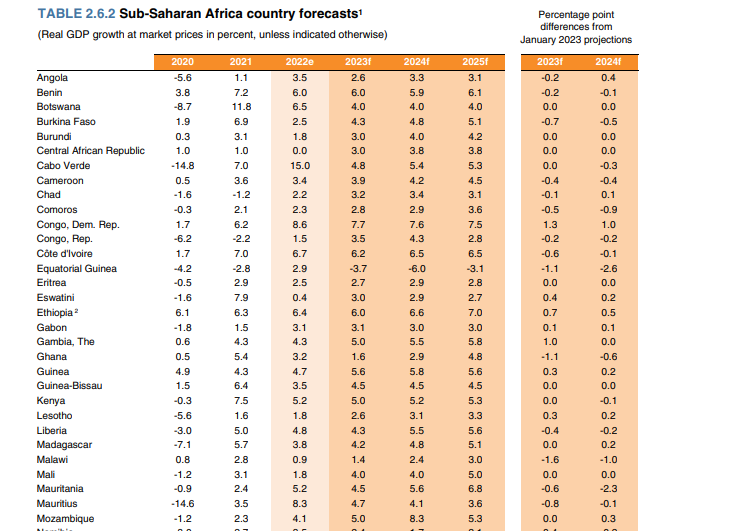
The World Bank has maintained its 1.6% Gross Domestic Product (GDP) growth forecast for Ghana in 2023, far lower than the expected 3.2% for Sub-Saharan Africa.
This places it in the 42nd position in Sub-Saharan Africa. The International Monetary Fund also projected a 1.6% growth rate for Ghana in 2023.
According to its June 2023 Global Economic Prospects Report, Ghana’s economy is however projected to expand by 2.9% in 2024.
The report stated that the slowdown in the economy is due to the challenges facing the economy, as the Ghana government is undertaking an International Monetary Fund support programme.
“In Ghana, more timely data highlight the weakness of economic activity amid the deleterious global shocks and heightened macroeconomic instability”.
Five African countries, Malawi (1.4%), Sudan (0.4%), South Africa (0.3%), South Sudan (-0.4%) and Equatorial Guinea (-3.7%) are expected to grow lower than Ghana in 2023.
Risks to outlook
The World Bank said its baseline projections remain subject to multiple downside risks amid uncertainty about developments in global commodity markets, the degree of additional global and domestic policy tightening needed to subdue persistent inflation, and the resilience of the world economy and global financial system to a prolonged period of tight monetary policies.
It pointed out that commodity prices may remain unusually volatile and vulnerable to further shocks if disruptions to the supply of major commodities worsen—for instance, due to intensifying geopolitical tensions or conflicts. Furthermore, global activity may decelerate faster than envisioned if the reopening of China’s economy fails to generate a durable recovery.
Sub-Saharan Africa’s growth to slow down to 3.3%
Growth in Sub-Saharan Africa (SSA) is expected to slow from 3.7% in 2022 to 3.2% this year—a 0.4 percentage point downgrade from January forecasts—with a moderate improvement to 3.9% next year.
Over half of the 2023 downgrade, it said, is attributable to an abrupt slowdown in South Africa. However, downgrades are widespread across energy and metal producers, and non-resource-rich countries.
Excluding South Africa, the Bretton Wood institution, however, said growth in SSA is expected to slow from 4.2% in 2022 to 3.9% this year.
Latest Stories
-
‘There is no competition’ – Justin Kodua confident of NPP General Secretary re-election
6 minutes -
J100 Accra Doubles Champions : Kolesolva/ Ndukwa, Agarwal/Patel seal title victories
8 minutes -
Sydney Wright crowned J100 Accra Champion
13 minutes -
J100 Accra Boys’ Singles: Verma denies Beckles back-to-back titles to claim crown
15 minutes -
Two friends fined GH¢12,000 for stealing
22 minutes -
Son jailed for threatening to stab mother
37 minutes -
Drive constitutional reform – GJA urges journalists
59 minutes -
NPP Delagates Congress: Confusion delays voting at Ashanti Region TESCON centre
2 hours -
Fire ravages shops, houses near Koforidua Central Police Station
2 hours -
NPP Delegates conference: The wisdom of the masses will prevail – Napo
3 hours -
Flydubai co-pilot attacked captain with axe, UAE official says
3 hours -
NPP Bosome Freho Constituency Chairman reportedly arrested over ballot paper incident
3 hours -
Medical plane with 6 on board missing off Massachusetts coast
3 hours -
Bolt driver jailed 25 years for robbing beautician
3 hours -
Happy 76th Birthday to the Daily Graphic!
3 hours