

Audio By Carbonatix
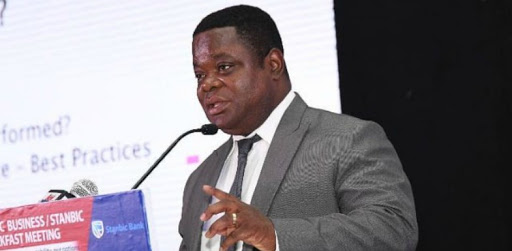
Head of the Economics Department at the University of Ghana has lauded government for announcing a ¢1 billion stimulus package for Small and Medium Scale Enterprises aimed at mitigating the impact of the coronavirus pandemic.
Prof Peter Quartey, however, believes that the lack of information on how the funds can be accessed and who is entitled to benefit should be addressed.
“I wouldn’t say [¢1 billion] is enough but it is a good gesture. I was quite excited to hear that the government has made some moves.
“But my question is how? I don’t think I got the how. ¢1 billion for who? How does one qualify? I believe by now, we should have known the how, otherwise people will think it is just one of the political statements that won’t happen,” he said on Joy FM’s Super Morning Show.
In his fourth address to the nation since Ghana started recording cases of COVID-19, a disease caused by the coronavirus, President Akufo-Addo announced that government will make available ¢1 billion relief package for businesses and households.
“The Minister for Finance has been directed by me to prepare, for approval by Parliament, a Coronavirus Alleviation Programme to address the disruption in economic activities, the hardship of our people, and to rescue and revitalise our industries.
“He will, then, immediately make available a minimum of one billion cedis to households and businesses, particularly small and medium scale enterprises,” President Akufo-Addo said Friday night.
Also, commercial banks across are expected to support local industries, especially in the pharmaceutical, hospitality, service and manufacturing sectors with an estimated ¢3 billion facility in response to the Bank of Ghana’s 1.5% decrease in Policy Rate and 2% in reserve requirement.
Additional relief to businesses which the President announced during the televised address is an extension of the tax filing date from April to June as well as a 2% reduction of interest rates by banks, effective April 1, 2020.
Prof Quartey who is also the Director of the Institute of Statistical, Social and Economic Research (ISSER) said he expects that in the next coming days, if not quicker, government will announce how businesses can benefit from the relief package.
“So that businesses know that I qualify because I pay taxed and if I don’t ay taxed, I do not qualify.”
He also wants clarity on how government will select the SMEs and whether or not the package includes the informal sector.
He referenced the Ghana Living Standard Survey which says the informal sector accounts for over 71 per cent of total employment in the country while the formal sector caters for 28 per cent.
“So you can see that the informal sector is quite big in our economy. How are you going to support them so that people do not lose their jobs and livelihoods? Then also, you find that the public sector employs only 6.8 per cent of the total labour force whereas the private sector employs 92.5 per cent. Public sector workers are guaranteed their salaries, what about private sector workers?
Schools have been closed down, what happens to teachers if this extends beyond May or June? In the UK private sector employs have been guaranteed up to 50 per cent of their wages for up to three months, I have not heard anything from government whether this 1 billion will cover wages or just to help you pay your bills. I think we need more about how this is going to turn out,” he said.
In order to ensure the effective disbursement of the funds, Prof Quartey called for transparency and accountability.
He said although it may not be enough, it can cover a decent proportion of the private sector.
“In the past we have seen government support going to party faithful, employees or businesses that one way or the other are linked to somebody. I think we should move away from that.
"Whether you are NPP, NDC, PPP or whatever, so long as you have a business and you are registered and you pay taxes, this should be very transparency specified, ascertained and implemented in a very transparent fashion.”
In the face of an impending global recession, he said, “if we do this, I believe no matter how small the amount is, it will go a long way to alleviate some of the sufferings.”
Latest Stories
-
Spain’s huge pork industry seeks salvation from swine fever threat
38 minutes -
Trump declares victory after rescue but threats to US operation in Iran still loom
1 hour -
US Secret Service investigates reports of gunfire near White House
1 hour -
Current account stability to mitigate pressure on cedi; currency to end year at GH¢11.40 to a dollar
1 hour -
Oil back above $110 after expletive-laden Trump threat to Iran
1 hour -
T-bills auction: Government records 32% undersubscription; interest rates rise again
1 hour -
Economy to remain relatively insulated from fallout of US–Iran conflict – Fitch Solutions
1 hour -
[Watch Live] Shatta Wale, Kofi Kinaata, and others ignite the grand finale of Gomoa Easter Carnival
4 hours -
Burkina Faso military leader Traore says ‘forget democracy’
4 hours -
DR Congo to receive ‘third-country’ deportees from the US under new deal
4 hours -
Four injured in robbery attack on Elshadai Enterprise at Akatsi
4 hours -
Two remanded for alleged attack, robbery at jewellery shop
5 hours -
Royals attend Windsor Easter Sunday service
5 hours -
Trump issues expletive-laden threat to Iran over Hormuz Strait blockage
5 hours -
Berekum Chelsea edge Aduana FC in Bono derby to boost survival hopes
7 hours