

Audio By Carbonatix
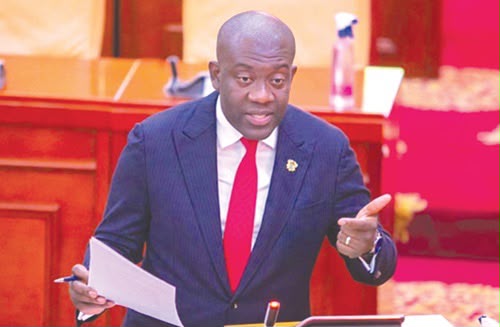
Ranking Member on Parliament’s Economy and Development Committee, Kojo Oppong Nkrumah, has questioned the government’s fiscal strategy.
He argues that barely nine weeks after Ghana exited the International Monetary Fund (IMF) Extended Credit Facility (ECF) programme, the Mahama administration is back in Parliament seeking approval for almost $1 billion in fresh loans.
According to the Ofoase-Ayirebi MP, the latest borrowing requests raise concerns about the government’s domestic revenue mobilisation efforts and the country’s long-term debt sustainability.
Speaking during debate on a motion seeking parliamentary approval for several international financing agreements, Mr Oppong Nkrumah urged the House not to assess each loan in isolation but to consider the cumulative borrowing taking place within a short period after the IMF programme ended.
Opening his remarks with the French expression, “Plus ça change, plus c’est la même chose”—meaning “the more things change, the more they remain the same”—he argued that despite government’s declaration that Ghana had successfully exited the IMF programme, the country’s dependence on external borrowing appears to be continuing.
He recalled that on May 15, 2026, the government announced Ghana’s successful exit from the IMF ECF programme, describing it as a major milestone in the country’s economic recovery.
However, he noted that just nine weeks later, Parliament is being asked to approve borrowing close to $1 billion.
According to him, the package includes about $300 million for the education sector, $500 million for road infrastructure, roughly $22 million for the Ministry of Finance, in addition to net borrowing of about $180 million already captured in the 2026 Budget.
Mr Oppong Nkrumah clarified that the Minority is not opposed to the projects being financed.
Having served in both government and opposition, he acknowledged that development financing serves legitimate national purposes and stressed that his concern was not with the sectors earmarked to benefit from the loans.
Instead, he argued that the key issue is why the government has returned to the debt market so soon after the IMF programme ended.
The former Information Minister said government had assured Ghanaians during the 2026 Budget that it had a stronger fiscal strategy capable of removing taxes while increasing revenue to 18 per cent of GDP.
He said he publicly supported that target at the time.
However, he argued that government’s own fiscal reports show the target has not been achieved.
According to him, one official report places the revenue-to-GDP ratio at 15.7 per cent, while another records 16 per cent, levels he said are no better than what the current administration inherited.
“It is because the domestic resource mobilisation measures are not performing that nine weeks after the IMF left town, they have gone back to the debt markets and are asking Parliament to approve close to one billion dollars.”
While supporting the loan agreements, Mr Oppong Nkrumah cautioned that excessive borrowing could undermine Ghana’s debt sustainability if domestic revenue performance does not improve.
He also criticised what he described as government spending priorities, arguing that resources are increasingly being directed towards quasi-fiscal operations instead of critical development needs.
Citing figures from the Bank of Ghana’s 2025 financial statements, he claimed that about GH¢16 billion had been spent on sterilisation operations, while approximately GH¢9.6 billion had been incurred through gold-related losses.
He proposed that government urgently strengthen domestic revenue mobilisation and adopt a whole-of-government approach to expenditure management to reduce reliance on external borrowing.
Mr Oppong Nkrumah concluded by reaffirming the Minority’s support for the loan agreements but insisted that government must address the underlying weaknesses in revenue generation and spending if Ghana is to avoid renewed debt pressures.
Latest Stories
-
Total expenditure as of July 2026 amounted to GH¢147.07bn, 16% below target – BoG
8 minutes -
Total revenue & grants stood at GH¢144.5bn in July 2026, slightly below target – BoG
24 minutes -
Ghana Sports Fund urges sports federations to submit credible proposals and measurable targets
28 minutes -
Sally Rooney books withdrawn in UK over Palestine Action support
35 minutes -
Musk says US government may be behind slowdown of Ukraine drone speeds
45 minutes -
Picking Chief Justices nearing retirement could give Mahama immense power – Bentil
55 minutes -
Netflix to shed 1,000 jobs in steepest cuts since 2022
1 hour -
Burnham had two hospitality dinners with Man City chairman, deleted records show
1 hour -
Semenyo ‘froze’ after alleged racist abuse, court told
2 hours -
‘Shameless’ – Mourinho critical of Vinicius Jr ban timing
2 hours -
Loyalty can outweigh competence in Chief Justice selection – Bentil
2 hours -
Man City suffer as PSG masterclass sets up Champions League win
2 hours -
Customer Service Africa CEO urges business leaders to observe staff and customer interactions
2 hours -
On night of mayhem for Liverpool, Barcola arrives in style
2 hours -
Muzic Mensah finds healing and renewed love in new single ‘WayƐ Late’
3 hours