


Audio By Carbonatix
Facebook has announced a breakthrough in its plan to create a device that allows people to type just by thinking.
It has funded a study that developed machine-learning algorithms capable of turning brain activity into speech
It worked on epilepsy patients who had already had recording electrodes placed on their brains to asses the origins of their seizures, ahead of surgery.
Facebook hopes it will pave the way for a "fully non-invasive, wearable device" that can process 100 words per minute.
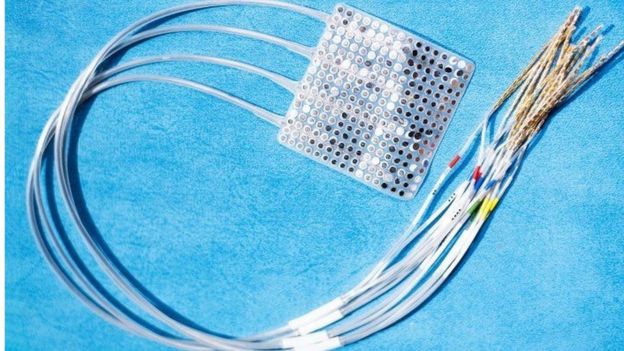 Image caption: Electrodes were temporarily placed on the surface of the brain of epilepsy patients
"Ultimately, the researchers hope to reach a real-time decoding speed of 100 words per minute with a 1,000-word vocabulary and word error rate of less than 17%," Facebook wrote on its blog.
"And by demonstrating a proof-of-concept using implanted electrodes as part of their effort to help patients with speech loss, we hope UCSF's work will inform our development of the decoding algorithms and technical specifications needed for a fully non-invasive, wearable device.
"Rather than looking down at a phone screen or breaking out a laptop, we can maintain eye contact and retrieve useful information and context without ever missing a beat."
Meanwhile, Elon Musk's Neuralink company has applied to US regulators for permission to start testing its own brain-hacking device on humans.
Some in the field believe it is time to pause to consider the ethics of such research and the possibilities it opens for the future.
"To me, the brain is the one safe place for freedom of thought, of fantasies and for dissent," neuro-ethicist Prof Nita Farahany told MIT Review.
Image caption: Electrodes were temporarily placed on the surface of the brain of epilepsy patients
"Ultimately, the researchers hope to reach a real-time decoding speed of 100 words per minute with a 1,000-word vocabulary and word error rate of less than 17%," Facebook wrote on its blog.
"And by demonstrating a proof-of-concept using implanted electrodes as part of their effort to help patients with speech loss, we hope UCSF's work will inform our development of the decoding algorithms and technical specifications needed for a fully non-invasive, wearable device.
"Rather than looking down at a phone screen or breaking out a laptop, we can maintain eye contact and retrieve useful information and context without ever missing a beat."
Meanwhile, Elon Musk's Neuralink company has applied to US regulators for permission to start testing its own brain-hacking device on humans.
Some in the field believe it is time to pause to consider the ethics of such research and the possibilities it opens for the future.
"To me, the brain is the one safe place for freedom of thought, of fantasies and for dissent," neuro-ethicist Prof Nita Farahany told MIT Review.
'Muscle twitches'
University of California San Francisco scientists asked the patients to answer out loud a list of simple multiple-choice questions ordered randomly. And the algorithms learned to identify:- the question they had been asked, 75% of the time
- their chosen answer, 61% of the time
'Safe place'
Researcher David Moses said: "It's important to keep in mind that we achieved this using a very limited vocabulary - but in future studies we hope to increase the flexibility as well as the accuracy of what we can translate from brain activity." The study is published in Nature Communications.
Image caption: Electrodes were temporarily placed on the surface of the brain of epilepsy patients
"Ultimately, the researchers hope to reach a real-time decoding speed of 100 words per minute with a 1,000-word vocabulary and word error rate of less than 17%," Facebook wrote on its blog.
"And by demonstrating a proof-of-concept using implanted electrodes as part of their effort to help patients with speech loss, we hope UCSF's work will inform our development of the decoding algorithms and technical specifications needed for a fully non-invasive, wearable device.
"Rather than looking down at a phone screen or breaking out a laptop, we can maintain eye contact and retrieve useful information and context without ever missing a beat."
Meanwhile, Elon Musk's Neuralink company has applied to US regulators for permission to start testing its own brain-hacking device on humans.
Some in the field believe it is time to pause to consider the ethics of such research and the possibilities it opens for the future.
"To me, the brain is the one safe place for freedom of thought, of fantasies and for dissent," neuro-ethicist Prof Nita Farahany told MIT Review.DISCLAIMER: The Views, Comments, Opinions, Contributions and Statements made by Readers and Contributors on this platform do not necessarily represent the views or policy of Multimedia Group Limited.
Tags:
DISCLAIMER: The Views, Comments, Opinions, Contributions and Statements made by Readers and Contributors on this platform do not necessarily represent the views or policy of Multimedia Group Limited.
Latest Stories
-
ADB-UCC open new chapter of institutional collaboration
4 hours -
Reform of all social media should come with Meta changes, UN says
4 hours -
GMTF, Ho Teaching Hospital begin work on Volta Cardiology Centre
4 hours -
How Telecel M’ahitti promo is transforming lives nationwide
4 hours -
Mason jailed 35 years for defiling two daughters
4 hours -
Ayitey Powers remanded over alleged death threat to NSA boss
4 hours -
Court orders the state to file disclosures in Wontumi bank fraud case
5 hours -
Ghana among 8 countries selected to pilot WHO tool for stronger clinical trial systems
5 hours -
Selma Yudha joins race for 60th NUGS President with promise of student-focused leadership
5 hours -
NSMQ 2026: Botwe denies Wesley Girls’ seeded spot, secures quarter-final spot after fierce battle
5 hours -
Zoomlion begins disinfection and disinfestation exercise across Upper East Region
5 hours -
Ghana AIDS Commission strengthens community-level HIV data collection to track 2030 target
5 hours -
Parliament approves three new Supreme Court Justices
5 hours -
Zoomlion intensifies disinfection, disinfestation exercise across Ahafo Region
5 hours -
GHASALC income rises 89% to GH¢1.84m as sector prepares for 2027 reforms
6 hours