


Audio By Carbonatix
A new species of bone-eating worm has been discovered by scientists during a study in which they dropped alligator carcasses into the Gulf of Mexico to investigate the deep ocean's ecosystem.
The worm, which has yet to be named, is the first of its kind found in the Gulf of Mexico.
The species was discovered when it crawled on the corpse of an alligator on the ocean floor -- and completely consumed its soft tissue within 51 days.
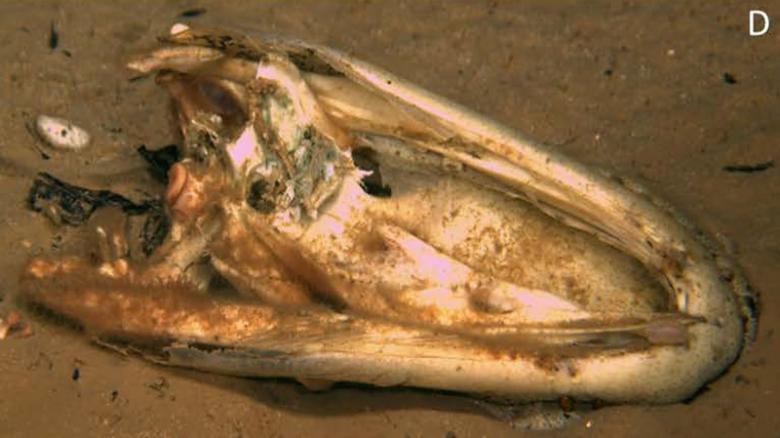 Scientists said the new worm species was the cause of the red hue seen on the alligator's lower jaw
In April, scientists posted a video of one of the alligator carcasses as they first dropped it on the ocean floor, which showed several pink-colored giant isopods crawling on the remains.
Clifton Nunnally, study co-author and researcher from the Louisiana Universities Marine Consortium, said in the video that he hoped to find evidence of any new bone-eating worms that may also be present deep under the Gulf of Mexico.
"The deep ocean is a food desert sprinkled with food oases," he said, while explaining that it may be common for dead alligators, which are native only to the United States and China, to fall to the ocean floor.
"Alligator carcasses are regularly found on beaches and coastlines, and after big storms or hurricanes, alligators have been seen alive 18 miles (29 kilometers) offshore," he added.
Scientists said the new worm species was the cause of the red hue seen on the alligator's lower jaw
In April, scientists posted a video of one of the alligator carcasses as they first dropped it on the ocean floor, which showed several pink-colored giant isopods crawling on the remains.
Clifton Nunnally, study co-author and researcher from the Louisiana Universities Marine Consortium, said in the video that he hoped to find evidence of any new bone-eating worms that may also be present deep under the Gulf of Mexico.
"The deep ocean is a food desert sprinkled with food oases," he said, while explaining that it may be common for dead alligators, which are native only to the United States and China, to fall to the ocean floor.
"Alligator carcasses are regularly found on beaches and coastlines, and after big storms or hurricanes, alligators have been seen alive 18 miles (29 kilometers) offshore," he added.
Scientists said the new worm species was the cause of the red hue seen on the alligator's lower jaw
In April, scientists posted a video of one of the alligator carcasses as they first dropped it on the ocean floor, which showed several pink-colored giant isopods crawling on the remains.
Clifton Nunnally, study co-author and researcher from the Louisiana Universities Marine Consortium, said in the video that he hoped to find evidence of any new bone-eating worms that may also be present deep under the Gulf of Mexico.
"The deep ocean is a food desert sprinkled with food oases," he said, while explaining that it may be common for dead alligators, which are native only to the United States and China, to fall to the ocean floor.
"Alligator carcasses are regularly found on beaches and coastlines, and after big storms or hurricanes, alligators have been seen alive 18 miles (29 kilometers) offshore," he added.
DISCLAIMER: The Views, Comments, Opinions, Contributions and Statements made by Readers and Contributors on this platform do not necessarily represent the views or policy of Multimedia Group Limited.
DISCLAIMER: The Views, Comments, Opinions, Contributions and Statements made by Readers and Contributors on this platform do not necessarily represent the views or policy of Multimedia Group Limited.
Latest Stories
-
Real-Time VAT on cross-border digital services – not a new tax and does not violate double taxation principle
25 minutes -
Digitalisation, AI key to Ghana’s tourism transformation – GHATOF
37 minutes -
Stronger GTA-private sector partnership needed to grow tourism – GHATOF
47 minutes -
Amazon eyes Ghana for broadband expansion after talks with Mahama
2 hours -
National Investment Quiz 2026: Six schools qualify for quarter-finals
2 hours -
‘Do not let Russia pay for its madness with lives of your people’ – Zelensky to Ghana, 46 other countries
2 hours -
6,079 promotion cases fully processed and paid – CAGD says amid nationwide teachers’ strike
2 hours -
Teacher unions to meet government Monday over nationwide strike
3 hours -
Photo story: Republic Bank-JoyNews Habitat Fair clinic wraps up after three days of housing solutions, expert engagement
3 hours -
National Peace Council urges investment in youth to sustain Ghana’s peace
3 hours -
Afenyo-Markin urges youth to speak up against injustice
3 hours -
CAF annuls Edo Queens victory, orders WAFU B final to resume from extra time
4 hours -
Interior Minister urges traditional authorities to enforce anti-bushfire bye-laws
4 hours -
3rd Republic Bank-JoyNews Habitat Fair Clinic ends on a high note after three days of strong patronage
4 hours -
Ten climbers missing after avalanche hits Himalayan base camp
4 hours