

Audio By Carbonatix
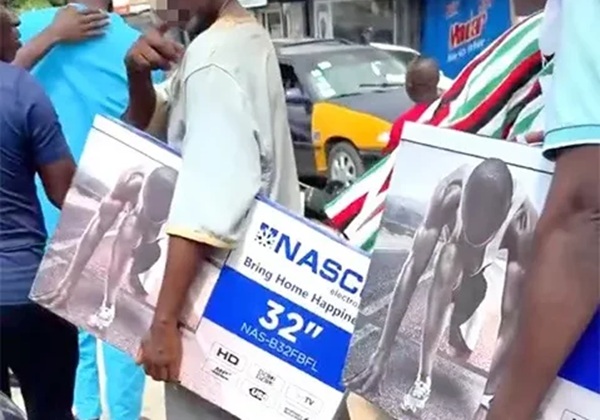
In Ghanaian politics, truth rarely travels alone. It moves with an entourage sometimes in pickup trucks, sometimes in brown envelopes, and lately, in flat-screen television boxes. So when citizens ask, “Was the TV a New Year gift or a campaign souvenir?” they are not being mischievous. They are being experienced.
Because we’ve been here before.
At Ayawaso West Wuogon, we watched a video that looked very much like vote buying. We shouted. We condemned. We invoked Ayawaso West Wuogon like scripture. Then came the denials. Lydia Alhassan denied everything, and we were told to move on. In Ghanaian politics, denial is not just a response; it is tradition.
Fast-forward to today, and the same disease has crossed party lines like a stubborn virus that refuses to respect political colours. Only the language has improved. It is no longer vote buying; it is goodwill. Not inducement, but kindness. Not bribery, but support for delegates. Same action. Upgraded vocabulary. And somehow, we are expected to clap.
Let’s be honest: when televisions, motorbikes, or anything with a warranty appear conveniently during primary season, it can never be charity. No one wakes up with a sudden love for democracy and decides the best expression of that love is a flat screen. If it walks like inducement and blinks like inducement, we shouldn’t need the Special Prosecutor to subtitle it for us.
We are now told that votes were not bought. Heaven forbid. Delegates were merely gifted perhaps to improve their viewing experience while watching democracy at work. Motorbikes were not incentives; they were tools for “enhancing political mobility.” This, apparently, is the new grammar of our democracy.
Yet jokes aside, vote buying remains vote buying, whether wrapped in cash, electronics, or seasonal generosity. Changing the packaging does not change the content. When elections become auctions, leadership becomes a commodity, and governance inevitably suffers.
The irony is painful. Hon. Fiifi Kwetey once warned us about greed. We laughed, scrolled past, and moved on because warnings are boring and power is exciting. Today, that warning has returned, this time carrying a television set.
The Majority Caucus has shocked the nation by doing the unthinkable by choosing principle over convenience. By calling for the annulment of the Ayawaso East primary and promising consequences for vote buyers, they’ve momentarily suspended the long-standing tradition of “protect our own at all costs.” Even more surprising, the reset agenda appears to be working in real life, not just on banners and speeches: alleged wrongdoing is being confronted, not massaged into excuses. If this keeps up, Ghanaian politics may soon discover that accountability is not a foreign concept after all.
What makes this moment even more revealing is the selective outrage. The NPP, which once denied, justified, and rationalised Ayawaso West Wuogon, now wants to lecture the nation on electoral purity. Ghanaians should treat that hypocrisy with the contempt it deserves. Moral authority cannot be switched on and off like a TV remote.
Condemnation must be consistent. We condemned vote buying then; we must condemn it now. Silence or outrage that depends on whose ox is gored only deepens the rot.
In this context, the recall of Baba Jamal deserves acknowledgment. Not because it magically fixes the problem, but because it admits an uncomfortable truth: our house is not immune to decay. Leadership is not about shielding allies; it is about protecting institutions. That signal matters in a political culture where accountability is too often sacrificed on the altar of party loyalty.
The real tragedy is accountability that never arrives. The Special Prosecutor is invited like a guest who never eats. Investigations begin with the confidence of harmattan rain and end in dry silence. No prosecutions. No deterrence. Just lessons politicians know they will never be examined on.
And so the cycle continues.
Until someone from any party is actually prosecuted, vote buying will remain normalised. Until we stop defending “our own” and condemning only “theirs,” morality will remain selective. Until voters stop pretending gifts are harmless, democracy will continue to be auctioned one TV at a time.
Because power handed to those driven by selfish interest will never transform a nation, no matter how many screens they donate. And one day, when the lights go off both literally and figuratively we will realise that the television was never the gift.
It was the receipt.
Latest Stories
-
Total expenditure as of July 2026 amounted to GH¢147.07bn, 16% below target – BoG
38 minutes -
Total revenue & grants stood at GH¢144.5bn in July 2026, slightly below target – BoG
54 minutes -
Ghana Sports Fund urges sports federations to submit credible proposals and measurable targets
57 minutes -
Sally Rooney books withdrawn in UK over Palestine Action support
1 hour -
Musk says US government may be behind slowdown of Ukraine drone speeds
1 hour -
Picking Chief Justices nearing retirement could give Mahama immense power – Bentil
1 hour -
Netflix to shed 1,000 jobs in steepest cuts since 2022
2 hours -
Burnham had two hospitality dinners with Man City chairman, deleted records show
2 hours -
Semenyo ‘froze’ after alleged racist abuse, court told
2 hours -
‘Shameless’ – Mourinho critical of Vinicius Jr ban timing
2 hours -
Loyalty can outweigh competence in Chief Justice selection – Bentil
2 hours -
Man City suffer as PSG masterclass sets up Champions League win
3 hours -
Customer Service Africa CEO urges business leaders to observe staff and customer interactions
3 hours -
On night of mayhem for Liverpool, Barcola arrives in style
3 hours -
Muzic Mensah finds healing and renewed love in new single ‘WayƐ Late’
3 hours