


Audio By Carbonatix
Social distancing would be needed for "at least half of the year" to stop intensive care units being overwhelmed, according to the government's scientific advisers.
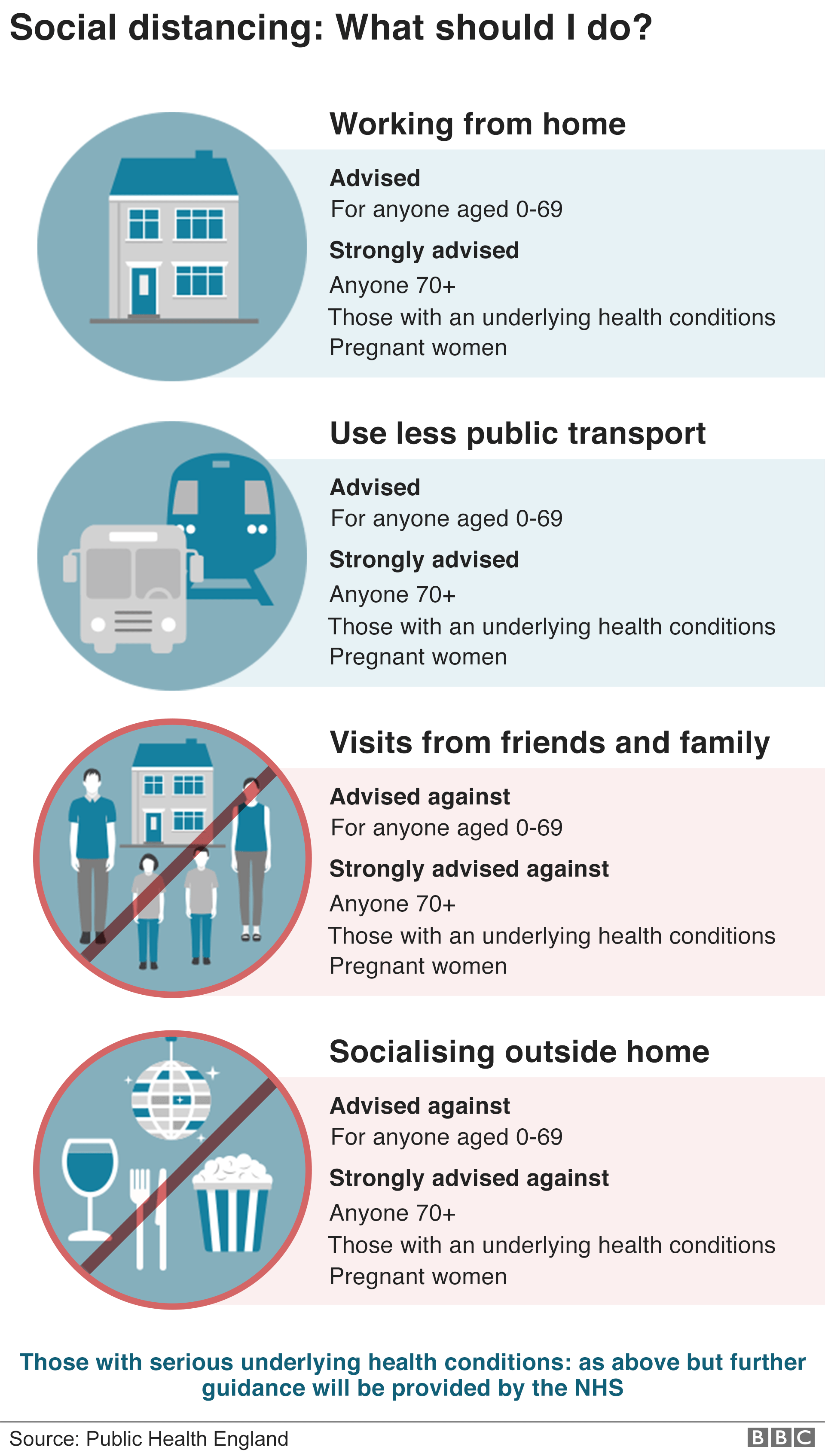
The Scientific Advisory Group for Emergencies (Sage) recommended alternating between more and less strict measures for most of a year.
Strict measures include school closures and social distancing for everyone.
Less restrictive measures include isolating cases and households.
It comes after Prime Minister Boris Johnson said on Thursday that the UK could "turn the tide" on the coronavirus outbreak within 12 weeks.
Schools in England, Scotland and Wales will close on Friday until further notice - except for vulnerable children and those with a parent identified as a key worker.
More than 65,000 retired doctors and nurses in England and Wales have been asked to return to work in the NHS to help tackle the outbreak.
And the chancellor is set to announce a wage subsidy package to try to protect millions of jobs.
Documents prepared by Sage said alternating measures could "plausibly be effective at keeping the number of critical care cases within capacity".
Less strict measures would also include social distancing - but just in vulnerable groups.
Sir Patrick Vallance, the government's chief scientific adviser, said the evidence in the documents published on Friday has "played a considerable role in shaping our recommendations".
"The UK is home to experts who are at the forefront of their chosen fields and we are making full use of their expertise to grow our understanding of Covid-19 as we work tirelessly to tackle this disease," he said.


We are in this for the long haul.
The science that has informed government strategy shows we can expect disruption to our lives for most of the next 12 months.
More than half that time is expected to involve the strict measures in place now, which include school closures.
This won't all be in one go, instead the heavy restrictions will come and go in order to manage the number of cases.
The government's aim is to prevent one massive spike in infections that would completely overwhelm intensive care.
If that happens then death rates would soar as the sickest patients would not get the treatment they need.
Instead the strategy will be to have a series of smaller, manageable peaks.
It should save lives, but the cost is widespread disruption to society for some time to come.
The advice also said:
- The best estimate of the proportion of people who die after being infected is in the range of 0.5% to 1%
- There would be a delay of two to three weeks between measures being put into place and their impact being felt in intensive care
- The triggers for the different measures to be implemented or removed could be set at a level of UK nations and regions - suggesting stricter policies could be enforced in London
- It is "unlikely" that mass school closures will either "reduce the final size of the epidemic" or delay its peak by "more than three weeks"
- It is "currently unclear" whether the warmer weather would affect the spread of the virus
- Large scale rioting is "unlikely and rarely seen in these circumstances" and altruism will "likely predominate"
Latest Stories
-
Trump administration moves to impose more than $100,000 fee for H-1B worker visas
1 hour -
Oil prices steady as investors weigh impact of expanded US sanctions against Iran
3 hours -
Trump administration plans to revoke visas of foreigners seeking asylum
3 hours -
US appeals court considers reassigning case from judge over AI use
3 hours -
Trump bought shares in Elon Musk’s SpaceX in June, financial disclosure shows
3 hours -
MTN approves $375 million share buyback after profit rise
4 hours -
Ghana gold buyers went weeks without funds, sources say
4 hours -
Nevada sues to block Trump administration’s Colorado River plan
4 hours -
Tunisian hospital receives 19 bodies after migrant boat sinks
4 hours -
Oil drops more than $2 despite new US sanctions on Iran
4 hours -
Dangote refinery drives seven-fold rise in Nigeria petroleum product exports, EIA says
4 hours -
Zambia closes courts on last day to file election challenge
5 hours -
Nearly three million Teslas recalled in China over hidden door handles
5 hours -
China probes use of formaldehyde to keep cabbages fresh
5 hours -
Veteran Nollywood actor Taiwo Hassan ‘Ogogo’ dies at 65
5 hours