

Audio By Carbonatix
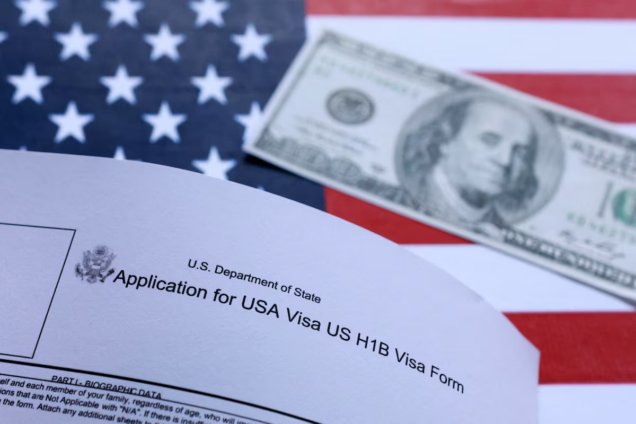
President Donald Trump's administration on Monday released a proposed regulation to codify an unprecedented fee of more than $100,000 on new H-1B visas for highly skilled foreign workers, a measure that has been blocked by the courts.
The fee, first temporarily imposed by Trump last year, dramatically raises the cost of visas that are heavily relied on in the tech, education, and research sectors.
A federal judge in June ruled that the fee was illegal and blocked the Trump administration from collecting it.
A Boston-based appeals court is reviewing that decision while another court considers whether a judge properly rejected a challenge to the fee by a major business group.
Trump's temporary fee increase expires in September, one year after it was issued. The proposed rule by the U.S. Department of Homeland Security, posted in the Federal Register on Monday, would make a $103,265 fee permanent. It could be finalised by the end of the year.
The H-1B program allows U.S. employers to hire foreign workers with training in speciality fields and offers 65,000 visas annually, with an additional 20,000 for workers with advanced degrees, approved for three to six years. Those visas typically carried fees of $2,000 to $5,000 before Trump's order.
The fee would not apply to visas granted to foreign citizens already in the United States on student visas, who make up a large share of new H-1B recipients, or to renewals of current visas.
DEBATE OVER VISA PROGRAM
Trump, a Republican, and other critics of the H-1B program say it is abused by many companies that replace American workers with cheaper foreign labour.
But business groups and many individual companies have said the visa program is needed to address a shortage of qualified American workers for certain jobs and to allow U.S. businesses to recruit top talent.
About 70 employers had paid the $100,000 fee on a total of 85 visa applications as of late February, according to court filings.
In imposing the fee, Trump invoked the president's authority under immigration law to restrict the entry of certain foreign nationals deemed detrimental to U.S. interests.
The fee is being challenged by the U.S. Chamber of Commerce, the largest U.S. business lobbying group, Democratic-led states and a coalition of unions and employers. Those lawsuits could be amended to challenge the rule proposed this week once it is finalised.
LEGAL CHALLENGES MOUNT
The lawsuits claim that Trump's power to restrict entry does not allow him to override the law that created the H-1B visa program.
The states and groups that sued also say that the Department of Homeland Security cannot impose fees, taxes, or other means of generating revenue for the United States without permission from Congress.
The Trump administration has maintained that the fee is not a traditional tax and that courts have little power to question the president's authority to restrict entry into the country.
Amid Trump's broader immigration crackdown, employers last year registered for about 344,000 H-1B visas, down more than 25% from 2024 and to fewer than half of the 794,000 visas sought in 2023, according to data from U.S. Citizenship and Immigration Services.
The Trump administration has also ordered enhanced vetting of H-1B applicants and proposed a new visa selection process that would favour higher-skilled and better-paid workers.
Earlier in August, the Department of Homeland Security, in a separate rule, added fees of up to $4,500 to applications to extend the stay of H-1B workers or to transfer employees based in other countries to the United States.
Latest Stories
-
Lawrence Kobena Nsarko Otoo, Esq
3 minutes -
Bel-Aqua intensifies mental well-being campaign ahead of 15th anniversary
5 minutes -
From banking to party finances: Alfred Kwadwo Thompson elected NPP Treasurer
10 minutes -
George Christian Papa Mends
15 minutes -
Ali Suraj elected NPP NASARA Coordinator
26 minutes -
Mustapha Hamid misses out on NPP Vice Chairmanship by 31 votes despite early poll lead
35 minutes -
Kojo Bamba, Henry Nana Boakye and Nana Akomea elected NPP Vice Chairmen
1 hour -
From Delta Force to NPP First Vice Chairman – Kojo Bamba’s political journey
1 hour -
Police restore calm at Larteh following Odwira festival disturbance
2 hours -
‘All the camps will dissolve’ – Bawumia demands one NPP for 2028
2 hours -
There is no time to waste – Bawumia orders NPP to begin 2028 work
2 hours -
Sarkodie visits MobileMoney Fintech LTD
3 hours -
John Boadu unveils new NPP strategy to win back youth and modernise party
3 hours -
Hawa Koomson elected NPP National Women’s Organiser
3 hours -
John Boadu begins NPP rebuild from grassroots ahead of 2028 election
3 hours