

Audio By Carbonatix
State election officials across the US are reporting record numbers of voters casting their ballots ahead of election day on 3 November.
More than 22m Americans had voted early by Friday, either in person or by mail, according to the US Election Project.
At the same point in the 2016 race, about 6m votes had been cast.
Experts say the surge in early voting correlates to the coronavirus pandemic, which has caused many people to seek alternatives to election day voting.
On Tuesday, Texas, a state that has relatively tight restrictions on who can qualify for postal voting, set a record for most ballots cast on the first day of early voting.
On Monday, the Columbus Day federal holiday, officials in Georgia reported126,876 votes cast - also a state record.
In Ohio, a crucial swing state, more than 2.3m postal ballots have been requested, double the figure in 2016.
Reports indicate that registered Democrats have so far outvoted registered Republicans - casting more than double the number of ballots. And of these early voting Democrats, women and black Americans are voting in particularly high numbers. Some are motivated by dislike for Donald Trump, while others have been energised by racial justice protests throughout the summer following the police killing of George Floyd in Minnesota.
But this early advantage does not mean that Democrats can already claim victory. Republicans, who claim postal voting is vulnerable to fraud, say Democrats may win the early vote, but that Republicans will show up in large numbers on election day.
According to a 2017 study by the Brennan Center for Justice, the rate of voting fraud overall in the US is between 0.00004% and 0.0009%.
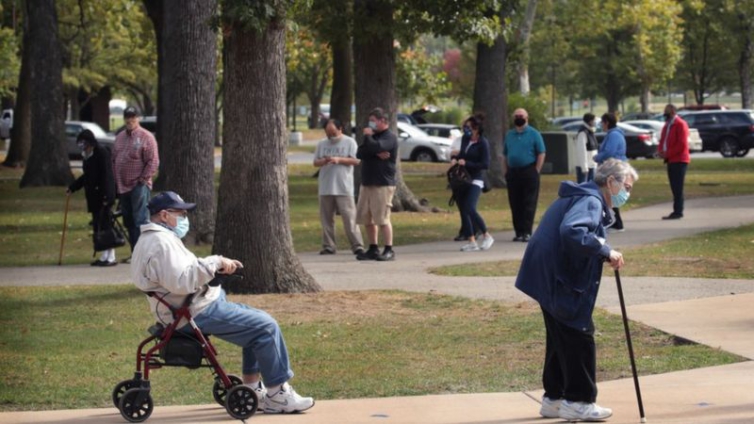
The enormous numbers of voters have led to long lines, with some people waiting for up to 11 hours for an opportunity to vote.
Younger people, who historically have been difficult to get to the polls, appear to be turning out in larger numbers this year. The youth vote may be the highest its been since 2008 for the election of Barack Obama - the country's first black president.
A recent survey by Axios found that four in 10 university students said they planned to protest if Mr Trump wins. Six in 10 said they would shame friends who could vote but choose not to.
By contrast, only 3% of surveyed students said they would protest if Joe Biden was elected.
Latest Stories
-
Global InfoAnalytics poll puts John Boadu, Justin Kodua and Titus Glover ahead in NPP executive race
6 minutes -
Ghana to establish skills development university with $50m from German support package
12 minutes -
Baffour Awuah under EOCO investigation over alleged financial loss and money laundering – Deputy AG
18 minutes -
How healthy is Ghana’s health sector?
23 minutes -
HACSA Tech4Girls graduates 80 young women with digital and technology skills
24 minutes -
Arrest of Manhyia South MP should involve Parliament, not police station – Kpebu
57 minutes -
Two Nigerians sentenced to 189 months in US prison over $2.4m cyber fraud
1 hour -
Cristiano Ronaldo leaves Portugal’s training camp after rift with Head Coach
1 hour -
Ghana Energy Awards opens nominations for landmark 10th anniversary edition
1 hour -
Aayalolo contra-flow: Are we treating the symptom instead of the disease?
1 hour -
GTEC orders Colleges of Education to begin 2026/2027 admissions despite fees approval delay
1 hour -
Legal reforms must solve real problems, improve justice – Bagbin
2 hours -
Ofori-Sarpong named Alumni President of the Year, honoured for PRESEC dormitory project
2 hours -
Germany commits $132m to Ghana for skills development and training university – Pelpuo
2 hours -
‘Influence should go beyond visibility’ – Taadi Banyinba GH launches The TB Impact
2 hours