

Audio By Carbonatix
Facebook has blocked Australian users from sharing or viewing news content on the platform, causing much alarm over public access to key information.
Australians woke up on Thursday to find the Facebook pages of all local and global news sites - as well as some key government sites - had been blocked.
The government said the ban threatened the tech giant's "credibility".
Facebook's move is in response to a proposed law in Australia which would make tech giants pay for news content.
Tech giants like Google and Facebook have argued the law doesn't reflect how the internet works, and unfairly "penalises" their platforms.
Those outside of Australia are also unable to read or access any Australian news publications on the platform.
The Australian government has said it is proceeding with the law, which passed parliament's lower house on Wednesday.
"Facebook needs to think very carefully about what this means for its reputation and standing," Communications Minister Paul Fletcher told the ABC.
On Thursday, many Australians were also unable to access the pages of key agencies including police and emergency services, health departments and the Bureau of Meteorology.
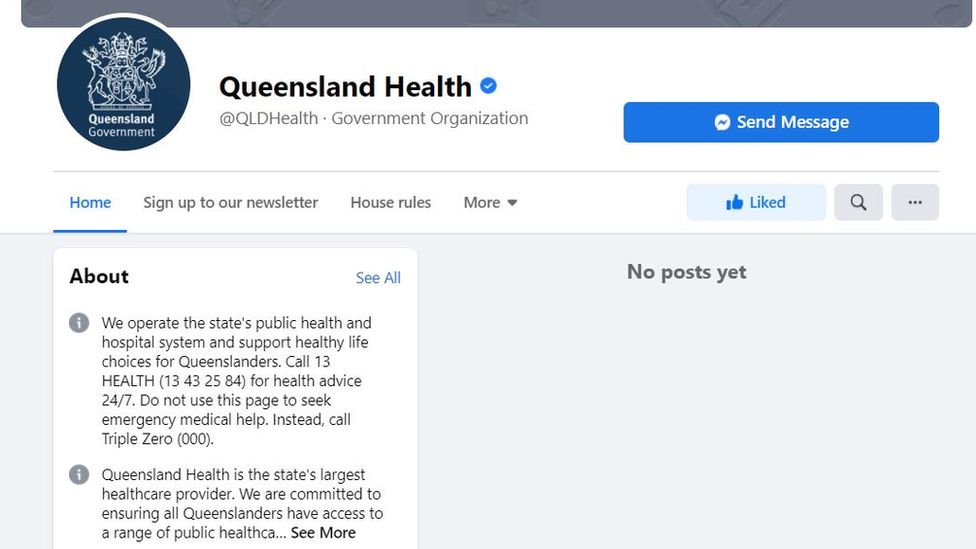
It sparked an immediate backlash, with many Australians angry about their sudden loss of access to trusted and authoritative sources.
"Facebook is acting like an oppressive government, severely restricting and censoring the flow of information to Australians," said Elaine Pearson from Human Rights Watch.
Treasurer Josh Frydenberg tweeted that he had had a "constructive" discussion with Facebook chief executive Mark Zuckerberg on Thursday.
"He raised a few remaining issues with the government's news media bargaining code and we agreed to continue our conversation to try to find a pathway forward," he said.
Facebook's announcement came hours after Google agreed to pay Rupert Murdoch's News Corp for content from news sites across its media empire.
What did Facebook say?
Facebook announced its new policy in a blog post on Wednesday, saying the proposed legislation had left it "facing a stark choice: attempt to comply with a law that ignores the realities of this relationship, or stop allowing news content on our services in Australia".
"With a heavy heart, we are choosing the latter," it said.
Under its new rules, Facebook said Australian users would not be able to read or share news content on the platform, while Australian news publishers would be restricted from sharing or posting any content on Facebook pages.
"Globally, posting and sharing news links from Australian publishers is also restricted," it said.
Australian users immediately reported being unable to see or share news, and the pages of major outlets such as ABC and the Sydney Morning Herald are now showing no posts.
The blog post on Wednesday, by Facebook's Australia and New Zealand managing director William Easton, said the social media company helped Australian publishers earn about AU$407m ($316m; £228m) last year through referrals.
Mr Easton wrote that the proposed legislation "seeks to penalise Facebook for content it didn't take or ask for".
"We hope that in the future the Australian government will recognise the value we already provide and work with us to strengthen, rather than limit, our partnerships with publishers," he said.
The American Economic Liberties Project, a Washington-based anti-monopoly group also criticised the move.
"By censoring Australian publishers to maintain its advertising revenue, Facebook has shown it is a threat to democracies worldwide," research director Matt Stoller said in a statement.

Facebook wants to call the shots

Australia is not a big market for Facebook. And Facebook says news isn't a big driver of revenue for the company. So why does it care so much about this law?
This is far more about the principle. Other countries have been looking at what is happening in Australia. There's speculation that Canada, even the EU could follow Australia's lead - something Facebook wants to avoid.
Facebook does already pay for some news. It's entered into commercial deals with media companies in the UK, for example.
What Facebook wants to do, however, is call the shots.
Its executives do not want governments to step in, telling them they have to pay for news - and even setting the price.
Facebook, then, has decided to show that there are consequences for governments if they want to take muscular action against Big Tech.
But that could backfire spectacularly. That Facebook can essentially switch off Australian news on its platform is already being criticised as anti-democratic - even authoritarian - in some quarters.
Latest Stories
-
NSMQ 2026: Kpando SHS brush aside Abor, Jukwa to storm One-Eighth stage with 32 point gap
11 minutes -
Duncan Amoah: Gov’t should create conditions for 24-hour economy, not build markets
17 minutes -
JoyNews-Republic Bank Habitat Fair finale turns homeownership dreams into real possibilities
51 minutes -
Bamiri chief commissions KG block, guest house to boost education and revenue
1 hour -
NSMQ 2026: Yaa Asantewaa Girls’ going ‘beck’ to Tanoso after Bishop Herman deals them early exit
2 hours -
Data Protection Commission acquires two vehicles to strengthen data protection enforcement
2 hours -
NSMQ 2026: Holy Child School storms back from two-year NSMQ absence to book One-Eighth ticket
3 hours -
GNFS dismisses reports of unpaid 2025 rent allowance
4 hours -
Gordon Asare-Bediako steps down from NPP Communications Director race, backs Dennis Aboagye
5 hours -
GES dismisses requirement for newly promoted teachers to submit documents for salary adjustments
5 hours -
Meko Bono 2026: Vice President pledges agricultural revival as Atebubu hosts grand homecoming
6 hours -
Russian skydiver Sergey Boytcov sets world record with 11,551-metre stratosphere jump
6 hours -
Ablakwa-led committee submits five reports to Mahama ahead of 2027 AU chairmanship
6 hours -
Africa not seeking Western cash in reparations campaign – Ablakwa
6 hours -
Production decline, reserve depletion threaten Ghana’s upstream sector – Jinapor
6 hours