

Audio By Carbonatix
The sanitation situation in Ghana is set to improve as a waste-to-energy project is being piloted at Gyankobaa in the Atwima-Nwiabiagya South district of the Ashanti Region.
The project, which will take 48 months to complete is expected to generate 400 KW of electricity from municipal waste. This will be scaled up to other parts of the country.
The German Government, through its Federal Ministry of Education and Research, signed a 5.8 million euro contract involving 4 institutions in Germany and 1 from Ghana.
These comprise 3 academic institutions, one research and development institution and a medium-scale industry.
The project’s overall aim is to develop concepts for waste segregation and the conversion of various fractions into energy by using biogas, pyrolysis and solar PV plants.
The project will also create business models to successfully replicate and propagate the models in 10 different regions in Ghana.
It will also build local experts to design, construct and maintain hybrid waste to energy facilities.
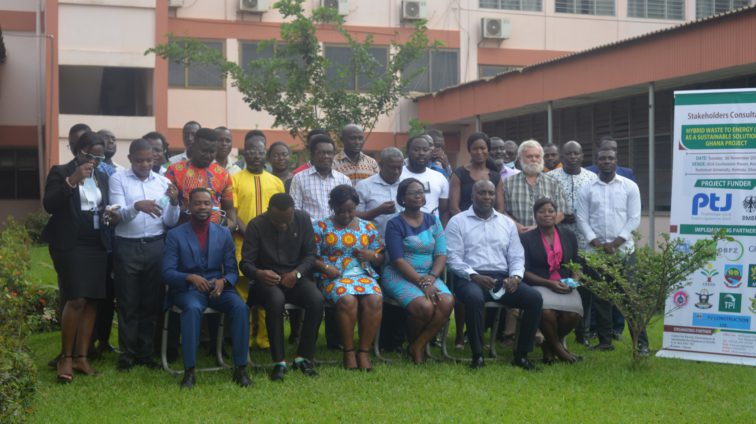
At a stakeholder consultation meeting at the Kumasi Technical University, the Project Coordinator and Head of the Renewable Energy Centre at the KsTU, Dr. Julius Ahiekpor said the project will begin full operation by the middle of 2022.
“We want to produce energy and train people to manage such projects in the future. It’s a pilot that has a research component,” he summarized.
How the project started
Germany's Federal Ministry of Education and Research (BMBF) of Germany in collaboration with Ghana’s Ministry of Environment, Science, Technology and Innovation, through the West African Science Service Centre in Climate Change and Adapted Land Use in Accra conducted feasibility studies on renewable energy resources in Ghana.
This was under the supervision of the Council for Scientific and Industrial Research.
Two scoping studies were commissioned around the same time by BMBF to examine the Bioenergy production and utilization in Ghana (BioGRAG) project and the possibility of producing bioenergy from cocoa husk through the Energize Ghana by Cocoa Husk (ENGHACOH) project coordinated by the University of Rostock and SRH-Berlin respectively.
The three individual studies and scoping reports crystallized into one project with the common objective of finding an appropriate treatment pathway for municipal solid waste generated in Ghana.
Latest Stories
-
La Beach demolition: Senyo Hosi condemns lack of consultation
8 minutes -
Russian glide bomb attack on Zaporizhzhia kills at least 15 people
23 minutes -
Jinapor warns underperforming energy sector CEOs of consequences, says no protection for failure
24 minutes -
Fire destroys head of tipper truck on Lower Volta Bridge
29 minutes -
Palmer signs new Chelsea contract until 2034
30 minutes -
World Cup visa scandal: Mahama will act on corruption allegations – Abass Nurudeen
32 minutes -
Abass Nurudeen accuses Minority of ‘scandal scavenging’ over World Cup visa controversy
33 minutes -
US Embassy recognised NSA, GFA and GTA as separate entities for visa applications – Sports Minister’s aide
40 minutes -
Only 30% of Ghanaian teachers satisfied with their jobs – CAPCOE data reveals
51 minutes -
Communities affected by construction of Akosombo Dam urge government to speed up compensation process
1 hour -
World Cup visa scandal: Sports Ministry not shielding anyone – Sports Minister’s special aide
2 hours -
World Cup visa scandal: Over 30 people misrepresented as GTA board members to US Embassy – Vincent Assafuah alleges
2 hours -
Fire destroys wooden structure near Yesu Mo Villa at Bush Road
2 hours -
NDC threatens sanctions over oversized campaign posters, gives aspirants 5 days to comply
2 hours -
Star Oil paid GH¢2.7bn in taxes, levies in nine months of 2026
3 hours