

Audio By Carbonatix
A leading activist who was released from prison in Egypt last month has told the BBC that during his time in detention he saw first-hand a system where torture was used to make people inform on each other.
Ramy Shaath has long been a significant voice in the secular opposition to the Egyptian authorities, past and present. A dual Egyptian-Palestinian national, the 50-year-old has also been a key figure in the Egyptian branch of the Boycott, Divestment and Sanctions (BDS) movement, which calls for a complete boycott of Israel over its treatment of the Palestinians.
Mr Shaath was detained by the Egyptian authorities in July 2019. He was accused of aiding a terrorist organisation, but no formal charges were ever made against him.
He believes that his opposition to moves towards the normalisation of ties between Israel and several Arab states was the final straw that prompted his arrest.
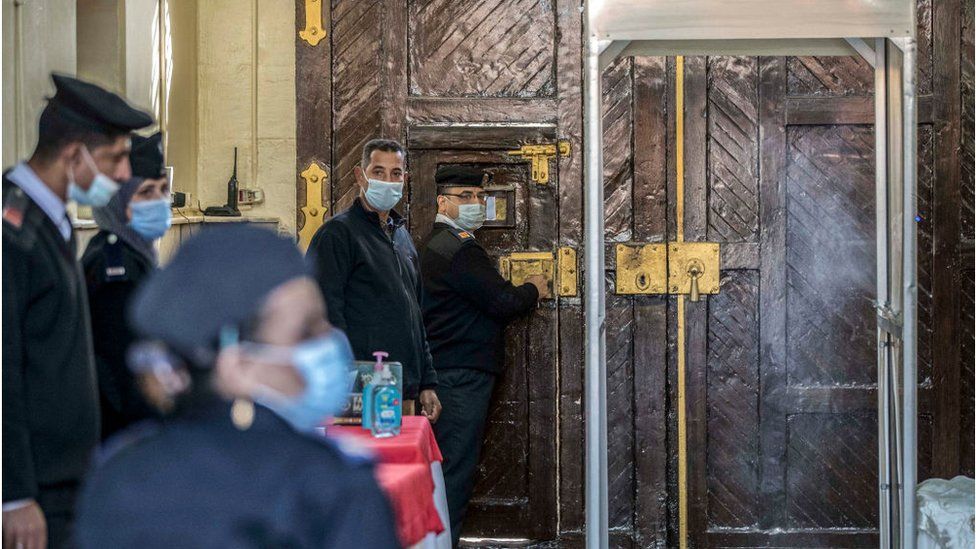
His conditions in jail were bleak - sharing a cell crammed with dozens of other prisoners.
But he ruefully concedes that he had it better than many others.
"In my case, I was not tortured. But being blindfolded, handcuffed and attached to a wall for three days - for me that's torture. In Egyptian terms, though, this is actually VIP treatment."
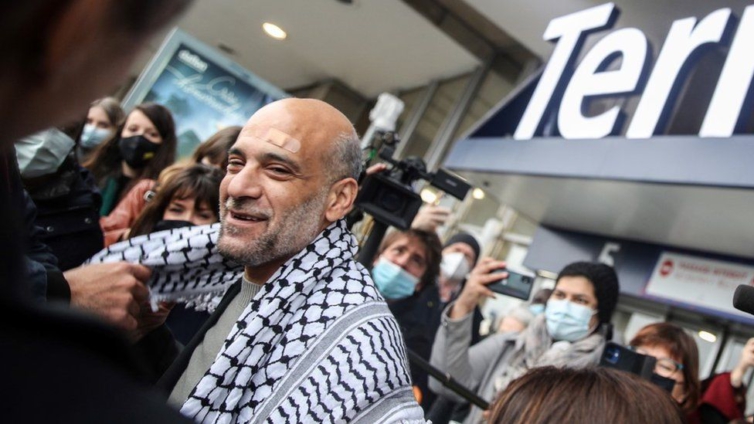
Now reunited with his French wife Celine Lebrun in Paris - and having had to give up his Egyptian nationality as a condition of his release - Ramy Shaath is recovering from his ordeal, but his mind is still with those he left behind in jail.
He tells the BBC that one of the things that most shocked him during his detention was the influx of prisoners with little or no political involvement.
He says many of those he met in jail were questioned under duress simply to provide more names for more arrests - however flimsy the basis.
He describes the interrogators' technique: "Just tell us names... about anything. If you're caught in a Facebook group, tell us names of others in the group. If you're at a demonstration, just tell us names."
'Gangster tactics'
In two and a half years, he himself was only interrogated once, for 45 minutes, and it had nothing to do with the charges he was facing. He says the aim of such detention is simply punishment for being an activist.
He says the situation was never as desperate under the rule of former President Hosni Mubarak - who was toppled by the 2011 uprising in which Mr Shaath played a role.
"We never reached this level of fear and arbitrary detention and torture... We've never seen confiscation of judiciary to this level."
"In Mubarak's time, there was an effort to keep a certain level of independence in the judiciary... I have seen lots of families thrown in jail, just as a measure of reprisal against their loved ones. It's gangster tactics, not state tactics."
Among many such cases, he cites the story of a father detained for more than two years after his nine-year-old son sang a song that he did not know was seen as anti-government at his school, which then denounced him.
"In some cases." he says, "when people are tortured, they are scared to talk about their friends who are actually interested in politics or the public sphere. They just give any names of other friends who have nothing to do with politics or activism... just so that when the security forces check them, they are OK. Although they can still be arrested and thrown in jail."
West 'could do more'
He believes that the West has considerable leverage over President Abdul Fattah al-Sisi, a regional ally, and could do more to curb human rights abuses.
For his part, Mr Sisi has previously denied that there are any political prisoners in Egypt, dismissing widespread reports that there are tens of thousands in jail.
Towards the end of last year, the president launched an initiative called the National Strategy for Human Rights - a five-year plan aimed at "enhancing respect for and protection of human rights". He also lifted a state of emergency in place since 2017.
His supporters say that security measures have been necessary to deal with the unrest and turmoil that ensued for years after the fall of Hosni Mubarak.
Despite his own experiences and those of others he met in jail, Ramy Shaath says he believes that the fervour for change unleashed by the 2011 uprising has not entirely dissipated.
For years, he says, people did not want to remember or talk about the 25 January revolution out of fear, shame and a sense of how things had gone so wrong - but this year he's been receiving hundreds of messages of congratulation and commemoration, with some starting to show pride once again in what happened.
Latest Stories
-
Édouard Mendy annonce sa retraite internationale avec le Sénégal
1 hour -
Lamine Yamal scores twice as Barcelona maintain perfect start
2 hours -
Haaland scores controversial winner for 10-man City at Man Utd
2 hours -
Ghana’s narcotics crisis deepens as drug seizures linked to country top US$1bn – Minority
2 hours -
CAF CC: Nations FC bow out after draw with FC Diarra in Accra
2 hours -
Kenyans dominate 2026 KGL Millennium Marathon as race champions mental health
2 hours -
Minority demands full-scale probe into Ghana’s alleged emergence as narcotics transit hub
2 hours -
NaCCA trains teachers to implement new Chinese language curriculum
4 hours -
Ghana, China deepen cooperation on galamsey and mining sector
4 hours -
JoyNews–Republic Bank Habitat Fair ends on a high note after 3 days of strong patronage, expert engagement
4 hours -
Emma Ofosua takes West African spoken word to three UK cities
4 hours -
Traditional artists will become more expensive because of AI – Aewura Arts
4 hours -
Clients would disappear after I finished their artworks – Aewura Arts recounts challenges
4 hours -
Turkish police detain dozens in raids on gay bars and homes of LGBTQ+ activists
5 hours -
Trump doubles down on united Ireland comments on day two of visit
5 hours