


Audio By Carbonatix
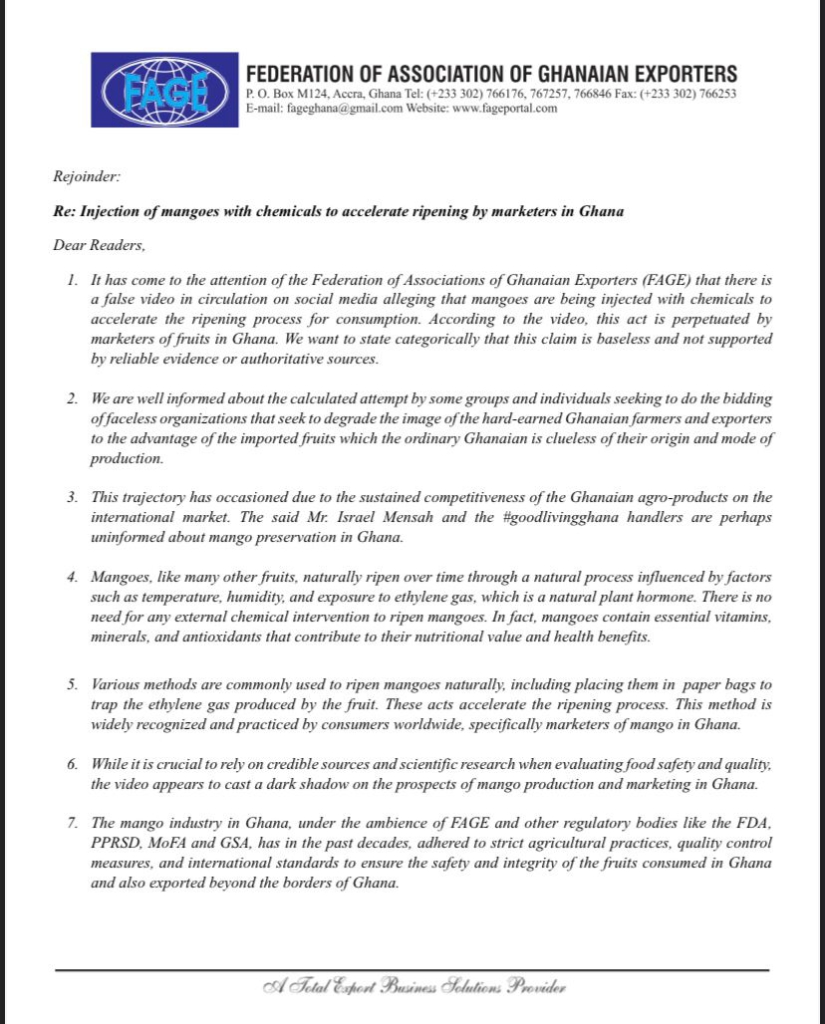
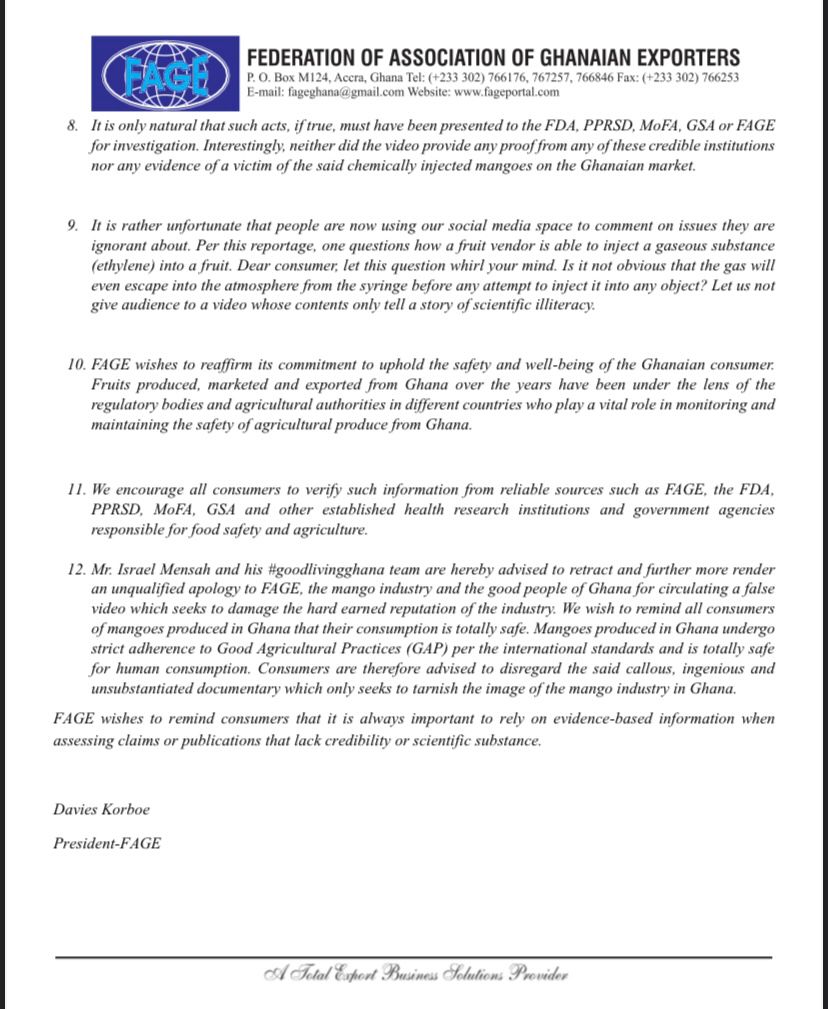
The Federation of Associations of Ghanaian Exporters (FAGE), has debunked claims made in a viral social media video that mangoes are being chemically injected to hasten the ripening process.
According to FAGE, mangoes in Ghana adhere strictly to Good Agricultural Practices (GAP) per international standards, and are thus safe for human consumption as they ripen through a natural process influenced by factors such as temperature, humidity, and exposure to ethylene gas.
In a press statement signed by its president, Davies Korboe, the federation described the said video as deceptive, and called on its creators to retract and apologize for the harm caused.
For information regarding the quality of food, FAGE urged the public to rely on organisations such as the Ghana Standards Authority (GSA), the Ministry of Food and Agriculture (MoFA), the Food and Drugs Authority (FDA), and Plant Protection & Regulatory Services (PPRSD).
The Federation in a statement said, "We are well informed about the calculated attempt by some groups and individuals seeking to do the bidding of faceless organizations seeking to taint the image of the hard-earned Ghanaian farmers, marketers and exporters to the advantage of the imported fruits which the ordinary Ghanaian is clueless of their origin and mode of production."
"This trajectory has occasioned due to the sustained competitiveness of the Ghanaian agro-products on the international market. The said Mr. Israel Mensah and the #goodlivingghana handlers are perhaps uninformed about mango preservation in Ghana.
Mangoes, like many other fruits, naturally ripen over time through a natural process influenced by factors such as temperature, humidity, and exposure to ethylene gas, which is a natural plant hormone. There is no need for any external chemical intervention to ripen mangoes. In fact, mangoes contain essential vitamins, minerals, and antioxidants that contribute to their nutritional value and health benefits.
It said the mango industry in Ghana, "under the ambience of FAGE and other regulatory bodies like the FDA, PPRSD, MoFA and GSA, has in the past decades, adhered to strict agricultural practices, quality control measures, and international standards to ensure the safety and integrity of the fruits consumed in Ghana and also exported beyond the borders of Ghana.
Read the full statement below:
Latest Stories
-
Meko Bono 2026: Vice President pledges agricultural revival as Atebubu hosts grand homecoming
1 hour -
Russian skydiver Sergey Boytcov sets world record with 11,551-metre stratosphere jump
1 hour -
Ablakwa-led committee submits five reports to Mahama ahead of 2027 AU chairmanship
1 hour -
Africa not seeking Western cash in reparations campaign – Ablakwa
1 hour -
Production decline, reserve depletion threaten Ghana’s upstream sector – Jinapor
2 hours -
Surveyors caution against treating compensation disputes as professional misconduct
2 hours -
Mahama calls for AU dialogue on migration after South Africa xenophobic tensions
2 hours -
I haven’t experienced any envy in the gospel music industry — Ohemaa Mercy
3 hours -
Prayer does not solve everything — Ohemaa Mercy
3 hours -
New PURC office symbolises stronger consumer protection – Dr Jinapor
4 hours -
Rev. Wengam re-elected Assemblies of God, Ghana General Superintendent
4 hours -
Less than 20km of clearing left to connect Accra-Kumasi Expressway to Kumasi – Agbodza
4 hours -
US judge strikes down policy suspending immigrant visa processing for 75 nations
4 hours -
MCEs collecting fees from galamseyers are facilitating illegality – Ken Ashigbey
4 hours -
Developer LMI Holdings commits to completing first 700 Saglemi housing units
5 hours