


Audio By Carbonatix
Global growth is forecast to be stable, despite higher interest rates, avoiding contraction.
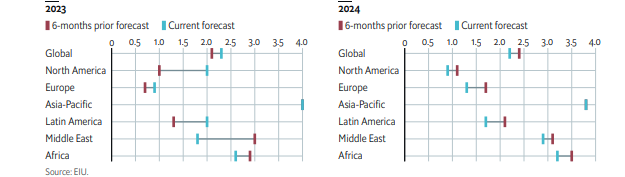
According to The Economist Intelligence Unit, the lagged impact of a broad rise in interest rates will constrain global economic activity in the remainder of 2023 and in 2024, but there are no indications of systemic strain in debt markets that could pull the world economy into a painful contraction.
“We forecast that US growth will slow significantly in 2024, but will avoid a recession, and some momentum will build in Europe as German industry normalises following energy-related disruptions. Moderate stimulus in China will inject sufficient momentum behind its economy to preserve expansion, while other emerging markets will benefit from reduced uncertainty that will come with the conclusion of global monetary tightening”.
“We forecast that global economic growth will decelerate to 2.2% (at market exchange rates) in 2024, from an estimated 2.3% in 2023. The outlook improves in subsequent years (we forecast growth of 2.7% a year on average in 2025-28) aided by the onset of monetary easing and increased funding for investment in technology and the energy transition”, it added in its latest Global Economic Outlook.
Africa is expected to grow at a rate of about 2.9% in 2023 and 3.5% in 2024.
Disinflation process to continue
It also forecasts that disinflation will continue, with risks weighted to the upside.
“The supply-side shocks that drove price increases in 2021-22 will reverse as supply-chain dislocation eases. This will drive inflation lower in most markets (we forecast that it will average 2.4% across developed economies in 2024), if not undo the rapid price gains of recent years”, it explained.
However, it said risks to the inflation outlook are skewed to the upside, adding, a widening of the Israel-Hamas war that disrupted oil supply would drive up hydrocarbon prices, and stronger than expected effects from El Niño climate conditions on agriculture production would push up food prices in 2024, especially in developing economies.
Also, there is a moderate risk that demand will prove more resilient than we expect in developed markets.
Latest Stories
-
CLOGSAG’s Bampoe Addo was a formidable voice for workers – FWSC eulogises
4 minutes -
Galamsey destroys over 100 acres of farmland at Akyem Atobriso
8 minutes -
GRIDCo completes tower replacement on Tema-Achimota transmission line
27 minutes -
Republic Bank-JoyNews Habitat Fair Mini Clinic ends on a high note at Achimota Retail Centre
30 minutes -
7-month-old baby found dead in a drain at Obuasi Old Estate
2 hours -
Tunisia coast guard recovers eight bodies of migrants whose boat sank
2 hours -
One man diagnosed with prostate cancer in the UK ‘every eight minutes’
2 hours -
We couldn’t afford prepaid credit after I lost 2012 election – Obuobia Darko
2 hours -
NSMQ 2026: Kpando SHS brush aside Abor, Jukwa to storm One-Eighth stage with 32 point gap
3 hours -
Duncan Amoah: Gov’t should create conditions for 24-hour economy, not build markets
3 hours -
JoyNews-Republic Bank Habitat Fair finale turns homeownership dreams into real possibilities
4 hours -
Bamiri chief commissions KG block, guest house to boost education and revenue
4 hours -
NSMQ 2026: Yaa Asantewaa Girls’ going ‘beck’ to Tanoso after Bishop Herman deals them early exit
4 hours -
Data Protection Commission acquires two vehicles to strengthen data protection enforcement
5 hours -
NSMQ 2026: Holy Child School storms back from two-year NSMQ absence to book One-Eighth ticket
6 hours