

Audio By Carbonatix
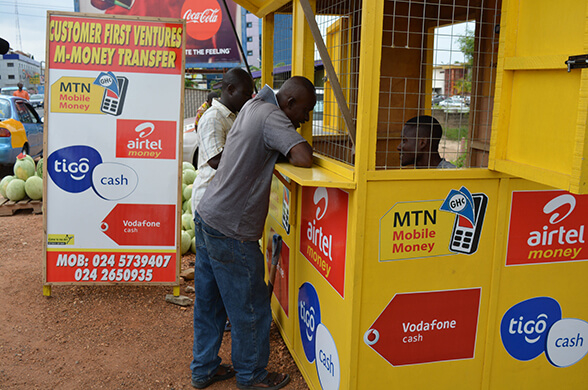
The Institute of Statistics, Social, and Economic Research has indicated that the new restriction on mobile money (MOMO) transactions could derail the digitization of micro, small, and medium-sized enterprises and progress in the cash-lite economy.
In a press statement copied to the Ghana News Agency, the Institute acknowledged that the proposed rate would have a minimal impact on small-value transactions.
However, ISSER noted that the move would adversely impact micro, small, and medium enterprises that rely on MoMo for their financial transactions.
“Worthy of attention is the potential impact on micro and small enterprises, especially traders and farmers within the agricultural value chains concentrated in rural areas. For these segments, especially traders and transporters of foodstuffs who rely on MoMo to address security concerns with carrying cash across the country, an increase in cost is likely to be transferred to consumers,” the statement said.
This move, the institute said, could be a trigger for both food and non-food inflation.
The institute raised concern that beyond the move to restrict MoMo transactions, the developing social media-driven e-commerce ecosystem, which relies on MoMo for payment, would also see the transfer of the revised charges to consumers.
“As service providers on the various e-commerce platforms will pass on the charges to consumers in the form of increased prices of goods and services,” the statement said.
In a joint statement copied to the media, MOMO agents around Ghana said they would implement a temporary measure that limits cash withdrawals to GHS 1,000 per transaction from December 1.
ISSER said that the potential impact of the restrictions might be significant, particularly for neglected and last-mile populations.
“On average, 76 percent of mobile money agents are within 30 minutes of consumers in rural areas. On the other hand, it takes 2 hours for over 50 percent of rural dwellers to reach an ATM, with only about 40 percent being able to reach a bank or microfinance in two hours,” the statement said.
This situation ISSER said that many MoMo users in rural areas, where ATMs, banks, and microfinance institutions were not an option, would be confronted with the option of either enduring the high transaction costs or resorting to cash.
Latest Stories
-
Police arrest 6 suspected notorious armed robbers in Kumasi
9 seconds -
Opinion: GHS1m is welcome, but Ghana Premier League’s biggest problem remains unsolved
1 minute -
Stylen Boy’s ‘Adole’ featuring Kurl Songx hits No. 1 on Ghana iTunes
4 minutes -
CBG’s assets rise to GH¢17.86bn as deposits, revenue and equity grow in 2025 – SIGA Report
7 minutes -
KNUST SHS considers slashing admissions over infrastructure deficit
12 minutes -
GEXIM Bank’s capital adequacy ratio rises to 75.3% in 2025 – SIGA Report
16 minutes -
CPC’s revenue plunges 47% as net loss widens to GH¢144m — SIGA
16 minutes -
Ghana Water turns GH¢3.06bn loss into GH¢635.23m profit in 2025 – SIGA Report
17 minutes -
Challenging Heights rescues 25 trafficked children from Lake Volta in weekend operation
32 minutes -
‘Nobody has any video of me embarrassing myself’ – Afenyo-Markin on ‘extortion’ allegation
38 minutes -
Government listening to ordinary Ghanaians with diesel relief – Duncan Amoah
39 minutes -
Photos: Manya Krobo Ngmayem Festival turns 133
49 minutes -
Government must go beyond short-term fuel relief – COPEC
50 minutes -
‘Revive traditional values to fight plastic pollution’ – EPA CEO
54 minutes -
Mahama’s administration is Ghana’s worst ever – Amin Adam
1 hour