

Audio By Carbonatix
A federal judge in Brazil has ordered mining giants BHP, Vale and their Samarco iron ore joint venture to pay 47.6bn reais ($9.67bn) in damages over a deadly dam burst in 2015.
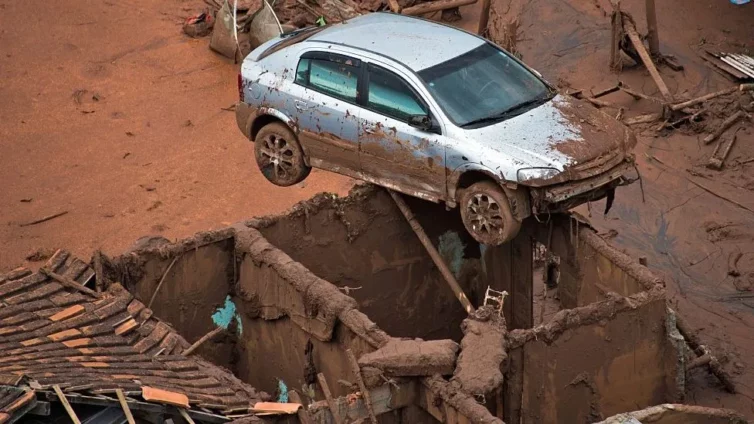
The collapse of the Fundão dam in the south-east of the country caused a giant mudslide that killed 19 people.
It also severely polluted the Rio Doce river, compromising the waterway to its outlet in the Atlantic Ocean.
It was not immediately clear how much each company is required to pay.
Judge Vinicius Cobucci said the companies were liable for "moral damages", or non-material harm, such as emotional distress suffered by those affected by the incident.
He added that the money, which will be adjusted for inflation since 2015, will be put into a state fund and used for projects and initiatives in the area impacted by the dam collapse.
The ruling came in response to a civil action brought by state and federal public prosecutors.
Vale told the BBC that it had not yet been informed about the ruling.
The company also said that as of December last year, the Renova Foundation, which the firms have been using to make compensation payments, has so far paid out 34.7bn reais.
BHP and Samarco did not immediately respond to requests for comment from the BBC.
The ruling allows for the companies to appeal the decision.
Samarco is a 50-50 joint venture between Australian mining group BHP and Brazil's Vale.
The disaster in Minas Gerais state, which also displaced 700 people, is considered to be one of the country's worst environmental disasters.
When the dam burst, it unleashed a deluge of thick, red toxic mud that wiped out the village of Bento Rodrigues.
It also polluted the Rio Doce river and Atlantic Ocean 650km away, devastating wildlife and tainting drinking water for hundreds of thousands of people.
A report released in 2016 found that the collapse of the dam was due to design flaws.
The technical report, commissioned by Samarco's joint owners BHP and Vale, did not assign blame for the disaster.
Dams holding mining waste, known as "tailings", commonly have walls made of a mixture of sand-like particles and clay-like silt.
The report said that a change in the Fundão dam's design between 2011 and 2012 led to less efficient water drainage, and ultimately to the dam's collapse on 5 November 2015.
Sand in the dam walls became saturated, and abruptly started to behave more like a liquid, in a process known as "liquefaction".
A small earthquake on the day of the dam burst may also have "accelerated" the failure, the report added.
The disaster triggered intense scrutiny of safety policies in the mining industry.
BHP and Vale also face a class action lawsuit in the UK with more than 700,000 claimants.
In January 2019, another tailings dam owned by Vale collapsed in the same state near the town of Brumadinho, resulting in 270 deaths.
Latest Stories
-
Auditing the Auditor-General: How special audit understated a COVID-19 expenditure
21 minutes -
A Partnership for Progress: Why the ProMark–KPMG collaboration matters for Africa’s digital assets future
30 minutes -
Catholic Bishops pressure gov’t to sign long-delayed mission schools agreement
2 hours -
Cedi under fresh pressure as Christmas import demand drives dollar surge
2 hours -
Ato Forson eyes first-week November for 2027 Budget, promises jobs and major infrastructure push
2 hours -
Catholic Bishops demand probe into ‘protocol admissions’ amid SHS placement challenges
2 hours -
SHS placement: Catholic Bishops demand probe into alleged payments for school places
2 hours -
Facts about Nigeria’s Dangote oil refinery Initial Public Offering
3 hours -
Trump says AI safety fears a ‘hoax’ as he rejects calls for greater safeguards
3 hours -
Oil climbs as Saudi pipeline outage, fresh attacks heighten supply concerns
3 hours -
Donald Trump Jr and Bettina Trump say Putin ally paid for some wedding festivities as a ‘gift’
3 hours -
Farouk Aliu Mahama supports medical student with GH¢10,000 donation
3 hours -
EU is set to propose ban on social media and AI chatbots for under-15s
4 hours -
No SHS space shortage – GES says 800,000 places available for just over 600,000 students
4 hours -
Emmys 2026: The winners and nominees in full
4 hours