

Audio By Carbonatix
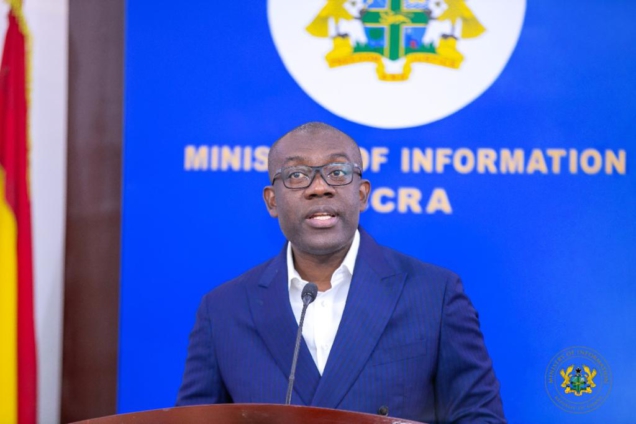
Minister for Information Kojo Oppong Nkrumah has revealed that many agencies operating at the District Assembly level do not report to the Assembly.
He stated that many of these agencies have officers who report directly to officials in the capital, Accra, rather than the District Chief Executive.
Speaking on Joy FM, he mentioned that this causes partial administrative decentralization.
“Therefore, their ability to fit in the local government structure and respond to the issues there is always questioned. That is the administrative decentralisation that he (Dr. Mahamudu Bawumia ) is talking about.”
The comments by the Information Minister follow statements made by the 2024 flagbearer of the NPP during his national address held at the UPSA auditorium in Accra.
While addressing the nation, Dr Bawumia stressed the significance of enhancing the role of the private sector, the need for fiscal and administrative decentralisation, and improving system functionality and institutional performance.
This, he believes, will not only lead to greater efficiency but also ensure value for money in government procurement processes.
“The move towards private sector provision of many public services would create fiscal space of at least 3% of GDP. This represents a major paradigm shift. Additionally, an efficient system of governance will require even fewer ministers,” Dr. Bawumia explained.
He added that his administration plans to reduce the fiscal burden on government by building upon successful initiatives such as the Free SHS and Free TVET introduced during the tenure of Nana Akufo-Addo’s government.
Touching on this, Mr Oppong Nkrumah said the policies which will be implemented by a Bawumia-led administration will help to address the issue of insufficient funding and low revenues recorded at the District Assembly level.
“One of the things I know he has been actively working on is, for example, the remnant of the infrastructure budget and what part of that can be dedicated to lower-level infrastructure.
"It is similar to what in this regime we have tried to do with the Development Authorities which have had its challenges but it circumvents it in a way and ensures that within the national budget, we have had some physical resources allocated for specific district to execute some projects.
“So when he talks about physical and administrative decentralisation, there is a difference between what we are doing now and what he would do if he becomes the leader of the Republic of Ghana on January 7, 2025," Mr Oppong Nkrumah said.
Latest Stories
-
Teacher unions declare nationwide strike over unpaid promotion arrears and delayed negotiations
32 seconds -
Engage Now Africa and LDS church commission boreholes for five communities in Upper East communities
22 minutes -
GPL 2026/27: Karela United bank on home form against Hearts of Oak
30 minutes -
NPLs declined to 15.7% in August 2026
48 minutes -
Existing Cedi notes to remain legal tender alongside Heritage Series – BoG
54 minutes -
Consumer, business sentiments positive – BoG
1 hour -
There’ll be no GH¢500 Cedi note as part of Heritage Series issuance – BoG
1 hour -
Heritage Series Cedi notes to modernise cedi while preserving national identity – BoG
2 hours -
Ghana’s business environment at ‘Inflection Point’ as private Sector takes greater lead — Vish Ashiagbor
2 hours -
At least 2 new airlines could join domestic aviation market by 2027 – GCAA Director General
2 hours -
What if Ghana’s next tourism boom begins with Ghanaians?
2 hours -
Energy Commission to monitor EV charging stations
2 hours -
Invest with confidence, Ghana’s golden era is beginning – Finance Minister
2 hours -
Do Ghana to launch The Great Ghana Day Out on World Tourism Day
2 hours -
Clean up our politics before politics cleans us up
3 hours