

Audio By Carbonatix
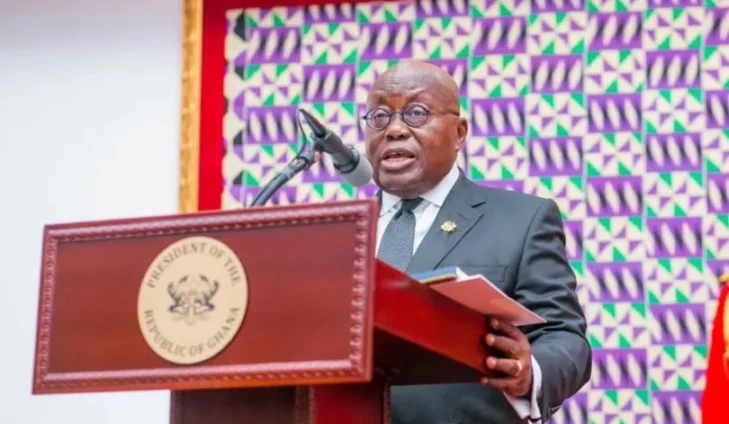
President Akufo-Addo announced on Tuesday, February 27, that Ghana had reclaimed its status as Africa’s largest gold producer, surpassing South Africa.
He said that was because of the progressive policies that the government had implemented, which has led to the revival of dormant mines like the Obuasi and Bibiani Mines, and the expansion of existing ones.
“Our gold production reached an unprecedented four million ounces, according to preliminary reports. The reduction in withholding tax on unprocessed gold by small-scale miners, from three per cent to one and a half per cent has resulted in some 900 per cent increment in gold export from the small-scale sector, over the last two years.
“Leveraging on these resources, we introduced the innovative Gold for Oil Policy, which accounts for some 30% of our total crude oil consumption,” he said.
President Akufo-Addo made this known when he delivered the State of the Nation’s Address on Tuesday, in Parliament.
He said that three large-scale mines were currently under development in the Ahafo, Upper East, and Upper West regions, with Cardinal Namdini planning to pour its first gold in the Upper East Region in the fourth quarter of this year.
“With these new mines, our gold production is expected to increase to some four point five million ounces (4.5 million oz) annually.”
The President stated that to add value to these amounts of production, the government has built a 400-kilogram gold refinery through a public-private partnership and is in the final stages of negotiating a London Bullion Market Association (LBMA) Certificate.
“For our green minerals, including lithium, we have put in place a policy for their exploitation and management, to ensure beneficiation across the value chain of these critical minerals.”
On Irrigation, the President said the government had begun the development of 7,100 hectares of irrigation infrastructure in five identified economic enclaves within the Afram Plains Agricultural Zone.
He said work was also continuing towards the completion of the Tamne Phase III Extension and Vea Irrigation Schemes, saying this would make an additional 1,250 hectares of irrigable land available for cultivation of rice and vegetables.
He said the Ghana Irrigation Development Authority would continue with the development of small earth dams in the Northern, Upper East, Upper West, North East and Savannah Regions to support the “One- Village, One Dam” (1V1D) Initiative.
Latest Stories
-
NPP’s 2024 Bolgatanga Central Parliamentary Candidate elected Upper East Regional Chairman
9 minutes -
Incumbent Northern NPP Chair wins as new faces break through in party executive elections
13 minutes -
Former Health Minister Okoe Boye elected NPP Greater Accra Regional Chair
28 minutes -
Joseph Kobinah Esibu elected NPP Central Regional Chairman
38 minutes -
Fernandez booed by Chelsea fans as Alonso offers glimpse of blueprint
45 minutes -
PSG sign World Cup winner Torres from Barcelona
54 minutes -
Odeneho Kwaku Appiah beats former EPA boss Kokofu, to emerge NPP Ashanti chair
57 minutes -
TDC defends statutory mandate, says its authority to develop Tema predates TMA
59 minutes -
Ignatius Kwesi Afrifa elected NPP Western Regional Chairman
1 hour -
Galamsey will be a key issue for NPP’s 2028 campaign – Annoh-Dompreh
1 hour -
Makafui Woanyah retains NPP Volta Regional Chairmanship
1 hour -
Ghana Law Society announces maiden annual Bar conference for September 30
1 hour -
Abronye DC retains NPP Bono Regional chairmanship
2 hours -
NSMQ 2026: Check out the 147 schools battling in 49 preliminary contests
2 hours -
NPP rebuilding to reclaim parliamentary seats lost in 2024 – Annoh-Dompreh
2 hours