

Audio By Carbonatix
The Public Affairs Manager of Cocobod, Fiifi Boafo, has attributed the decline in production to adverse weather conditions.
According to him, the significant impact of weather patterns on cocoa cultivation, including heavy rainfall at the start of the cocoa season is a primary concern.
While acknowledging that rainfall is essential for cocoa production, he noted that the excessive precipitation experienced this season hindered the fruiting process, thus reducing the expected harvest.
Furthermore, Mr Boafo highlighted the detrimental effects of severe harmattan conditions on cocoa pods, exacerbating the situation.
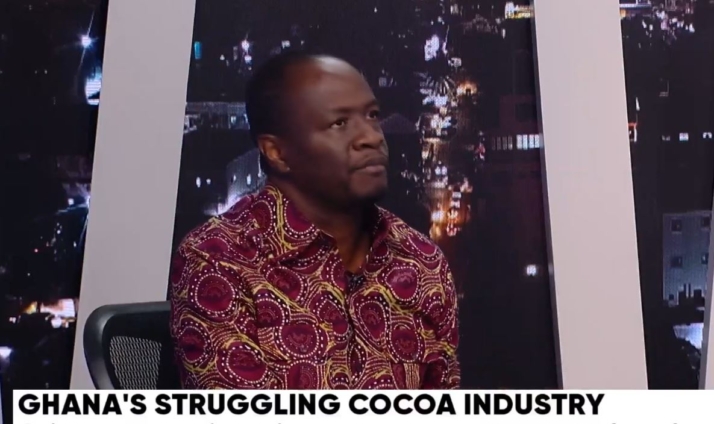
Mr Boafo gave this explanation when he was contributing to a discussion on Ghana’s struggling cocoa industry on JoyNews’ PM Express on Wednesday, March 27.
“The major contributory factor for low cocoa production is the weather situation we’ve experienced this cocoa season. It started with a heavy rainfall. Then it got to a time where you expected the pods you had to develop for you to harvest then we experienced severe harmattan.
“So this El Niño challenge is largely a contributory factor to the low production we experienced this year,” he told host Evans Mensah.
Mr Boafo also highlighted the swollen shoot disease that has plagued cocoa production.
Giving more details, he said about 590,000 hectares of cocoa farms in Ghana have been affected by the said disease.
Given that, these farms are under rehabilitation and are not producing cocoa beans at the moment.
“At the moment, about 590,000 hectares of cocoa farms in Ghana have been affected by swollen shoot and so it is affecting production. Indeed, we are rehabilitating some of these affected farms. And since the only known solution is cutting the affected trees, all the affected farms are not fruiting at the moment, “he said.
Ghana, one of the world’s leading cocoa producers, has been grappling with declining cocoa production in recent years.
The challenges posed by unpredictable weather patterns, illegal mining, and smuggling among others further exacerbate the already existing pressures on the industry, with repercussions felt both domestically and globally.
Currently, there is a global shortage of cocoa beans, thus shooting up the price of one tonne of cocoa to an unprecedented amount of $10,000.
However, research shows that Ghana might not significantly benefit from this increment since cocoa production has also significantly dropped this year.
Latest Stories
-
Kushner states regret over World Cup sell-off plan
1 hour -
50,000-litre LPG tanker fire contained on Tema Motorway as Fire Service averts disaster
1 hour -
Supreme Court clears way for Trump to keep building White House ballroom
2 hours -
Amazon rigged billions in ad pricing, lawsuit from states and US watchdog alleges
2 hours -
US singer D4vd’s celebrity lawyers withdraw from murder case
2 hours -
How Shein lost its shine ahead of long-awaited stock market debut
2 hours -
Allround Baby Pants launched in Ghana to ease diapering for mothers
3 hours -
Aggrieved Gold Coast Fund Management Company customers to petition Mahama over locked-up funds
3 hours -
NSMQ 2026: PRESEC, Legon dethrones defending champions Mfantsipim in thrilling battle to book semi-final spot
3 hours -
NPP set to overhaul constitution as delegates prepare to vote on sweeping reforms
3 hours -
Ghana’s cashew industry faces processing gap as Côte d’Ivoire moves to capture more value
4 hours -
“Our greatest wealth is not in our soil but our people” — Upper West Minister
4 hours -
Luex Healthcare launches children’s health education book series with Luey the Lion
4 hours -
NAGRAT urges gov’t to communicate early if September deadline cannot be met
4 hours -
We trust government to meet September deadline on teachers’ promotions – NAGRAT
5 hours