

Audio By Carbonatix
The Governor of the Bank of Ghana (BoG) opened up about the tumultuous banking sector crisis that unfolded in 2017 and the decisive actions that reshaped Ghana’s financial landscape.
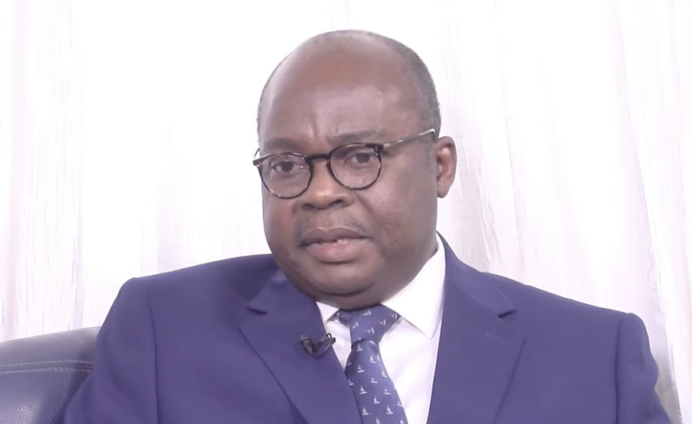
With a firm stance in a revealing interview on Joy News’ PM Express Business Edition on January 2, Dr Ernest Yedu Addison, justified the revocation of banking licenses as a critical move to restore stability and confidence in the sector.
Dr Addison painted a grim picture of the banking sector he inherited in 2017. “Sometimes people forget very easily,” he said.
“Women with babies strapped to their backs were being beaten in banking halls because they couldn’t withdraw their money from microfinance institutions. The chaos was undeniable.”
According to the Governor, the sector had devolved into a near Ponzi scheme, leaving depositors without confidence in financial institutions.
“The financial system is supposed to promote savings and channel those savings into investments to support growth. But what we had was a system that had lost public trust,” he stated.
Dr Addison emphasised that the revocation of banking licenses was unavoidable.
“When I give you a bank license, I am giving you permission to take people’s money, but the money is not yours,” he explained.
The Governor detailed the widespread malpractices that plagued the sector.
“Shareholders were taking depositors’ money and using it to run their own businesses. That’s not banking,” he said.
“Some of the funds were being used for brick-and-mortar investments that weren’t liquid enough to meet withdrawal demands. It was a complete disregard for the rules of banking.”
The collapse of Capital Bank and UT Bank in August 2017 marked the beginning of the sector’s cleanup. Over time, other poorly managed institutions were removed, making way for stronger, better-governed banks.
“We cleaned up the system to allow the banking sector to play its rightful role in a market economy like ours,” Dr Addison affirmed.
The IMF’s Role and Prior Actions
Dr. Addison also revealed the International Monetary Fund’s (IMF) involvement in addressing the crisis.
“The IMF flagged the banking sector crisis as a major challenge when I took office,” he said.
Policies to address the issues had been discussed with the previous administration, but no action had been taken.
“By the time we came in, these policies had reached the point of becoming prior actions—either you implemented them, or there wouldn’t be a program for Ghana. It was as simple as that.”
Despite the controversies surrounding the cleanup, Dr. Addison expressed pride in the BoG’s achievements.
“The Bank of Ghana received an international award for the very effective cleanup of our banking system, and I think we should value that,” he said.
The Governor highlighted the transformation of the sector post-cleanup.
“Today, the banks that remain are well-capitalised and adhere to stronger corporate governance standards. They are properly managed and supervised,” he noted.
Reflecting on the challenges and successes, Dr. Addison underscored the importance of vigilance in financial regulation.
“A banking license is a special kind of instrument. It comes with responsibilities and rules that must be respected. The actions we took were justified to protect depositors and ensure the stability of the financial system,” he asserted.
The Governor’s bold decisions during the crisis ultimately set the stage for a more robust banking sector.
“It was not an easy road, but we’ve emerged stronger,” he concluded.
Latest Stories
-
Who paid for it? – NPP MP demands audit trail of Ghana’s South Africa evacuation
4 minutes -
Security analyst calls for review of Vigilantism Act to address emerging threats
8 minutes -
Gillman & Abbey Funeral Service and Remembers Group partner to preserve legacies and expand funeral services in Ghana
14 minutes -
NSMQ 2026: Ghana National College stays seeded as St Monica’s, Presby SHS fall in One-Eighth
15 minutes -
Minority caucus demands full account of Ghana’s South Africa evacuation spending
17 minutes -
Ghana’s rail network declines sharply over six decades – World Bank
23 minutes -
NSMQ 2026: Prempeh College avenges 2018 defeat to WASS, storms into quarter-finals
28 minutes -
Meta settles with US states over social media harms
30 minutes -
Viral Black Stars supporter ‘Powder Man’ granted GH¢400,000 bail in alleged visa fraud case
32 minutes -
What Mahama’s 10 new laws mean for cocoa farmers, workers, importers and businesses
54 minutes -
Major underground drainage works to begin on Dr Busia Highway on September 7
57 minutes -
Man City to make offer for £120m-rated Enzo Fernandez
57 minutes -
Wontumi’s withdrawal won’t make significant difference to NPP chairmanship race – Asah-Asante
1 hour -
Chinese teens are turning to mind-numbing drugs to ‘run away from reality’
1 hour -
CIA chief met Russian intelligence services but not Putin, Kremlin says
1 hour