

Audio By Carbonatix
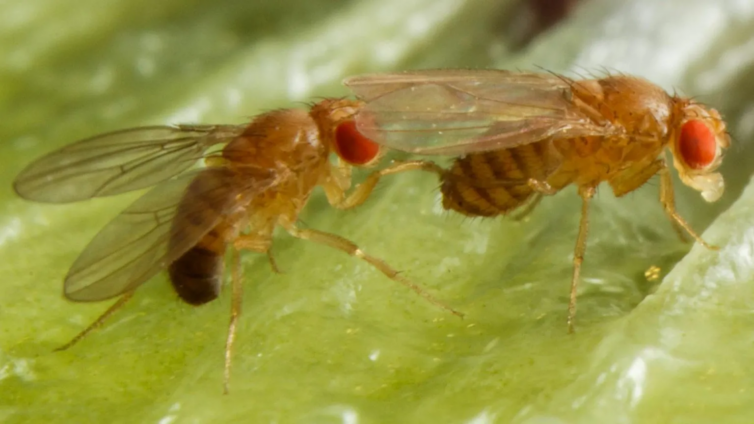
Male fruit flies that drink alcohol become more attractive to females, according to a new study.
Adding alcohol to males' food increases their release of chemicals that attract females and leads to higher mating success.
Fruit flies, or Drosophila melanogaster, are often found around our food waste bins as they feed on rotting fruit which gradually produces alcohol.
Scientists have been trying to study why they are attracted to alcohol and how it affects them.
Previous research has studied different theories about this attraction, such as the flies were seeking a euphoric state or a substitute for the high of mating among males rejected by females.
Study author Bill Hansson, head of the Department of Evolutionary Neuroethology at the Max Planck Institute, said such research has taken an anthropomorphic view of fly behaviour, whereas this latest study suggests drinking alcohol gives the flies a reproductive advantage.
"We don't think flies drink alcohol because they are depressed," he said.
The fly's attraction both to the carbohydrates and yeast in rotting fruit, as well as to the alcohol, cannot be separated, he added.
In the study, alcohol, and particularly methanol, increased the males' production and release of chemical sex signals, called pheromones, which made them more attractive to females.
Pheromones are released into the air from one individual to influence the behaviour of another animal of the same species.
Males were therefore strongly attracted to alcohol, especially those males which had never mated.
The new study also showed that the fly's response to smelling alcohol is controlled by three different neural circuits in its brain.
While two are responsible for attracting male flies to small amounts of alcohol, a third ensures that excessive amounts have a deterrent effect.
Because alcohol is toxic, the fly's brain must carefully weigh the risks and benefits of drinking it, and it does this by balancing signals of attraction with aversion.
"This means that the flies have a control mechanism that allows them to get all the benefits of alcohol consumption without risking alcohol intoxication," lead author Ian Keesey, of the University of Nebraska, said.
For their investigations, the researchers combined physiological studies - such as imaging techniques to visualise processes in the fly brain, chemical analyses of environmental odours, and behavioural studies.
The paper is published in the journal Science Advances.
Latest Stories
-
Pay me by Sept. 11 or face the court – Kow Essuman demands salary, benefits from Finance Minister
17 minutes -
Bawumia’s destiny lies in the hands of God; not you – Muslim Forum for Peace and Unity replies Rev. Owusu Bempah
18 minutes -
NPP NEC meets today to discuss and approve party’s position paper on Constitution Review proposals
25 minutes -
Today’s frontpages: Thursday, September 10, 2026
32 minutes -
Ghana Garden and Flower Show returns on Sept 11 with focus on green jobs, business and wellbeing
33 minutes -
Titus-Glover camp says Mustapha Salam wasn’t pressured to withdraw from National Organiser race
35 minutes -
Ghana’s acclaimed Christian – Muslim unity bigger than Owusu Bempah’s hatred and bigotry – Muslim Forum for Peace and Unity
37 minutes -
Karpowership lights up young minds on International Literacy Day
47 minutes -
Banking sector NPLs fall to GH¢19.9bn as asset quality improves
50 minutes -
Republic Bank Ghana, UPSA sign strategic MoU to advance professional development and industry-academia collaboration
55 minutes -
MTN 30th Anniversary CEO Invitational Golf Tournament set to tee off at Achimota
58 minutes -
Ghana woos Australian investors into critical minerals
1 hour -
Akufo-Addo’s former legal counsel Kow Essuman, writes to Finance Minister to demand his ex-gratia payment
1 hour -
NSMQ Final: St Augustine’s get GH¢120,000 motivational package from old boys
2 hours -
AFCON 2027: Ghana has no business doing football if we can’t beat Somalia and The Gambia to qualify – George Afriyie
2 hours