

Audio By Carbonatix
The Bank of Ghana Governor Dr. Johnson Asiama has revealed that the central bank is moving towards risk-sensitive regulation and a system award model for regulating the banking sector.
According to him, this is not just about enforcing compliance but rather “shaping a banking system, that is agile, accountable, and prepared for the future”.
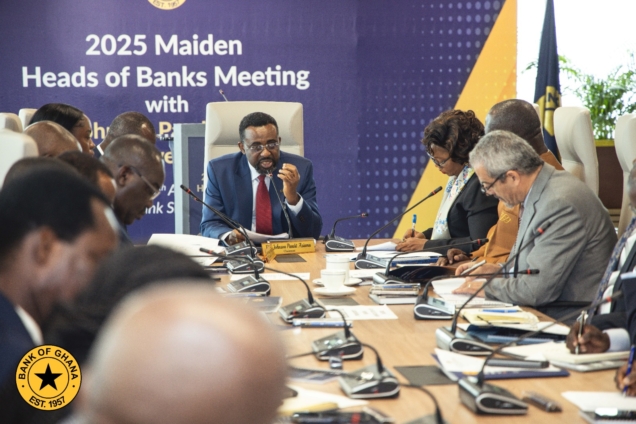
The Governor announced this at a meeting with Heads of Commercial Banks at the Bank Square. This is part of a strategy to engage heads of commercial banks after every Monetary Policy Committee meeting.
In attendance were chief executives or representatives of regulated banks in Ghana and officials of the Bank of Ghana, including the 1st Deputy Governor, Dr. Zakari Mumuni.
Key Focus Areas for Regulation
The Bank of Ghana Governor noted that the first step will be risk identification and mitigation.
According to him, this will focus on the use of data analytics and early warning indicators to identify emerging risk.
The 2024 Fraud Report revealed a 5.0% increase in fraud cases and a 13.0% rise in value at risk.
According to the Governor, this will need “reinforcing the urgency of stronger internal controls and oversight”.
The central bank will also focus on building digital resilience as part of regulating the banks.
Dr. Asiama advised banks to assume greater responsibility for the safety of their systems, product integrity, and customer protection, adding that “banks must invest significantly in product security features, expand public financial education”
Another area the Governor highlighted is governance and compliance.
Dr. Asiama revealed that the Bank of Ghana will be depending on its supervision in the area of “board effectiveness, compliance culture, and accountability across all levels of institutions.”
He added that “Compulsory Basel III & IV Training for all Bank Directors to enhance regulatory knowledge and governance among bank directors, is under consideration”.
The rest of the areas that will be critical for the Bank of Ghana include enhancing collaboration, which the Governor believes “should be done by co-creating solutions and not merely enforcing rules”.
The rest are building capacity for future challenges and prioritising sustainable oversight, especially credit risk and reputational exposure.
Latest Stories
-
Are we marketing Ghana before fixing the experience? A hard question for our tourism ambition
45 seconds -
AFCON 2027Q: Prince Adu Kwabena major doubt for Ghana after head injury
2 minutes -
Government to procure furniture to help more SHSs move from double-track — Haruna Iddrisu
9 minutes -
Adutwum spokesperson alleges ‘turf war’ between Education Ministry and GES over Free SHS
11 minutes -
Black Stars: Adu Kwabena a doubt for September-October games after head injury
23 minutes -
Fire guts four-bedroom apartment at Millennium City
25 minutes -
KMA seeks funding to restart stalled Kumasi Central Market Phase II project
45 minutes -
Government unveils new guidelines to improve regulation of non-profit organisations
50 minutes -
Annoh-Dompreh cautions against partisan application of law in political speech cases
57 minutes -
Oti Peace Council sensitises Assembly Members in Jasikan, Kadjebi on conflict prevention
1 hour -
Nawara petitions Ghana Police over alleged armed raid, gold seizure and destruction of mining equipment
1 hour -
Ahafo Ano South West DCE Abubakar Sedik dies after brief illness
1 hour -
Ghana must draw lessons from Nkrumah’s Seven-Year Development Plan — Kwesi Pratt
1 hour -
Oil hits over 1-week low on hopes of boost to diplomacy in Iran war
3 hours -
They take GH¢100, sometimes GH¢200 – Okada riders allege police extortion in Accra
3 hours