

Audio By Carbonatix
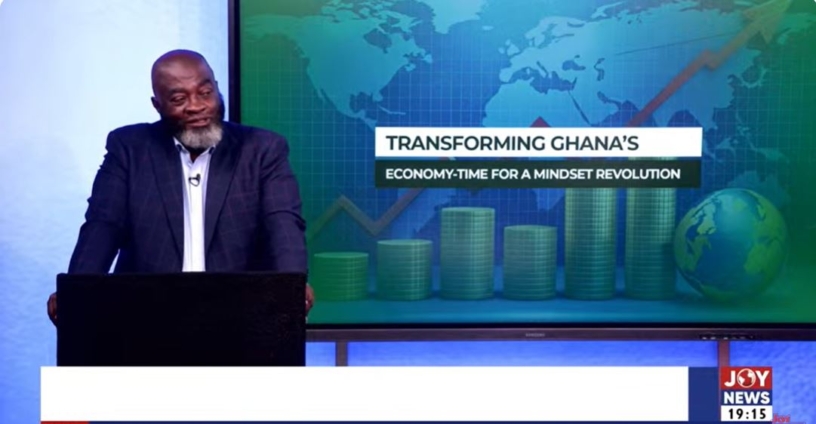
Founder and Senior Partner at AB and David Africa, David Ofosu-Dorte, has said that Ghana is more dependent today than it was before gaining independence, raising deep concerns about the country's mindset, productivity, and political culture.
Speaking at the JoyNews and Amalgam of Professional Bodies Speaker Series, Mr Ofosu-Dorte traced the roots of Ghana’s deep-seated disempowerment to a historical lineage of chieftaincy, slavery, and colonisation.
According to him, these experiences have left an indelible mark on the national psyche, affecting generations and creating a society that struggles with true autonomy.
He challenged the traditional interpretation of Ghana's independence, arguing that the nation never truly achieved full independence but rather transitioned into self-rule without dismantling the systems of dependency.
“So far as I'm concerned, we were never a dependent nation in the true sense," he noted. "Dependence means being entirely reliant on others. What we attained was self-rule, but ironically, it appears we are more dependent today than we were previously."
He lamented that over the years, post-colonial leadership — whether civilian or military — and now multi-party democracy, have worsened this culture of dependence. Citizens increasingly expect politicians to be the sole agents of national transformation, a mindset he says has led to political sycophancy and worsened national disempowerment.
"Unfortunately, multi-party democracy, which was supposed to liberate us, has led to a situation where citizens align with parties primarily for personal gain, deepening the worship of leaders even more," he said.
Drawing on examples from global history, Ofosu-Dorte compared Ghana's lack of bold, transformational projects today to the ambitious national efforts of the 1960s, such as Russia’s launch of Sputnik One, America’s moon landing, and China’s aggressive modernization under its "996" work culture. He emphasized the urgent need for Ghana to reignite a spirit of ambition and hard work.
"In a country with very low productivity, increasing productivity through various means is essential," he added. "If we don't rebuild a confident, hardworking society, the transformative change we hope for will remain elusive."
Latest Stories
-
Challenging Heights rescues 25 trafficked children from Lake Volta in weekend operation
6 minutes -
‘Nobody has any video of me embarrassing myself’ – Afenyo-Markin on ‘extortion’ allegation
12 minutes -
Government listening to ordinary Ghanaians with diesel relief – Duncan Amoah
12 minutes -
Photos: Manya Krobo Ngmayem Festival turns 133
23 minutes -
Government must go beyond short-term fuel relief – COPEC
24 minutes -
‘Revive traditional values to fight plastic pollution’ – EPA CEO
28 minutes -
Mahama’s administration is Ghana’s worst ever – Amin Adam
36 minutes -
BSIFF 2026 puts local language cinema at the centre of African film conversation
42 minutes -
MMFL makes strong showing at 2026 JoySports Invitational
43 minutes -
NPP vetting was candid and went beyond routine questions – Afoko
43 minutes -
CIIG 6th Insurance Excellence Awards highlights need to protect professional standards
50 minutes -
GEXIM Bank’s interest income surges 90% to GH¢153.9m – SIGA report
51 minutes -
GNFS rescues man trapped beneath loaded truck after it overturns at Kibi
52 minutes -
African Union backs Sudanese-led dialogue to end conflict
52 minutes -
VRA reverses GH¢106m loss to record GH¢88m profit in 2025
54 minutes