

Audio By Carbonatix
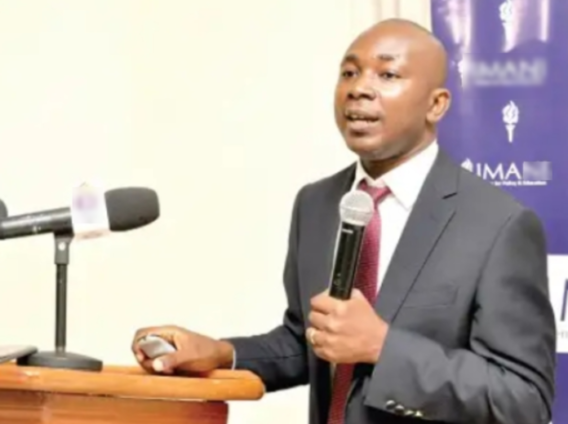
Economist Prof. Godfred Bokpin has warned that government cannot continue on its current fiscal path into 2026.
He says the government must begin to align its budget with the promises it made to Ghanaians.
“From 2026, 2027, government will have to operate its own budget, reflecting largely the promises it made to the electorate,” Dr. Bokpin said on JoyNews’ PM Express on Monday, May 12.
He noted that much of what is happening this year is not enough. “We are not doing much this year,” he said.
“Getting the cedi stabilised and all of that, it’s good news to some extent, but I am not in favour of major disruptions in the market.”
He said Ghana should be building long-term confidence.
“I would prefer that we accumulate the reserves that allow confidence to be sustained for a much longer period, even beyond five or 10 years.”
For him, the 2026 budget makes it clear. “It shows that we cannot continue on the path of expenditure-based fiscal consolidation to sustain the cedi.”
He stressed that stabilising the currency should not come at the expense of real economic transformation.
“You see the Asian growth dynamics, and you want to link it to whether there’s also a significant improvement from an interest rate point of view.
"And whether that translates to a lower cost of borrowing. And how all of that aligns with export diversification and realisation policy.”
Dr. Bokpin said the big question is whether these policies are actually working together.
“We want to be sure all these things link up in building the economy.”
He pointed to the cost of producing goods locally as a key issue.
“Let me give you an example. How does this lend well to local production of goods versus imported goods?”
He said the data shows a worrying trend.
“From November 2023, inflation on imported products actually rose higher than local inflation. So it means we were better off importing than producing here.”
That, he said, is dangerous for the private sector.
“What does that mean for the competitiveness of the indigenous private sector, those who produce here?”
Dr. Bokpin acknowledged recent positive inflows.
“In a certain sense, we can say that yes, we’ve seen the inflows, and that is playing out.”
But he warned that without deeper reform, it won’t last.
“So in my estimation, for the rest of this year, there’s a future for this path. But we have to stabilise it.”
For him, the message is simple. Ghana’s current fiscal strategy has an expiry date. “From 2026,” he said, “you’re on your own.”
Latest Stories
-
If CJ needs ethics law to know SOE comments were wrong, he may not be worthy of office – Arthur Kennedy
35 minutes -
Stop touring state agencies and focus on the Judiciary’s problems – Arthur Kennedy to CJ
41 minutes -
Apologise and don’t do it again – Arthur Kennedy to Chief Justice over SOE comments
46 minutes -
Chief Justice remains committed to judicial independence, justice and equality – Judicial Service
1 hour -
Ghana concludes evacuation of citizens from South Africa; total returnees reach 1,900 – Ablakwa
2 hours -
Africa must define its own green transition path – Prof Fatima Denton
2 hours -
WASSCE 2026: English Language performance falls to 62.4% – WAEC
2 hours -
WASSCE 2026: Social Studies records sharp rebound as Maths, Science also improve
3 hours -
2026 WASSCE entry rises by 11% as 512,862 candidates sit exams
3 hours -
WASSCE 2026: English Language performance falls to 62.4% – WAEC
3 hours -
WAEC cancels 2026 WASSCE results of 8,295 candidates over examination irregularities
3 hours -
WAEC releases provisional 2026 WASSCE results for 512,862 candidates
4 hours -
CJ’s remarks on SOEs were made in good faith, not to undermine judicial independence – Judicial Service
7 hours -
Bright Future Alliance pays courtesy call on Akufo-Addo, invites him to African Leaders of Influence Lectureship Series
7 hours -
This is an attempt to break the Minority caucus – Patricia Appiagyei on alleged GH¢70k payment
7 hours