

Audio By Carbonatix
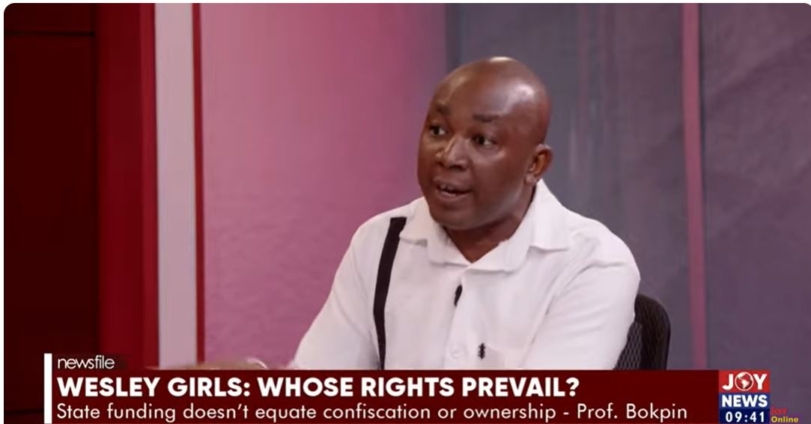
Economist and Finance Professor at the University of Ghana, Professor Godfred Bokpin, has urged the government and the public to approach current debates on religious rights in mission schools with caution, warning that any reforms must not erode the identity or long-standing investments made by these institutions.
His comments come amid intensifying national conversations following the Supreme Court’s directive to Wesley Girls’ High School to respond within 14 days to claims that Muslim students face restrictions on prayer, fasting, and the wearing of hijab.
Speaking on JoyNews' Newsfile on Saturday, November 29, Prof. Bokpin stressed that mission schools—Christian or Muslim—have historically partnered with the state in delivering quality education, and their rights over the schools must be respected.
“If we look at it in totality, the state grants space for mission schools to preach, and this partnership has been sustained for decades. No religious body will give up its right over its mission schools—they won’t,” he said.
He noted that it is inherently difficult for any religion to fully exercise its practices inside mission schools of another faith, and this reality should be acknowledged rather than denied.
“I believe we should be moving towards unity that recognises diversity,” he said. “We must promote tolerance that gives each group a safe space to operate. As the state supports all institutions, that approach becomes more sustainable.”
Prof. Bokpin drew from his personal experience attending a Muslim mission school, explaining the nuanced differences even within Islamic groups. Orthodox Muslims, he said, often feel uncomfortable in Ahmadiyya schools due to differences in belief and teaching—yet the Ahmadis were among the earliest to embrace Western-style education and invested heavily in establishing schools.
He commended the progress Muslim communities have made in promoting education, especially for girls, describing it as a “momentum shift” from past practices.
However, he emphasised that this new appreciation for formal education must not become a basis to dilute, override, or undermine the values upon which mission schools were built.
“This late realisation should not grant anyone the right to weaken mission schools for the investment they have made over the years,” he cautioned. “They have contributed significantly to national development.”
Latest Stories
-
Adipa residents give government seven days to halt Agbogbloshie waste transfer
6 minutes -
Desks rotting in abandoned Kintampo South E-Block: A decade of neglect and a waste of state resources
8 minutes -
West Africa cannot simply import security models without accounting for local realities – WAMS
9 minutes -
Bono East Minister directs MCE to stop hotel project near Konkrompe SHS
31 minutes -
AGN Chair urges action-driven tracking and reporting on inclusive climate adaptation in Ghana’s agriculture
34 minutes -
Man City rule breaches not my concern – Mancini
34 minutes -
NSA releases PIN Codes for 2026/2027 national service private candidates and foreign-trained graduates
37 minutes -
GMet forecasts thunderstorms, rain across parts of Ghana this evening
39 minutes -
APRA wins Africa PR Legacy Award
42 minutes -
UN Special Rapporteur on adequate housing to visit Ghana
45 minutes -
Telecel Ghana concludes SME Month 2026 with Business Runway in Takoradi
52 minutes -
Ghana must embrace AI to transform tourism — GHATOF
53 minutes -
National Investment Quiz: Corpus Christi, Wesley Girls, advance to semi-finals
1 hour -
Is Ghana losing the fight to protect children online?
2 hours -
Ghana Institution of Surveyors pushes for Governing Council Bill, conference reforms
2 hours