

Audio By Carbonatix
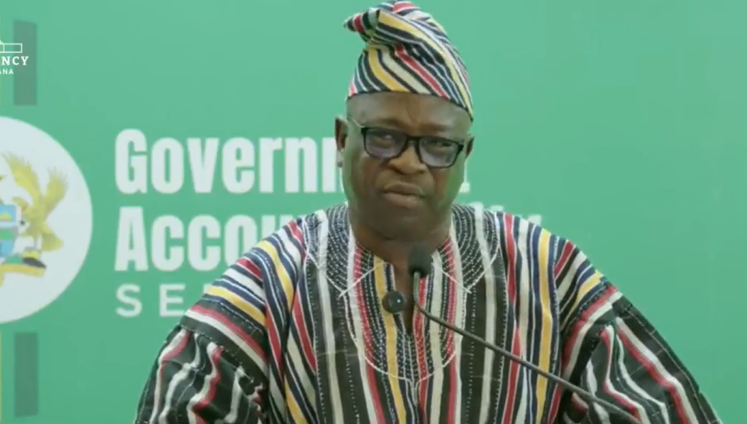
The Minister for Climate Change, Seidu Issifu, has stressed that climate action must be treated as a strategic investment critical to Ghana’s economic growth and long-term stability, rather than as charity.
Speaking at the Government Accountability Series on Wednesday, May 6, he said Ghana is positioning itself as an active player in global climate efforts, with a focus on aligning climate initiatives with national development priorities.
“Climate action is not a charity. It is a strategy. It is an investment in Ghana’s future stability, resilience, and prosperity,” he stated.
Mr Issifu noted that his office is working to ensure Ghana plays a more influential role in shaping global climate solutions, rather than remaining a passive recipient of support.
“The office remains committed to ensuring that Ghana is not simply a recipient of climate support but a proactive partner, shaping solutions and advancing sustainable development,” he added.
He explained that ongoing efforts are aimed at strengthening Ghana’s position within global climate finance systems, while improving the country’s capacity to attract sustainable, long-term investment.
These efforts, he said, are aligned with key national priorities, including the transition to cleaner energy, industrial growth, and infrastructure development.
According to the Minister, his office has supported several initiatives, including the expansion of solar rooftop systems and distributed renewable energy, the integration of climate considerations into the government’s 24-hour economy programme and the Big Push infrastructure agenda, as well as the promotion of green industrial zones.
He added that partnerships have been strengthened to advance renewable energy, electric mobility, and technology transfer.
“Our approach is clear. Climate action must support Ghana’s research agenda on industrial transformation, create new economic opportunities, and strengthen long-term energy security. It must power development rather than slow development,” he said.
Despite these efforts, Mr Issifu acknowledged significant challenges confronting Ghana’s climate agenda, particularly in accessing and utilising climate finance.
He identified limited technical capacity in carbon markets as a major constraint, especially in areas such as project development, measurement, reporting, verification systems, and regulatory frameworks.
“There is still limited technical capacity in carbon markets, particularly in areas such as project development, measurement, reporting, and verification systems and regulatory frameworks,” he said.
He also pointed to delays in accessing international climate finance due to complex accreditation processes.
“We continue to face slow and complex accreditation processes for accessing major climate finance mechanisms such as the Green Climate Fund and the Adaptation Fund,” he noted.
Mr Issifu further highlighted declining levels of grant-based funding and increasing competition for concessional resources as emerging concerns.
“There is a growing donor fatigue, with declining levels of grant-based climate finance and increasing competition among countries for limited concessional resources,” he said.
He warned that reliance on loan-based financing poses risks to the country’s fiscal stability.
“There remains a heavy reliance on loan-based climate finance, which raises concerns around debt sustainability and fiscal pressures,” he added, calling for a shift towards more grant-based and concessional funding.
According to the Minister, these challenges underscore the need for reforms and innovation in Ghana’s climate financing approach.
“These realities underscore the urgency of reform and innovation. They reinforce the need to build stronger institutions, develop new finance models, and position Ghana not only to access climate finance but to deploy it effectively,” he stated.
Looking ahead, Mr Issifu said government will prioritise scaling up funded climate programmes, securing accreditation for national institutions, and expanding renewable energy and climate-resilient infrastructure.
Other priorities include developing bankable climate projects, deepening participation in carbon markets, and strengthening monitoring and reporting systems.
“Our long-term objective is to position Ghana as a regional leader in climate resilience, sustainable industrialisation, and climate-smart investment,” he concluded.
Latest Stories
-
T-bills auction: Government exceeds target marginally; yield on 91-day bill remains unchanged
2 hours -
GPL 2026/27: 10-man Aduana hand Kotoko defeat in Kumasi
2 hours -
GPL 2026/27: Medeama ease past Basake Holy Stars
2 hours -
Appiah Adomako writes: Why DVLA must stop treating every expired licence holder as delinquent
2 hours -
Localization must transfer decision-making power, not just project responsibilities
3 hours -
Modernising Ghana’s traditional markets through the 24-Hour Economy markets initiative
3 hours -
New economy will boost local production and create jobs – Finance Minister
3 hours -
Real-Time VAT on cross-border digital services – not a new tax and does not violate double taxation principle
4 hours -
Digitalisation, AI key to Ghana’s tourism transformation – GHATOF
4 hours -
Stronger GTA-private sector partnership needed to grow tourism – GHATOF
4 hours -
Amazon eyes Ghana for broadband expansion after talks with Mahama
5 hours -
National Investment Quiz 2026: Six schools qualify for quarter-finals
5 hours -
‘Do not let Russia pay for its madness with lives of your people’ – Zelensky to Ghana, 46 other countries
5 hours -
6,079 promotion cases fully processed and paid – CAGD says amid nationwide teachers’ strike
6 hours -
Teacher unions to meet government Monday over nationwide strike
6 hours