

Audio By Carbonatix
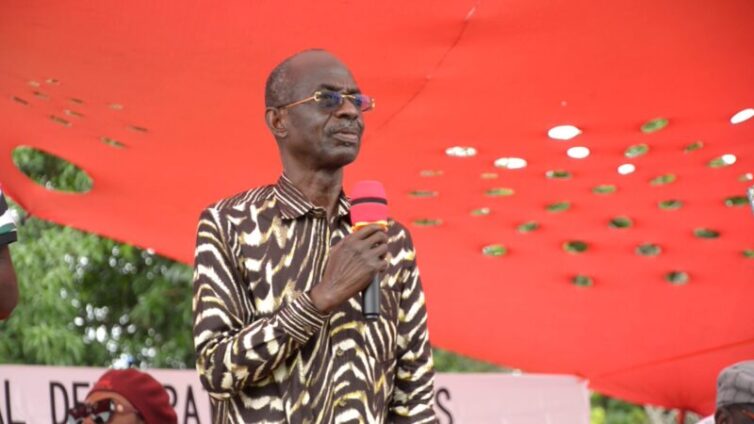
National Chairman of the NDC, Johnson Asiedu Nketia, says the power to appoint District Chief Executives (DCEs) has become a poisoned chalice that political parties should willingly surrender in favour of local democracy.
In a frank conversation on JoyNews’ PM Express on Wednesday, June 25, the veteran politician made a compelling case for elected DCEs, calling the current appointment system both politically damaging and deeply undemocratic.
“No, it’s not a pleasant activity,” he admitted when asked about his experience supervising DCE nominations within the party.
“Trying to choose among party people as to who should be a DCE — that is not a power anyone should be proud to hold.”
He illustrated the dilemma vividly. “In some districts, more than 20 people apply. Whatever the case, the position is one.
"You are going to make just one choice, and after that, you have 19 people, funnily looking at you.” For him, the conclusion is clear: “You are better off allowing them to go and contest — and the winner sworn in.”
Asiedu Nketia’s call aligns with a long-standing push by civil society and governance advocates for local government reform.
Ghana’s current system gives the President the power to appoint Metropolitan, Municipal, and District Chief Executives — a practice many argue undermines accountability and stifles grassroots participation.
When asked whether the NDC’s position supports the election of MMDCEs on a non-partisan basis, the Chairman pointed out that while there is strong consensus on electing them, there is less agreement on whether that process should be political.
“President Mahama is expressing his opinion and then leaving it with the Constitutional Review Committee,” he said.
“We all know there is a push for MMDCEs to be elected, but the same cannot be said about the demand for them to be elected on a partisan basis.”
Pressed by host Evans Mensah on whether supporting non-partisan elections of DCEs could be part of his legacy, Asiedu Nketia was reflective, but firm.
The power to appoint, he implied, had become a burden rather than a privilege.
“Let the people decide,” he repeated — a phrase that underlined his broader argument: decentralisation should mean more than delegation from Accra. It should be ownership by communities of their own governance.
The NDC Chairman’s remarks come at a time of renewed interest in decentralisation reforms, particularly as Ghana debates the shape of its local democracy under the 1992 Constitution.
Though a 2019 referendum on partisan local elections was withdrawn by the Akufo-Addo administration, pressure continues to mount for a new attempt — this time with broader political will.
Latest Stories
-
Police commend Kpando MCE for rehabilitating District Headquarters
11 minutes -
Government adjusts border security and narcotics meeting invitations after Sammi Awuku raises concerns
16 minutes -
Zonda Tec expansion to create 1,000 indirect jobs – Mahama
25 minutes -
Kit Up Ghana Foundation donates jerseys to Achimota Basic School
27 minutes -
The Infrastructure of Resilience: Why Africa’s climate future is an engineering problem we are failing to solve
33 minutes -
I’m not contesting Tema Central in 2028 – TDC boss Nunekpeku
39 minutes -
One Week Observation – Obaapanin Julian Seiwaa Gyimah
47 minutes -
Withholding audit information or underreporting on COVID-19 fumigation is a serious offence—Domelevo
52 minutes -
Mahama urges banks to offer long-term financing for locally assembled cars
54 minutes -
Accra set to go ‘All Out’ as Guinness Ghana DJ Awards 2026 Pub Fest comes off on September 25
55 minutes -
Sterling admits dangerous driving after M3 crash
56 minutes -
Vehicle assemblers must meet local content threshold to enjoy VAT exemption – Mahama
60 minutes -
Health Ministry secures new US employment pathway for qualified Ghanaian nurses
1 hour -
GRIDCo completes 4km, 161kV transmission line linking Yendi Solar to Tamale-Yendi network
1 hour -
Government to regulate EV charging stations to protect power stability – Mahama
1 hour