

Audio By Carbonatix
The Akenten Appiah-Menka University of Skills Training and Entrepreneurial Development (AAMUSTED), Kumasi campus, was filled with emotion, urgency, and a call to action as students gathered for a lecture on Ghana’s growing environmental crisis.
Held in a lecture hall of 105 students, the event drew hundreds of students of BSc Social Studies eager to understand the dangerous effects of galamsey, the illegal small-scale mining practice threatening Ghana’s land, water, and people.
Led by environmental lecturer Dr. Simon Boateng, the lecture peeled back the layers of a national disaster that continues to unfold.
The university, known for its strong academic foundation in entrepreneurship and accounting, also promotes ethical leadership and real-world problem-solving. And the course, environmental issues in Ghana was a clear example of that commitment.
Dr. Boateng showed evidence of how galamsey is affecting waterbodies among others. Through disturbing videos, he brought the crisis into the lecture room: rivers turned brown and poisoned, elderly patients lying in hospital beds, their bodies failing from exposure to toxic water. The mood was somber.
One student, struggling to hold back tears, stood and asked a question that got everyone thinking: “How do we stop galamsey?”
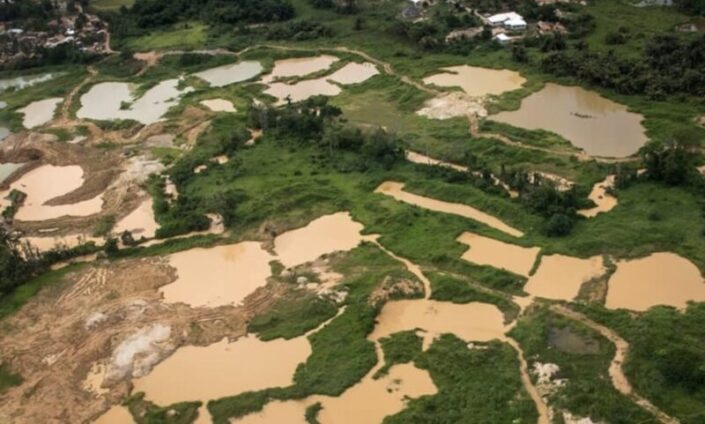
According to a report from the Centre for Remote Sensing and Geographic Information Services (CERSGIS), more than 670 square kilometers of land nearly the size of Singapore has been destroyed by illegal mining. Rivers once full of life are now choked with chemicals like mercury, arsenic, and lead.
These polluted waters are the same ones used daily by rural communities for drinking, farming, and cooking. The damage goes beyond nature, it is killing livelihoods and costing lives. “Our crops are dying, and people are getting sick because of dirty water,” said Nadia Salu, a student lamented.
Dr. Simon explained that Ghana’s environmental issues didn’t start today. The roots stretch back to colonial times, when natural resources were extracted with little concern for environmental consequences. Fast-forward to today, and rivers like the Pra, once used by colonial governors for their final baths, are now so polluted they are unrecognizable.
Key issues covered in the lecture included deforestation, afforestation, land degradation, air and water pollution, and flooding. Dr. Simon explained that floods can happen naturally like from melting icebergs, but many in Ghana are man-made, caused by clogged drains filled with refuse.
He asked, “Did you know some people still drink from the same pond as animals?” The silence that followed said it all.
Student Daniel Asamoah asked a question many were thinking: “How do we fix this?” Dr. Boateng laid out several strategies. First, create employment opportunities in mining communities to prevent the youth from joining illegal operations.
Next, support responsible mining, formalize artisanal mining licenses, and invest in local economies. He stressed that community involvement and policy reform were key, as well as using technology to monitor illegal mining and offering healthcare and support to affected communities.
“Environmental problems are everyone’s problem,” he said. “We need all hands on deck.”
For many, the experience was life-changing. “I never realized the impact of galamsey till I saw that 60-year-old man in the hospital,” said this writer, Fasila Alhassan. “What if it was my mom?”
“Dr. Simon’s passion for conservation is inspiring,” said Herrietta Ziem, another student. “I’m motivated to make a difference.”
Kwame Frimpong added, “The lecture was informative and interactive. The real-life videos made the problems feel so real.”
The session ended with questions and answers, where students asked thoughtful questions and shared ideas.
Dr. Boateng challenged the students to take action. Their assignment: visit local communities, interview the elderly about environmental changes, and bring back pictures and videos for discussion during the next lecture.
Latest Stories
-
Prof. Kwofie urges publishers to use indigenous knowledge systems to decolonise AI
3 hours -
NDC’s two years of economic gains not enough to establish stability – Alan Kyerematen
3 hours -
AFCON 2027Q: Nine new call-up for Cote, The Gambia matches
3 hours -
Ghana’s MSMEs: Burdened by regulation and overtaxed; why the system isn’t working
4 hours -
Patience Akyianu, former Barclays Bank Ghana MD and Hollard Group CEO, reported dead
4 hours -
Mahama pushes ‘health sovereignty’ agenda, says Global South needs control over resources
4 hours -
Mahama: We are reforming systems, fighting corruption and improving use of public funds
4 hours -
Catholic Bishops welcome task force to tackle drug menace, acknowledge inter-agency efforts
4 hours -
Ghana Catholic Bishops demand urgent action against drug trafficking
4 hours -
Tamale: 5 arrested over suspected drug activities; police seize pistols, narcotics
4 hours -
We have lost a great developer – Mankranso residents pay tribute to late DCE
4 hours -
Ghana Law Society sets September 30 for maiden Bar Conference on legal reforms
5 hours -
GPL Week 3: Port City’s Gyetuah bags a brace as 9 outstanding players named NASCO Players of the Match
5 hours -
Visibility without substance is just noise; I don’t seek popularity—Dr Oppong-Fosu
5 hours -
The late Abubakar Sedik was an exceptional DCE – Ashanti Regional Minister
5 hours