

Audio By Carbonatix
At Shona EPZ, a garment factory in Kenya's capital, Nairobi, the tension is inescapable.
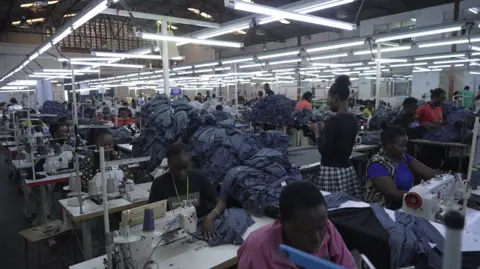
The industrious thrum of the heavy-duty sewing machines, along with the workers' chatter, normally fills the plant with a reassuring rhythm.
But today, every sound is tinged with uncertainty as the future of the firm is uncertain because of the possible end of a key piece of US trade law.
The African Growth and Opportunity Act (AGOA), which embeds in legislation a landmark trade agreement that has for 25 years given some African goods duty-free access to the US market, expires on Tuesday.
However, this policy is at odds with the Trump administration's record of imposing tariffs.
Envoys from various African countries have gone to the US to try to negotiate an extension, but it is not clear if that will happen.
Considered the cornerstone of US-Africa economic relations, Agoa's aim was to help industrialise the continent, create employment and lift dozens of countries out of poverty.
It was based on a philosophy of replacing aid with trade.
Agoa has proved very valuable for countries such as Kenya and Lesotho and the fate of thousands of workers, like 29-year-old Joan Wambui, is tied up with its future.
The end of the deal could spell the end of her job.
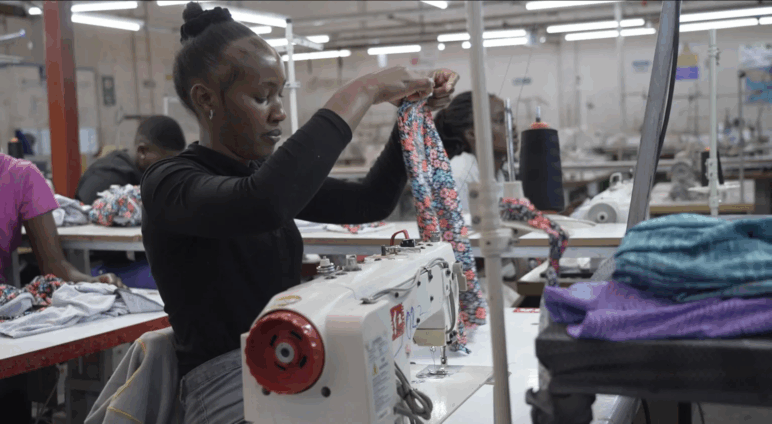
Ms Wambui has worked at Shona EPZ, helping to sew sportswear exclusively for the American market, for just six months. In that short time, her salary has become the mainstay of her household. She supports her four-year-old daughter, two sisters in college, along her mother.
Losing her job, she says, would affect more than just her own life.
"If Agoa expires, where shall we go?" Ms Wambui asks in a worried tone, her hands and feet moving in time on the sewing machine as she stitches together pieces of fabric.
For her, a regular wage has meant more than income. It has meant dignity and the ability to pay school fees, keep food on the table and enabled her to look forward to a better future.
"It's going to hit me hard. Starting to look for a new job. In Kenya, it's hard to find a job, very hard," she says as she folds the piece of fabric she has just stitched.
Kenya's apparel industry has thrived under AGOA.
In 2024 alone, the country exported $470m (£350m) worth of clothing to the US, supporting more than 66,000 direct jobs, three-quarters of them done by women, according to the Kenya Private Sector Alliance, an umbrella group of private businesses.
Factories like Shona EPZ have become important sources of employment, especially for young people who have struggled to find stable work in a tough economy.
"Most of the people here were taken from the streets," Ms Wambui says. "They were drug addicts. If it expires, they might go back there, and here they are reformed."
Shona EPZ does not require new employees to be skilled – the company is committed to training those it gives a job to.
The lack of clarity over the future of Agoa has already had an impact on Shona EPZ's output.
Normally, the factory produces nearly half a million garments each month, but this year output has slumped to about a third, as buyers hold back on long-term orders.
Garment sales from Kenya have also been hit this year by the 10% tariff introduced by the Trump administration earlier this year. A renewal of AGOA would not get rid of that, but would mean no additional tariffs.
"If the extension isn't granted, we may have to send people home and possibly shut down," factory director Isaac Maluki tells the BBC.
"If we can't get enough work to sustain the people here, we will have no choice."
Over the past seven years, Shona EPZ, which employs 700 people, has invested $10m in building the firm.
"If the extension doesn't happen, we are looking at the $10m investment going down the drain," a worried Mr Maluki explains.
The uncertainty stretches far beyond Kenya.
Across Africa, more than 30 countries currently export over 6,000 products to the US under Agoa, ranging from textiles to agricultural goods.
The programme has been credited with creating jobs, boosting industries, and giving African economies a stronger foothold in global trade.
But looking at a future deal, African negotiators need to rethink their approach, according to trade policy expert Teniola Tayo.
"African countries really need to figure out what they want from the US and what they can offer, because you need to be offering something in exchange for market access," she says.
African leaders have been lobbying Washington intensely.
At last week's UN General Assembly, trade was high on the agenda.
Kenya's Trade Minister Lee Kinyanjui revealed that Nairobi was pushing for at least a short extension.
"An ideal situation would be the extension of Agoa so transition mechanisms can be put in place," he said.
At the same time, Kenya is trying to strike its own bilateral deal with the US.
Last week, President William Ruto said he expected to sign a trade deal with the US the end of the year while urging Washington to extend the continent's duty-free access under Agoa for at least five more years.
South African President Cyril Ramaphosa similarly warned that its lapse would carry serious consequences for his country.
At the same time, Kenya and others are looking for new markets to reduce overreliance on the US.
Trade expert Ms Tayo says this should include taking advantage of the African free-trade area.
"When Africans trade amongst themselves, they tend to produce higher-value goods, more manufactured goods, versus simply exporting raw materials," she argues.
But this all takes time. For workers like Ms Wambui, the timelines of diplomacy and trade negotiations feel far removed from the daily urgency of feeding a family.
She has just one request for the Kenyan and US governments: give young people more opportunities.
"We have ideas and the drive to make a difference. We just need support to show our potential," she says as she and her colleagues head outside the factory for their lunch break.
Latest Stories
-
Pastor Mensa Otabil’s mother-in-law to be buried today
5 minutes -
GoldBod losses: Why act like Ghana has never lost money on Gold? – Manteaw
20 minutes -
Don’t credit GoldBod for Ghana’s macroeconomic stability – Bokpin
38 minutes -
US lifts security restrictions on ships from Nigeria after 12 years
57 minutes -
Oil edges up on uncertainty over exports through Hormuz
1 hour -
US judge allows Trump to end thousands of Ethiopians’ deportation protections
1 hour -
Liberia agrees to accept up to 1,200 third-country deportees from US
1 hour -
At least nine killed in hotel fire in India’s Kolkata
2 hours -
Earl Spencer to ‘tell the truth’ about his sister Princess Diana in new book
2 hours -
Meta hooked children on Facebook and Instagram, US court hears
2 hours -
African forest investment takes centre stage at Lagos business roundtable
2 hours -
Venus Williams given US Open singles wildcard – will Serena join her?
2 hours -
Premier League to publish verdicts on referee and VAR decisions
2 hours -
The 10.94 Cedi to 1 USD Paradox: Macroeconomic triumph, the import subsidy trap, and the threat to youth employment
2 hours -
Fifa sacking ‘deeply troubling’ – Uefa executive
3 hours