

Audio By Carbonatix
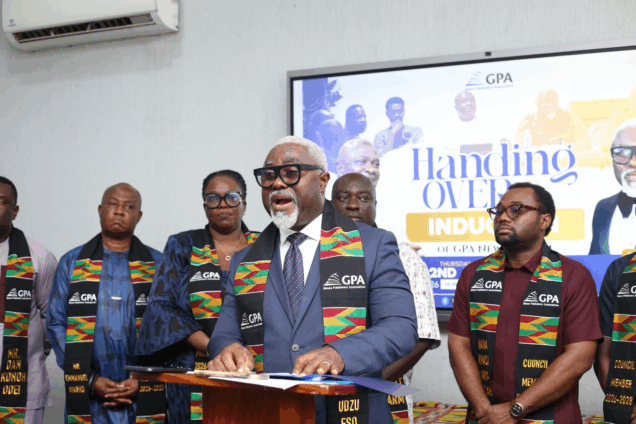
The newly inducted President of the Ghana Publishers Association (GPA), Edward Yaw Udzu, has outlined an ambitious four-point agenda aimed at revitalising Ghana’s publishing industry, strengthening its role in national development and addressing long-standing structural challenges.
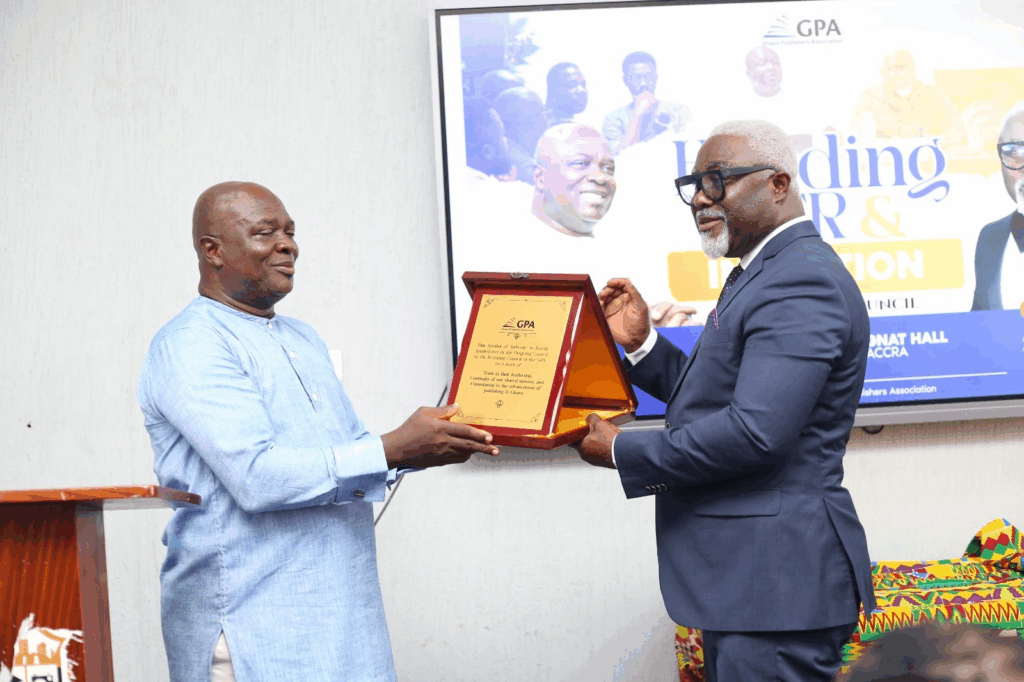
Speaking at the handing-over and inauguration of the new GPA Council at the GNAT Hall in Accra on Thursday, January 22, the President expressed deep gratitude to members of the Association for the confidence reposed in the new leadership, describing his election as both an honour and a solemn responsibility.
“I accept this responsibility with humility, a clear purpose, and a strong sense of duty to our members and the nation,” he stated, emphasising that publishing must be recognised as far more than a commercial venture.

According to him, publishing forms the backbone of education, cultural preservation and knowledge transmission, and remains a critical driver of sustainable national development.
He noted that books shape minds, support learning and transmit values across generations, adding that no country can achieve lasting progress without deliberate investment in its book industry, authors and knowledge systems.
Drawing on over three decades of professional experience spanning publishing, marketing and the law, the President acknowledged the difficult realities confronting Ghanaian publishers.
These include rising production costs, currency instability, piracy, limited market access and the growing need to innovate in response to evolving educational and technological demands.
Despite these challenges, he maintained that they also present opportunities for reform, collaboration and growth, provided industry players act collectively.
The President announced that the new council would focus on four strategic priorities, a deliberate departure from the seven-point agenda of the previous leadership.
“My mentor focused on seven, and we are saying four,” he explained. “This should tell you that we intend to focus sharply on what has been left undone.”
The first priority is strong and sustained engagement with government. He stressed that the publishing industry must be recognised as a strategic partner in national development, particularly in education and literacy.
The Association, he said, would intensify advocacy for a clear and predictable national policy on the periodic purchase of books for public schools, libraries and state institutions.
Such a policy, he argued, would not only improve educational outcomes but also create a sustainable local market capable of supporting investment in high-quality publishing.
The GPA President welcomed the government’s commitment to education, as reflected in the 2026 national budget statement, which allocates GH¢3 billion to educational infrastructure and learning support interventions.
Of particular interest to publishers, he noted, is the planned supply of textbooks for kindergarten, primary and Junior High School learners across the country.
While commending the initiative, he expressed concern that clear modalities for the selection and procurement of these books had not yet been communicated.
He therefore called for transparent, well-defined guidelines and timelines to ensure fairness, accountability and value for money.
“We believe that an open and structured procurement process will not only benefit learners but also strengthen the local publishing industry and sustain quality educational content in Ghana,” he said.
He added that the Association would also engage government on issues such as taxation, import duties on printing materials and access to affordable finance, all of which contribute to high production costs. Engagement, he assured, would be collaborative, evidence-based and consistent.
The second priority is the building of a resilient and innovative publishing ecosystem. The council plans to strengthen partnerships with educational institutions, development partners, international publishing bodies and digital platforms.
Both print and digital publishing, he noted, would be positioned as complementary tools for reaching today’s learners and readers, while encouraging innovation across the entire value chain.
The third priority centres on robust protection of intellectual property. Piracy, he said, continues to undermine creativity, investment and the livelihoods of authors and publishers.
In collaboration with CopyGhana, law enforcement agencies and relevant state institutions, the GPA will pursue stronger enforcement mechanisms, improved industry coordination and sustained public education on intellectual property rights.

The fourth and final priority is capacity building and member growth. The President reiterated the need for continuous training, professional development and access to market intelligence to enable Ghanaian publishers to compete effectively both locally and across Africa.
“A strong association must deliver tangible value to its members,” he said.
Underlying all four priorities, the President pledged a firm commitment to transparency, inclusivity and accountability. He stressed that the Ghana Publishers Association must serve all its members large and small, traditional and digital with fairness, integrity and open communication.
To partners and stakeholders, he extended an invitation for collaboration, while reaffirming the Association’s readiness to contribute meaningfully to government policy on education and culture.
Addressing fellow publishers, he concluded with a call for unity and collective action.
“The future of our industry depends on unity of purpose,” he said. “Together, we will build a publishing industry that supports education, rewards creativity, creates opportunity, and reflects the aspirations of the Ghanaian people.”
Latest Stories
-
Allround Baby Pants launched in Ghana to ease diapering for mothers
43 minutes -
Aggrieved Gold Coast Fund Management Company customers to petition Mahama over locked-up funds
59 minutes -
NSMQ 2026: PRESEC, Legon dethrones defending champions Mfantsipim in thrilling battle to book semi-final spot
1 hour -
Ghana’s cashew industry faces processing gap as Côte d’Ivoire moves to capture more value
1 hour -
“Our greatest wealth is not in our soil but our people” — Upper West Minister
1 hour -
Luex Healthcare launches children’s health education book series with Luey the Lion
2 hours -
NAGRAT urges gov’t to communicate early if September deadline cannot be met
2 hours -
We trust government to meet September deadline on teachers’ promotions – NAGRAT
2 hours -
“We dare not fail” – Gov’t promises to honour teachers’ promotion pay deal
3 hours -
The GH¢19.8 billion mirage: Inside Ghana’s state enterprise turnaround
3 hours -
Luv FM High School Debate: KNUST SHS and Osei Adutwum SHS set up thrilling final after dramatic semi-finals
3 hours -
KNUST AI Coordinator urges structured adoption of AI in teacher education
3 hours -
Nepal rescuers blast hillside in search of hydropower workers as families wait anxiously
3 hours -
Teachers who pass promotional exam to get January 2026 start date after gov’t resolves promotion dispute – Dr Apaak assures
3 hours -
NSMQ 2026: St. John’s School rally from slow start to book semi-final spot
3 hours