

Audio By Carbonatix
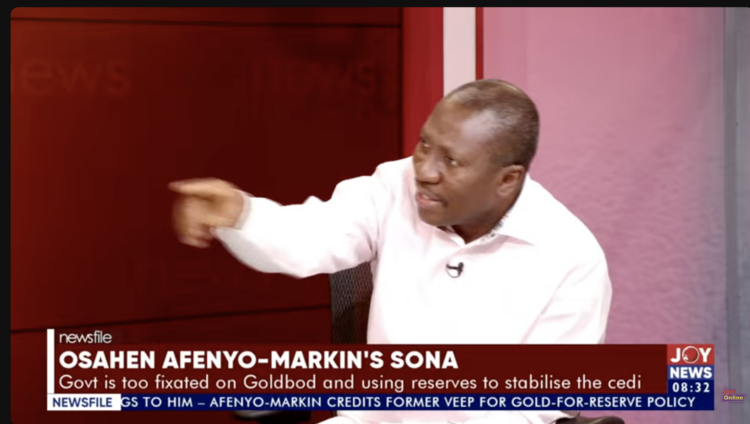
Minority Leader Alexander Afenyo-Markin has criticised the government’s handling of agriculture, arguing that strong public statements are not being matched by concrete action, despite heavy budgetary allocations to the sector.
Speaking on Newsfile a day after President John Dramani Mahama delivered his 2026 State of the Nation Address, the Effutu MP questioned the government’s priorities and the visibility of the Agriculture Minister.
“If government is that serious, there would have been sufficient investment in agriculture — but they are fixated on the gold board thing, abandoning other areas of the economy,” he said.
According to Afenyo-Markin, the administration has devoted much of its attention to the Ghana Gold Board, at the expense of farming, food production and value addition.
His comments come at a time when the government is defending its investment in the agricultural sector. In the 2026 budget, GH¢2.2 billion was allocated to the Ministry of Food and Agriculture, alongside GH¢1.7 billion for roads, processing zones and value chains.
Additional funding includes GH¢245 million for food security and agro-industrial programmes, GH¢828 million for agricultural enclave roads, and GH¢690 million for Farmer Service Centres.
Despite these figures, the Minority Leader insisted that farmers and agribusinesses have yet to feel the impact of the spending on the ground.
He also renewed his criticism of the cancellation of the One District One Factory (1D1F) initiative, which was introduced to promote decentralised industrialisation and job creation.
In July 2025, Trade Minister Elizabeth Ofosu-Adjare told Parliament that the 1D1F programme had been scrapped, with the government shifting focus to agro-processing parks under the 24-hour economy policy.
However, Afenyo-Markin argued that more than a year later, no clear alternative framework has been presented.
“The Trade Minister is yet to outline a concrete replacement strategy,” he said, calling on the government to explain what incentives are being offered to attract private sector investment.
He noted that without a well-defined industrial policy, efforts to link agriculture to manufacturing and job creation could be undermined.
Latest Stories
-
Young Positivist writes : Waste trafficking in Ghana
36 seconds -
JoySports Invitational Tournament 2026: A look back at a day of fitness, fierce competition and fun
1 minute -
FoSCel urges Ghanaians to know their genotype
6 minutes -
Mahama honours Nkrumah’s role in founding Non-Aligned Movement
18 minutes -
Tanker drivers demand audit and elections, cite poor representation and toll increase
34 minutes -
Bayport Ghana reports strong financial and ESG performance in 2025
39 minutes -
IGP deploys reinforcement team to contain violence in New Winneba shooting incident
41 minutes -
Two dead, 6 injured in Accra-Kumasi Highway crash
51 minutes -
Birth, death registration are mandatory – Deputy Registrar tells Ghanaians
1 hour -
GoldBod defends $1.315bn forex generation, says transactions backed by GANRAP
1 hour -
Sherif Ghali steps down as CEO of Ghana Chamber of Young Entrepreneurs after 10 years
1 hour -
Signals Bureau case: ‘I had about 60 questions’ – Atta Akyea welcomes extra cross-examination day
1 hour -
Africa’s colonial ecological debt could exceed hundreds of trillions of dollars – Report
2 hours -
Ibrahim Sulemana joins Sassuolo on loan from Atalanta
2 hours -
Former UK Prime Minister Keir Starmer to stand down as MP to focus on world affairs
2 hours