

Audio By Carbonatix
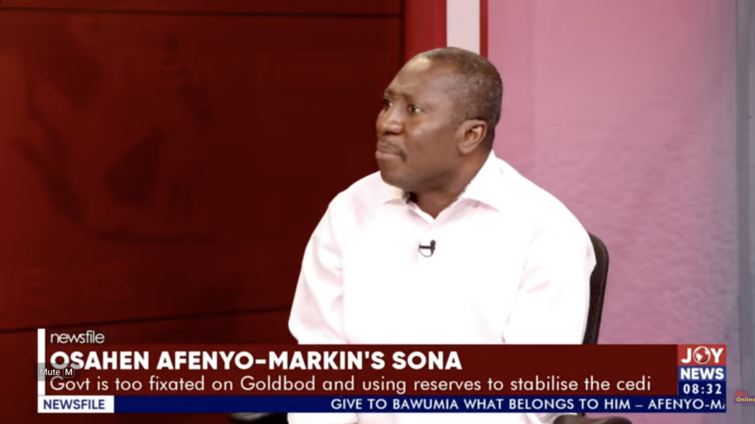
Minority Leader Alexander Afenyo-Markin says Ghanaian entrepreneurs are worse off under the current administration, citing what he describes as a lack of tax incentives and an increasingly aggressive revenue collection drive by the Ghana Revenue Authority.
Speaking on Newsfile on Saturday, a day after President John Dramani Mahama delivered his 2026 State of the Nation Address, Afenyo-Markin said government policies were putting undue pressure on the few businesses still operating in the country.
The Minority Leader, who is also a lawyer, revealed that his own law firm had recently been subjected to a tax audit, which he described as part of a wider pattern of pressure on private businesses.
“I challenge anyone to mention a single incentive for the private sector since they came into office. Rather, GRA is always on their neck,” he said.
He argued that instead of creating a supportive environment for entrepreneurs, the government appeared focused on maximising revenue at the expense of business growth and sustainability.
Afenyo-Markin’s comments come amid a significant expansion in tax collection efforts. According to the GRA’s Domestic Tax Revenue Division, it mobilised GH¢130.2 billion in 2025, representing a 20.3 per cent increase over 2024. The authority has set a target of GH¢162.59 billion for 2026, a further 21 per cent rise.
As part of its new strategy, the tax authority plans to decentralise audit operations and strengthen what it describes as “risk-based interventions” across different categories of taxpayers.
While acknowledging that revenue mobilisation is necessary, Afenyo-Markin warned that the current approach could be counterproductive.
He said the government should prioritise policies that stimulate investment, expand production, and grow the tax base, rather than “chasing a shrinking pool of compliant businesses”.
“The problem is not collecting taxes. The problem is how you do it, and whether you are helping businesses to grow so they can pay more in the long term,” he added.
In defence of its economic approach, the government has pointed to measures in the 2026 budget aimed at easing pressure on businesses. These include the abolition of the COVID-19 Health Recovery Levy and a reduction in the effective VAT rate to 20 per cent.
Officials say the measures are intended to lower operating costs and improve the business climate.
However, Afenyo-Markin insists the reforms do not go far enough.
He argued that without clear, targeted incentives for entrepreneurs, small and medium-sized enterprises would continue to struggle, thereby limiting job creation and economic growth.
Latest Stories
-
Aggrieved Gold Coast Fund Management Company customers to petition Mahama over locked-up funds
15 minutes -
NSMQ 2026: PRESEC, Legon dethrones defending champions Mfantsipim in thrilling battle to book semi-final spot
29 minutes -
Ghana’s cashew industry faces processing gap as Côte d’Ivoire moves to capture more value
40 minutes -
“Our greatest wealth is not in our soil but our people” — Upper West Minister
45 minutes -
Luex Healthcare launches children’s health education book series with Luey the Lion
58 minutes -
NAGRAT urges gov’t to communicate early if September deadline cannot be met
1 hour -
We trust government to meet September deadline on teachers’ promotions – NAGRAT
2 hours -
“We dare not fail” – Gov’t promises to honour teachers’ promotion pay deal
2 hours -
The GH¢19.8 billion mirage: Inside Ghana’s state enterprise turnaround
2 hours -
Luv FM High School Debate: KNUST SHS and Osei Adutwum SHS set up thrilling final after dramatic semi-finals
2 hours -
KNUST AI Coordinator urges structured adoption of AI in teacher education
2 hours -
Nepal rescuers blast hillside in search of hydropower workers as families wait anxiously
3 hours -
Teachers who pass promotional exam to get January 2026 start date after gov’t resolves promotion dispute – Dr Apaak assures
3 hours -
NSMQ 2026: St. John’s School rally from slow start to book semi-final spot
3 hours -
Promotion pay row: Gov’t gives teachers September 2026 to complete salary adjustments
3 hours