

Audio By Carbonatix
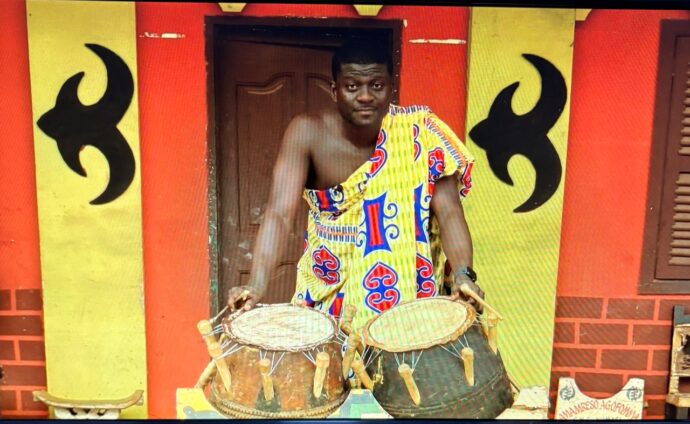
At the Kumasi Centre for National Culture, the rhythm rises into the air, steady and measured. To the unfamiliar ear, it is music. But to those who understand, it is language.
This is the ‘Atumpan’, the talking drum; a centuries-old system of communication that once carried the voice of kings across communities.
Atumpan in Akan is a word believed to have been borrowed from northern Ghana, tracing a history of cultural exchange between the Asante people and their northern neighbours. But its role within Asanteman would grow far beyond its name.
Long before microphones, long before mobile phones, the drum was the bridge between the palace and the people.
Cultural historian Nana Domfeh Gyeabuor explains that the system was both structured and deeply symbolic.
“In every community in Asanteman, whatever information the king gives out to the chiefs, through the linguist, will also be made known to the divine drummer,” he said.
That drummer is no ordinary performer. He is known as ‘Odomankoma-Kyerema’ of the divine drummer.
“Kyerema means tongue. The person is the voice. Whereas the linguist is the thought and tongue of the king, the divine drummer is also the voice of the palace to the community. Whatever information is given from the palace, it is the divine drummer’s duty to broadcast that information,” he explained.
In those days, the language of the drum was widely understood. Communities could interpret its tones as they rise and fall and respond accordingly. And when meaning was lost, they turned back to the source. The drummer would explain.
Even today, within traditional settings, the drum retains its authority. When a chief walks through the palace, the drum speaks ahead of him, announcing his presence, reciting praise, shaping perception. In some moments, it does even more.
“In fact, the only person who could talk to the king when he’s in a different mood to change the mood is either the ‘Kwadwom’ people or the talking drummers,” Nana Domfeh said.
The ‘Kwadwom’ performers are traditional singers who deliver appellations and musical praise, especially when a king is about to speak. Together, they form part of a broader system of communication deeply rooted in tradition.
Historically, drumming was more than a skill; it was described as a calling, often passed down through generations.
In many families, if a grandfather was a divine drummer, the role would naturally pass to his sons and grandsons, preserving both the craft and its meaning.
Beyond the palace, the talking drum also played a crucial role in community life. It was used to summon people for gatherings, festivals, and funerals, and other moments when collective attention was required.
Before the announcement of the death of a chief, king, or queen mother, a combination of drums including ‘Kete’, ‘Adowa’, and ‘Fontomfrom’ would be played to alert the community. The sound alone signaled that something significant was about to be communicated.
For Nana Domfeh, the importance of preserving this tradition cannot be overstated.
“This was given to us way back in the 15th or 16th century. So we need to preserve it so that the generation yet unborn will come and understand that this is where we are from and this is where we are progressing to,” he said.
At the Cultural Centre in Kumasi, the drums continue to speak, echoing a language shaped by history, carried through generations, and still understood by those who listen.
“This is part of our heritage. We should adore and be interested in it so that we can transcend this information on to our kids and their kids. Because if we lose our culture, we lose our identity, and if we lose our identity, we lose ourselves and our future,” he stated.
Long before Ghana learned to speak through technology, it spoke through rhythm, and in some places, it still does.
Latest Stories
-
NPP UK branch calls for independent audit into gold purchasing operations and parliamentary probe
16 minutes -
Zanetor Agyeman-Rawlings pledges decisive action on climate change, galamsey and environmental degradation
20 minutes -
Bawumia was brainchild behind Domestic Gold Purchase Programme – Samuel Jinapor
22 minutes -
Fuel prices set to go up from September 1, Petrol to sell at GHC 16.69 and Diesel, GHC 17.90 – COMAC
24 minutes -
Our World Our People withdrawn due to curriculum duplication, not politics – Adutwum’s spokesperson
27 minutes -
GANRAP is essentially a rebranding of Domestic Gold Purchase Programme – Abu Jinapor
33 minutes -
I am tired of being in opposition, my goal is to win in 2028 – Boakye Agyarko
44 minutes -
Ghana’s road maintenance funding gap deepens as only 37% of needs met – World Bank
44 minutes -
Roland Europe Group appoints Opoku Sanaa as Head of Sales, Middle East & Africa
46 minutes -
Sammyflex TV’s Roland Amartey girds up for 2026 Ghana Music Awards UK coverage
58 minutes -
U.S. bank queried payments for Ghana ambassador’s residence renovated by company owned by embassy’s IT officer
1 hour -
GoldBod to generate US$1.4bn in FX in September
2 hours -
GAF 2026/2027 enlistment opens September 3 for degree holders
2 hours -
Reparatory justice: Mahama announces high-level UN side event in September
2 hours -
Bosome Freho Assembly invests first tranche Common Fund in water and education projects for 19 rural communities
2 hours