

Audio By Carbonatix
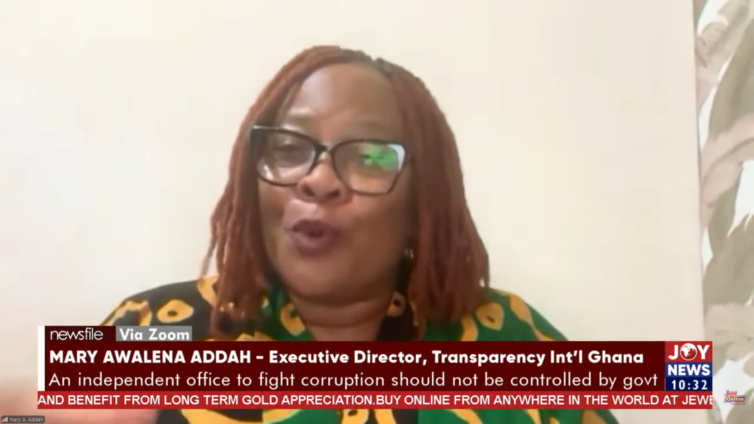
Executive Director of Transparency International Ghana, Mary Awalena Addah, has acknowledged progress in the fight against corruption through the Office of the Special Prosecutor (OSP), while highlighting structural and constitutional limitations that have prevented the office from achieving its full potential.
Speaking on JoyNews’ Newsfile programme on Saturday, April 18, Addah reflected on civil society’s role in shaping Ghana’s anti-corruption framework. She explained that Transparency International and other advocacy groups had long called for a stronger anti-corruption architecture, including a fully independent prosecutorial office, as outlined in early NACA proposals initiated during the current President’s tenure.
“Civil society concluded that the fight against corruption could be strengthened if we separated investigatory and prosecutorial functions,” Addah stated.
“Unfortunately, due to constitutional constraints, we were unable to achieve that ideal. Nonetheless, the establishment of the OSP was the best compromise at the time, and we supported it with evidence-based recommendations.”
Addah noted that despite its imperfections, the OSP has recorded measurable results. Between 2024 and 2025, the office expanded its caseload from 27 to 167 cases, including corruption and corruption-related offences. It has also recovered approximately GH₵35 million and averted potential losses exceeding GH₵7.18 billion.
She further cited public confidence in the OSP, referring to a recent survey in which 77.7% of citizens supported anti-corruption bodies operating independently of government control. Additionally, 55.2% of respondents identified the OSP as the most credible institution to investigate and prosecute corruption cases, ahead of constitutionally mandated bodies such as the Commission on Human Rights and Administrative Justice (CHRAJ).
Addah also reflected on political challenges faced by the OSP, noting attempts to undermine the office under both previous and current administrations.
“The office has been subject to attempts to undermine it, both in previous and current administrations. These distractions risk impeding the OSP from fulfilling its mandate of investigating corruption, overseeing procurement-related offences, and recovering misappropriated assets,” she noted.
Despite these challenges, she reaffirmed the continued relevance of the OSP, pointing to ongoing initiatives, including proposals for a national ethics and anti-corruption office, as evidence of gradual reform within Ghana’s anti-corruption framework.
“While the OSP may not be a flawless institution, the evidence shows tangible progress. Civil society remains committed to supporting reforms that enhance its effectiveness and independence,” she concluded.
Latest Stories
-
US teen drops lawsuit against Meta, Google and Snap ahead of trial
44 minutes -
Meghan could return to acting once back in UK
54 minutes -
Bali jails Swiss tourist for insulting sacred Day of Silence
1 hour -
At least 50 killed, mostly children, as overloaded boat capsizes in Nigeria
1 hour -
Nii Lante Vanderpuye apologises to Sammy Gyamfi, NDC over GoldBod comments
4 hours -
US sanctions more Cuban companies and officials
4 hours -
There is something different this time – Dr Yamson hails Mahama govt’s economic management
4 hours -
Gold for Reserves has risky, but necessary – Dr Yamson backs Mahama govt’s gold strategy
4 hours -
‘You want the trade, but not the people?’ – Dr Yamson tears into South Africa’s xenophobia
5 hours -
Walmart sales under strain as US shoppers pull back
5 hours -
The Premier League’s new plan to end corner chaos
5 hours -
US Open offers biggest prize fund in Grand Slam history
5 hours -
‘I feel I am imprisoning myself’ – Djokovic on drive & doubts
6 hours -
India’s Gen Z are driving up a mega boom in its beauty market
6 hours -
Ronaldinho seeks 300th goal with comeback aged 46
6 hours