

Audio By Carbonatix
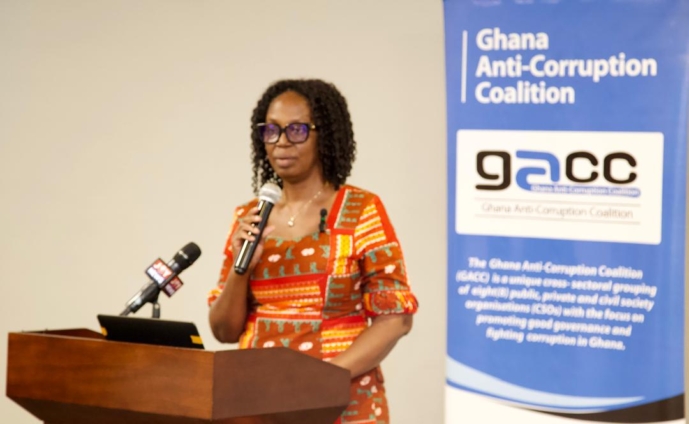
The Ghana Anti-Corruption Coalition (GACC) has released its 2025 State of Corruption Report, highlighting both progress and persistent weaknesses in Ghana’s fight against corruption.
The third edition of the coalition’s flagship report reviews developments from January to December 2025 and assesses the country’s performance on key corruption indicators, the work of state accountability institutions and the contributions of civil society and the media.
The report draws on evidence from the Corruption Perceptions Index, Afrobarometer surveys, Auditor-General’s reports, the Ibrahim Index of African Governance, and other sources to assess Ghana’s anti-corruption landscape.
Progress recorded
According to the GACC, key accountability institutions made notable progress during the period under review through investigations, prosecutions, audits, public education, and asset recovery.
The Office of the Special Prosecutor, for instance, initiated 71 investigations, secured seven convictions, saved approximately GH¢5.73 billion, recovered GH¢6.5 million and US$2 million, and seized assets valued at more than GH¢102 million.
The Ghana Audit Service also recovered about GH¢10 million out of GH¢150.36 million in unearned salaries, allowances, and other financial irregularities linked to 2,408 separated staff following a nationwide payroll audit. It recovered a further GH¢14.95 million through routine audits.
The report also acknowledges the contribution of civil society organisations and the media to public sensitisation, policy advocacy and accountability initiatives.
Persistent challenges
Despite these interventions, the GACC says Ghana’s anti-corruption efforts have not yet produced a decisive reduction in corruption risks.
The report identifies weaknesses in enforcement and implementation, inadequate political will and unsustainable funding as major obstacles to the effectiveness of the country’s anti-corruption framework.
It further notes that legislative reforms have stalled and that funding constraints are affecting both state and non-state institutions, with some organisations increasingly reliant on donor support.
“Ghana’s governance systems remain vulnerable, and corruption continues to demonstrate resilience in the face of existing controls,” the report states.
The coalition therefore calls for accelerated reforms, adequate and sustainable funding for accountability institutions, fair and consistent enforcement of anti-corruption laws, and stronger collaboration between state and non-state actors.
The GACC says the report is intended to serve as a resource for policymakers, accountability institutions, civil society organisations, development partners, researchers, the media and citizens working to strengthen transparency and accountability in Ghana.
Below is the full report.
Latest Stories
-
Banks NPL ratio of 16.1% is still too high – S&P
1 hour -
US death row inmate Christa Pike taken to hospital after surviving two lethal injections, says lawyer
2 hours -
Japan raises residency fee for foreign nationals by twenty-fold
2 hours -
Nollywood actor CJay Nwoks dies in Lagos hospital
2 hours -
Guidelines, regulations of cryptocurrency in Ghana fall short of comprehensive oversight – IMF
2 hours -
Don’t stand and just criticise, propose solutions – RMD urges Nigerians
2 hours -
I didn’t want to be in the spotlight – Tems
2 hours -
COCOBOD’S GH¢16.3bn SPV: Real progress toward a sustainable cocoa sector
2 hours -
Morocco appoints first woman head of government, El Mansouri vows to meet citizens’ expectations
4 hours -
King Mohammed VI appoints Fatima Ezzahra El Mansouri as Morocco’s new head of government
4 hours -
Impossible for England to find another Kane – Tuchel
4 hours -
Ghana lose Morocco friendly as Atlas Lions turn to Mali
4 hours -
Burnham ‘really concerned’ if Man City owners sell up after rule breaches
4 hours -
2026/2027 GPL: Kelvin Nkrumah strike sends Medeama top of league table
4 hours -
Punish Manchester City this season, say other club chiefs
4 hours