


Audio By Carbonatix
China will scrap tariffs for all African countries from Friday – except Eswatini, which maintains ties with Taiwan.
As of December 2024, China had already implemented a duty-free policy for 33 least-developed African nations. The policy now covers 53 countries, and will be in place until 30 April 2028. It is unclear what will happen after that.
Beijing has boasted that it is the first major economy to offer Africa unilateral zero-tariff treatment.
But analysts say that while China is seizing the chance to enhance its soft power, tariffs are rarely the main obstacle for exporters in Africa, which has a huge trade deficit with China.
A huge imbalance
"China is positioning itself as the trade liberaliser and Africa-friendly economic partner, in contrast to Donald Trump and the US," says Lauren Johnston, a senior research fellow at the AustChina Institute.
The US imposed tariffs of up to 30% on some African nations in August, though most are now subject to a 10% tariff, after the US Supreme Court struck down many of the duties.
The expansion of China's zero-tariff regime could increase African agricultural exports, which will "help to elevate rural incomes, improve rural productivity, and ultimately to reduce hunger and poverty", Johnston says.
But Sino-African trade is marked by a growing imbalance in China's favour, with Chinese exports to Africa far exceeding African exports to China, and that gap is widening.
Last year, Africa's trade deficit with China rose by 65% to about $102bn.
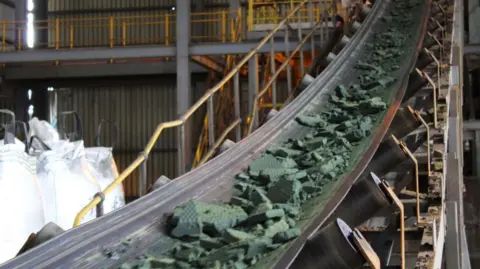
Africa's exports to China are dominated by minerals and raw materials, such as crude oil and metallic ores.
Currently, China's main trading partners in the region include Angola, driven primarily by oil, the Democratic Republic of Congo, and South Africa.
However, a consistent duty-free regime across such a heterogeneous continent could result in uneven gains, Johnston notes.
More developed, industrialised economies like South Africa and Morocco will be better positioned to expand exports, she says.
On its own, the zero-tariff policy does not address continent-wide needs for economic restructuring and infrastructure upgrading, adds Jervin Naidoo, a political analyst at Oxford Economics Africa.
"Many African economies still face structural constraints, such as limited industrial capacity, weak logistics, and a reliance on raw commodity exports, which tariff reductions alone cannot address," he says.
Alfred Schipke, director of the East Asian Institute in Singapore, agrees that short-term economic impact "will likely be modest and concentrated in African countries that already have export capacity".
"Over the long term, however, the potential could be more meaningful, especially if African countries are able to expand production, diversify exports, and move up the value chain," Schipke says.
Amit Jain, another Singapore-based expert in China-Africa relations, notes that changing consumer demand in China could open up new markets for African producers. For instance, Chinese consumers are buying far more coffee and nuts than they did 20 years ago.
Economist Ken Gichinga agrees.
"These new measures will improve access to Chinese markets, closing that trade deficit and expand opportunities for African companies to prosper," he told the BBC.
"For Kenya, it will be a big boost to certain subsectors such as avocado. The agriculture sector will benefit the most - macadamia nuts, coffee, tea and leather."
Africa fiscal policy economist Wangari Kebuchi said short-term support for foreign exchange earnings and "a modest boost to agriculture, mining and logistics sectors" were welcome, but medium and long-term fiscal gains would not materialise from market access alone.
"The structural problem has not changed. Africa continues to export raw materials and import manufactured goods. That asymmetry drives persistent trade deficits, constrains domestic revenue mobilisation, and limits the jobs and tax base that governments need to fund public services.
"Zero tariffs on commodities that have already left our shores unprocessed do not solve that problem. They can entrench it. African governments must now ask the harder questions. How do we use improved market access as leverage for industrial policy?"
And what about Eswatini?
The analysts believe the exclusion of Eswatini is a political move with limited economic impact.
In fact, Jain believes that this "may even help Eswatini win even more economic concessions from Taiwan".
The landlocked nation in southern Africa is among just 12 countries that maintain diplomatic relations with Taiwan, which Beijing considers a breakaway province that will eventually be "reunited" with China.
Many in Taiwan, a self-governed island, consider themselves to already be part of a sovereign nation.
Last month, Taiwan's leader Lai Ching-te had to cancel a trip to Eswatini after three other African countries – Seychelles, Mauritius and Madagascar – barred his aircraft from flying over their territories. Taiwan has accused them of doing so under "intense pressure" and economic coercion from China.
By sidelining Eswatini, China is "weaponising its ties with African countries, and showing how relations with China come with strings attached", Wen-Ti Sung, a political scientist with the Australian National University's Taiwan Centre.
"China wants to show the world how it treats its friends, versus Taiwan's friends," he says.
Latest Stories
-
Delta-BCI partnership reaches 166,000 people with breast cancer education
2 minutes -
Power restoration fault suspected in Kumasi Central Market fire
5 hours -
The 7-foot giant of Ngleshie Amanfro: Seven-foot Ghanaian Ephraim Saawa dreams of joining the national basketball team
6 hours -
Government promises support for Kumasi Central Market fire victims
6 hours -
Vibes The Movie: Big Ghun’s Ghanaian film earns five nominations at 2026 REFFA
6 hours -
‘I’m a fulfilled man’—Justice Korbieh on missing out on Supreme Court despite two nominations
7 hours -
MamaCare CEO warns unresolved conflicts among health workers could undermine maternal and neonatal care
7 hours -
Health professionals urged to translate medical knowledge into practice to save mothers
7 hours -
Retired judge Justice Francis Korbieh charges 1,568 new lawyers to uphold integrity
8 hours -
Conflicts among care providers linked to maternal, neonatal deaths – Expert
9 hours -
GIS marks 10th TIME conference, champions improved teaching practices
9 hours -
BRICS Or Balance? What Ghana’s bid really means
9 hours -
Adamus Resources launches breast cancer awareness campaign in Nzema
9 hours -
GPRTU wants full TRAFFITECH-GH implementation to start in 2027
9 hours -
How 10-mile walks for basic education birthed a 50-year legal career for Justice Korbieh
9 hours