


Audio By Carbonatix
Young climate advocates are raising concerns that Ghana’s recurring flood crisis is being driven as much by human behaviour and weak enforcement of sanitation laws as by climate change and inadequate drainage systems.
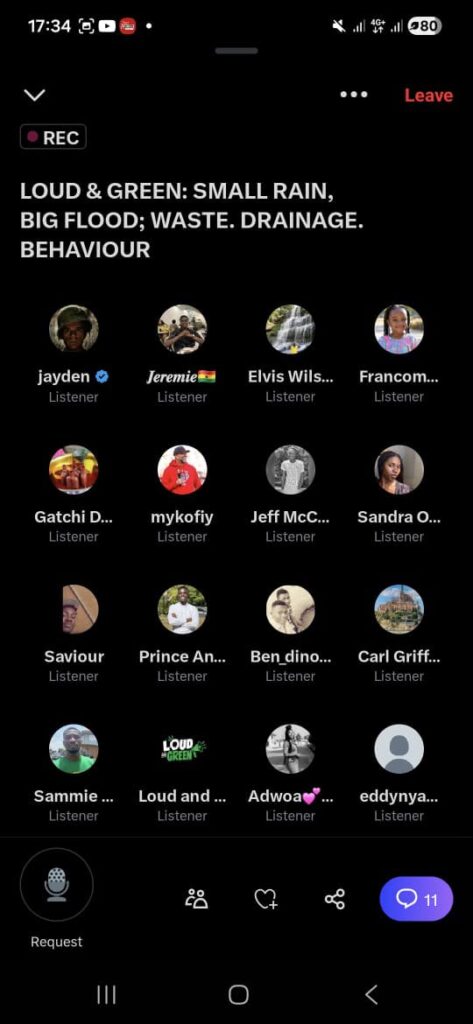
The concerns were shared during the maiden edition of the Loud and Green XSpaces on JoyNews X, held under the theme “Small Rain, Big Flood: Waste, Drainage and Human Behaviour.”
Participants argued that years of indiscriminate waste disposal, poor urban practices and weak enforcement have normalised environmentally harmful behaviour across communities.
Climate communicator Maxwell Aklorbortu described an incident during a trip from the Volta Region to Accra in which a passenger reportedly threw a plastic bottle out of a moving vehicle.
He said when he challenged the act, the individual—whom he described as a military officer—reacted angrily, underscoring what he sees as a broader societal disregard for environmental responsibility.
“Ghanaians have been able to normalise what is abnormal to the extent that we see no wrong with it,” he said.
Mr Aklorbortu noted that improper waste disposal directly contributes to flooding, as plastics and refuse block waterways and alter natural water flow patterns.
“Water flows through its natural course. When you block it with plastics or structures, it will find another route, and that route may be through people’s homes,” he explained.
Youth climate reporter Lady Diana Banyeh also shared her experience of being trapped in floodwaters around Madina Zongo Junction after a recent downpour.
She said traders continued dumping waste into drains even as water levels rose, worsening the situation and creating hazardous conditions for commuters and residents.
“Businesses were closed, homes were flooded and you couldn’t even tell the difference between the road and the gutter,” she recalled.
Climate activist Gafaru Aminu, however, cautioned that individual behaviour must be viewed alongside systemic challenges, arguing that leadership and infrastructure play a key role in shaping public conduct.
He stressed that without accessible waste disposal systems and strong institutional support, even well-meaning citizens may eventually adopt poor environmental habits.
“Once leadership decides to be intentional about these issues, the structures will be put in place,” he said.
The discussions formed part of the launch of the youth-led Loud and Green initiative, which seeks to amplify young voices in climate advocacy and make environmental conversations more accessible.
Participants agreed that without behavioural change and stricter enforcement of environmental laws, Ghana risks continuing its cycle of “small rains, big floods” across urban communities.
Latest Stories
-
Samson’s Take: Mr President, let the court speak before the bulldozer
4 minutes -
Inconsistency in applying laws on false publication problematic – Barker-Vormawor
8 minutes -
Ghana Jollof: If police have established other people are involved, why haven’t they arrested them? – Barker-Vormawor
16 minutes -
Commissioner-General calls for stronger tax cooperation to boost regional revenue mobilisation
18 minutes -
Ghana Jollof: Police must distinguish criminal speech from unpleasant content – Barker-Vormawor
25 minutes -
If it was wrong under NPP, it cannot be right under NDC – Barker-Vormawor
27 minutes -
Don’t turn away students over trunks and chop boxes – GES directs SHSs
41 minutes -
Foreign Affairs Ministry requests special audit of evacuation spending since 2017 to date
1 hour -
Livestream: Newsfile discusses Ghana Jollof case, cocaine shipment, COVID audit, constitutional reforms
2 hours -
SA Evacuation Exercise: Detailed breakdown of the GH¢27.18m spent on chartered flights
2 hours -
Foreign Affairs Ministry submits 200-page report to Minority on GH¢49.7m South Africa evacuation
2 hours -
US and Denmark reach deal over Greenland after Trump annexation threats
2 hours -
Ghanaian nurses set for US opportunities as GEA brokers Columbus partnership
2 hours -
Time to list Uncle Ebo Whyte in Guinness Book
2 hours -
Mahama orders review of SHS menu as Education Minister assures students of adequate food
5 hours