

Audio By Carbonatix
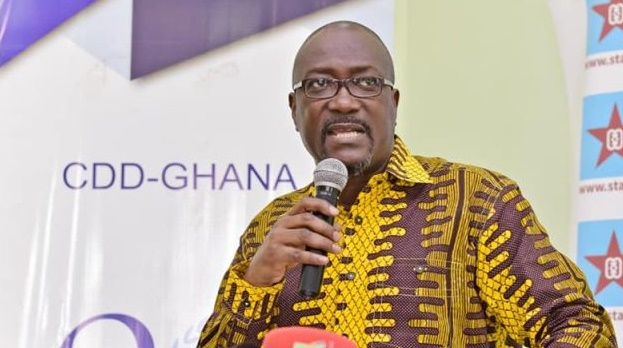
The Executive Director of the Ghana Centre for Democratic Development (CDD-Ghana) has cautioned that privately organised awards ranking government ministers could create unintended consequences for governance and weaken the President's authority in managing his team.
Professor H. Kwasi Prempeh's comments come amid public debate over the Ghana Ministers of State Excellence Awards, which has sparked criticism from sections of the public and prompted a response from the Presidency.
Speaking on Joy News’ PM Express Business Edition on Monday, he argued that such awards could interfere with a President’s internal assessment of ministers and complicate decisions relating to appointments and reshuffles.
“Assuming, for example, that the President, who is probably contemplating a reshuffle on the eve of that decision, is met with an award designating a particular minister as the best minister,” he said.
Prof Prempeh noted that the same minister being celebrated publicly could, by the President’s own standards and internal evaluations, be facing removal from office.
“Meanwhile, that minister may well have been on the cutting block, on the president's cutting block, right by the president's own internal standards and benchmarks and other things,” he stated.
According to him, a situation where a third party publicly elevates a minister above colleagues can create unnecessary complications for presidential decision-making.
“This minister was probably going to be given the axe, and all of a sudden we have a third party with some private or whatever interest promoting this person as the one who, in their view, is the best minister,” he said.
Prof. Prempeh stressed that beyond the implications for individual ministers, the awards also raise broader concerns about the principle of collective responsibility in government.
He explained that ministers are appointed to specific portfolios but ultimately work together to deliver the President's mandate and the executive arm of government.
“Ministers, even though appointed to particular roles and assigned particular roles, deliver on a mandate collectively, which flows from the president and also terminates with the president,” he said.
He argued that successful governance depends heavily on teamwork among ministers and warned that competitive award schemes could undermine that spirit.
“There is this idea of collective responsibility, and there's a sense in which the ministers must work together as a team to deliver on the mandate of the executive, the president,” he stated.
Prof. Prempeh warned that awards identifying individual ministers as superior performers could encourage personal ambition at the expense of collaboration.
“When you begin to throw these kinds of perverse incentives that cause one or the other minister or some other ministers to begin to pursue solo projects in order to get personal glory, you can also undermine the teamwork that is at the foundation of this principle of collective responsibility,” he said.
He maintained that the potential impact goes beyond individual recognition and could affect the President’s ability to effectively supervise and manage government appointees.
“I think these kinds of awards can have perverse, concrete perverse incentives, and can undermine the president's ability to properly manage his or her team,” he said.
While raising concerns about the awards, Prof. Prempeh acknowledged that the popularity of such initiatives may point to a public appetite for independent assessments of government performance.
“But I think you do put your finger on an important point, which is, are they filling a gap? Isn't the market filling a gap?” he said.
“The markets are very good at identifying sometimes state field worth and filling that gap with a product that sometimes appears to address this issue.”
Latest Stories
-
Tarkwa court jails labourer for three years over GH¢123,000 theft
32 minutes -
GAEC must retain nuclear scientists for Ghana’s nuclear ambitions – Minister
1 hour -
Man reportedly mistaken for game and shot by hunter dead in forest
1 hour -
19-year-old mason jailed 15 years for defiling seven-year-old pupil
1 hour -
Ghana’s banking sector assets rise 20.47% to GH¢500.2bn – BoG Governor
1 hour -
22 injured as Sprinter bus overturns at Sege after tyre burst
1 hour -
UN housing expert urges Ghana to strengthen Rent Control Department amid housing affordability concerns
1 hour -
Delta-BCI partnership reaches 166,000 people with breast cancer education
2 hours -
Power restoration fault suspected in Kumasi Central Market fire
7 hours -
The 7-foot giant of Ngleshie Amanfro: Seven-foot Ghanaian Ephraim Saawa dreams of joining the national basketball team
7 hours -
Government promises support for Kumasi Central Market fire victims
7 hours -
Vibes The Movie: Big Ghun’s Ghanaian film earns five nominations at 2026 REFFA
8 hours -
‘I’m a fulfilled man’—Justice Korbieh on missing out on Supreme Court despite two nominations
8 hours -
MamaCare CEO warns unresolved conflicts among health workers could undermine maternal and neonatal care
8 hours -
Health professionals urged to translate medical knowledge into practice to save mothers
9 hours