

Audio By Carbonatix
Most Ghanaians continue to support democratic governance despite concerns over corruption, economic hardship, and the appeal of military rule in some neighbouring countries.
The study found that 55 per cent of respondents preferred democracy to military rule, while 23 per cent favoured military governance.
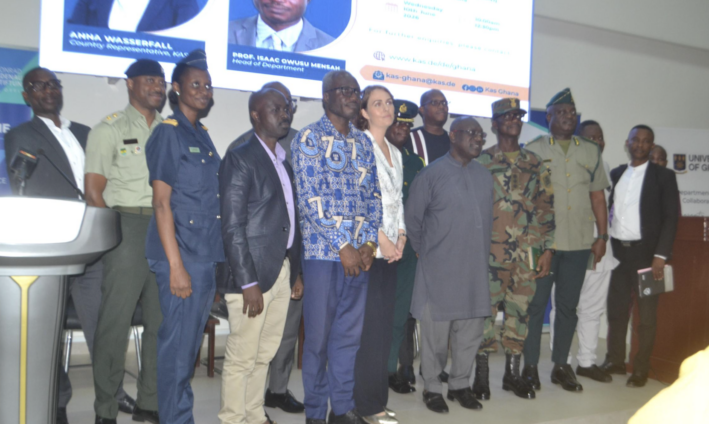
Professor Isaac Owusu Mensah, Head of the Department of Political Science at the University of Ghana, presented the findings at a dissemination event organised by the Department with support from the Ghana Office of the Konrad-Adenauer-Stiftung (KAS).
Titled “Stocktaking of Ghana’s Democracy: Undertones and Public Perceptions of Military Rule and Democracy in Ghana,” the study involved a cross-sectional survey of 6,719 respondents selected through a multi-stage sampling process across all 16 regions and 107 constituencies.
The research was complemented by focus group discussions with 50 participants in the Greater Accra Region.
The findings showed that 60 per cent of respondents believed democracy was functioning well in Ghana, while more than half expressed satisfaction with the way it was being practised.
Respondents identified the ability to choose leaders through elections, freedom of expression, and equal political participation as key benefits of democratic governance.
However, corruption, slow decision-making, political polarisation, and failure to improve living conditions were cited as major weaknesses.
Corruption emerged as the most significant threat to Ghana’s democracy, with 39.5 per cent of respondents identifying it as the greatest challenge to democratic development.
More than 75 per cent said corruption had reduced their confidence in democracy, while over 80 per cent indicated that economic challenges also threatened governance.
The study also revealed strong electoral participation, with 85 per cent of respondents indicating they had voted or intended to vote in future elections.
Participation in other democratic activities, including civic engagement, political discussions, protests, and political party programmes, remained relatively low.
On military rule, 84 per cent of respondents were aware of regimes in neighbouring West African countries, most associating them with restrictions on freedoms, fear, repression, and human rights abuses.
Nevertheless, more than half believed military governments could be more effective than civilian administrations in combating corruption and maintaining security.
Some respondents considered military takeovers justifiable under certain circumstances, particularly when democratic governments failed to address corruption, improve economic conditions, and create employment opportunities.
Professor Owusu Mensah said the findings should serve as a warning to political leaders to address governance challenges that could undermine public confidence in democracy.
He noted that while Ghanaians valued democratic freedoms and fundamental human rights, admiration for military regimes in neighbouring countries reflected frustrations over corruption and economic difficulties.
Ms Anna Lena Sabroso-Wasserfall, Country Director of KAS Ghana, said the findings highlighted both the strengths and challenges of Ghana’s democratic development.
She said the Foundation would continue to conduct similar studies and provide platforms for engagement among government officials, political parties, civil society organisations, religious bodies, and other stakeholders to strengthen democratic governance.
“The study gives us optimism and hope, but it also means that we must not be complacent. It shows us where potential concerns and criticisms exist and where we need to continue working together to strengthen democracy in Ghana,” Ms Sabroso-Wasserfall said.
Latest Stories
-
Ghana housing finance conference adopts communiqué to improve affordable housing access
3 hours -
Special Initiatives Minister urges Wa Technical Institute to enrol more girls as EU-backed solar training lab opens
3 hours -
In the matter of my first year at the Bar
3 hours -
ActionAid Ghana calls for an end to child marriage, greater investment in girls’ rights
4 hours -
Newsfile to tackle World Cup visa scandal, beach demolitions, education strikes, BRICS bid
4 hours -
UK-Ghana Trade & Investment Summit: Trade Resource Centre to help businesses maximise UK-Ghana trade opportunities
4 hours -
Embassy of Denmark celebrates World Maritime Day
4 hours -
Linking LEAP to productive inclusion could cut extreme poverty by 2030 – UNICEF
5 hours -
Trade Ministry backs use of creative arts to rehabilitate prison inmates
5 hours -
Negotiations with government to continue despite strike suspension – GNAT
6 hours -
‘Ghana cannot afford to waste public resources; every cedi has a job’ – Ato Forson
6 hours -
Ghana expects economic boost as World Assemblies of God Congress brings 10,000 delegates to Accra
6 hours -
Joy in Nayilifong as Farouk Aliu Mahama donates 100kVA transformer to improve power supply
6 hours -
Chief Justice urges employers to tackle mental health stigma in workplaces
7 hours -
Analysis: Ghana’s yellow fever numbers reveal a gap between vaccination and protection
7 hours