

Audio By Carbonatix
Ranking Member on Parliament’s Economy and Development Committee, Kojo Oppong Nkrumah, has proposed a five-point strategy to tackle Ghana’s growing youth unemployment crisis.
The Ofoase-Ayirebi MP warned that current interventions are failing to produce the needed results.
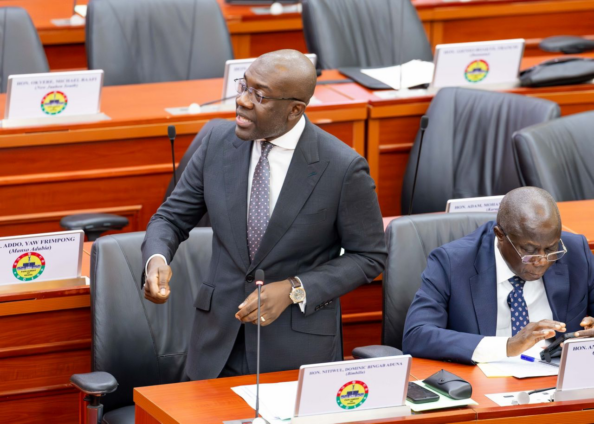
Speaking on the floor of Parliament on Thursday, June 11, he described youth unemployment as one of Ghana’s most pressing socio-economic challenges and called for urgent, measurable action.
“Mr. Speaker, we do not need more slogans or promises that results are in the pipeline. We need a more effective architecture to solve the worsening youth unemployment problem in our country.
"Data from the Statistical Service is clear. The youth unemployment problem is getting worse. The time to act is now,” he said.
According to the MP, recent data from the Ghana Statistical Service shows that unemployment among persons aged 15 to 24 rose from 32 per cent in December 2024 to 32.5 per cent by the third quarter of 2025.
He noted that nearly two million young Ghanaians are currently neither in education, employment, nor training, while almost half of young people in the Greater Accra Region remain unemployed.
While acknowledging that successive governments have struggled with the challenge, Mr Oppong Nkrumah said the country must move beyond promises and focus on practical solutions that create sustainable jobs.
“Ghanaian youth do not want slogans. They want feasible programmes that create dignified, productive and well-paid jobs,” he stated.
As part of his proposals, he called for all job creation programmes to be tied to published delivery scorecards that measure key indicators such as the number of beneficiaries, cost per job created, time-to-placement, and employment retention rates.
“Anchor every job programme to a published delivery scorecard with clear metrics on beneficiaries, cost per job created, time-to-placement and employment retention,” he urged.
The Ofoase-Ayirebi MP also advocated a clear distinction between skills training programmes and actual job creation initiatives, arguing that training alone cannot solve unemployment if beneficiaries have no employment opportunities afterwards.
He further proposed greater private-sector participation in job creation, with the government focusing on reducing investment risks, co-investing in strategic sectors, and creating an enabling regulatory environment for businesses to expand employment.
Mr Oppong Nkrumah also recommended making apprenticeship programmes the backbone of Ghana’s youth employment strategy through national certification, employer support and structured pathways into jobs and entrepreneurship.
Additionally, he called for the establishment of a credible Labour Market Information System to provide timely data on vacancies, skills gaps and labour demand to support evidence-based policymaking.
He concluded by urging government to adopt bold and measurable reforms to reverse the unemployment trend and create opportunities for Ghana’s growing youth population.
Latest Stories
-
Total expenditure as of July 2026 amounted to GH¢147.07bn, 16% below target – BoG
58 minutes -
Total revenue & grants stood at GH¢144.5bn in July 2026, slightly below target – BoG
1 hour -
Ghana Sports Fund urges sports federations to submit credible proposals and measurable targets
1 hour -
Sally Rooney books withdrawn in UK over Palestine Action support
1 hour -
Musk says US government may be behind slowdown of Ukraine drone speeds
2 hours -
Picking Chief Justices nearing retirement could give Mahama immense power – Bentil
2 hours -
Netflix to shed 1,000 jobs in steepest cuts since 2022
2 hours -
Burnham had two hospitality dinners with Man City chairman, deleted records show
2 hours -
Semenyo ‘froze’ after alleged racist abuse, court told
2 hours -
‘Shameless’ – Mourinho critical of Vinicius Jr ban timing
3 hours -
Loyalty can outweigh competence in Chief Justice selection – Bentil
3 hours -
Man City suffer as PSG masterclass sets up Champions League win
3 hours -
Customer Service Africa CEO urges business leaders to observe staff and customer interactions
3 hours -
On night of mayhem for Liverpool, Barcola arrives in style
3 hours -
Muzic Mensah finds healing and renewed love in new single ‘WayƐ Late’
4 hours