


Audio By Carbonatix
African women have worn headscarves for many years for religious, cultural reasons and even as a fashion statement but they were traditionally worn by older, usually married women.
They are a common feature in ceremonies such as weddings and even funerals.
Many also love the convenience of it - it can be a quick fix for a bad hair day.
And young South African women are embracing the doek (as it is known in Afrikaans).
One of the most popular forms of headscarves across Africa is the gele from West Africa. It can be incredibly elaborate and is usually starched so the material becomes stiff to hold its shape.
In Nigerian how a Yoruba woman wears her headscarf can be a sign of her marital status - if worn with the ends facing down its means a woman is married and if worn with the ends up, she is single.
Here in South Africa, there is a necessary debate about the doek in the corporate world.
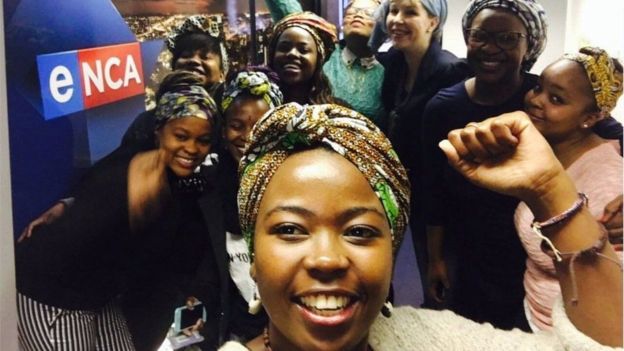
Cue social media storm.
The hashtags #RespekTheDoek and #DoekTheNewsroom trended for a number of days here last week with many people - including men and even women from all racial groups - wearing a doek to show their support for the young journalist.
The channel, while explaining that its dress code does not allow on-air journalists to wear headgear to work, has said it is now reviewing that policy.
But many believe the channel's reaction showed how the workplace has not changed with the times.
Some say it shows an intolerance to black culture.
"We are, after all, in South Africa where we have to be sensitive to everyone's culture and not just of those that don't wear doeks," says former entertainment writer Itumeleng Motuba.
"But don't forget that the workplace also insinuates that black natural hair is unprofessional. It seems looking African is unprofessional, which is rather ludicrous."
Kgothatso Maditse, a poet, agrees.
"It just goes to show just how far we are from accepting anything African if it doesn't have the 'right' stamp of approval. The longer we keep avoiding these topics, the longer we prolong and pacify an obviously stale way of thinking," she says.
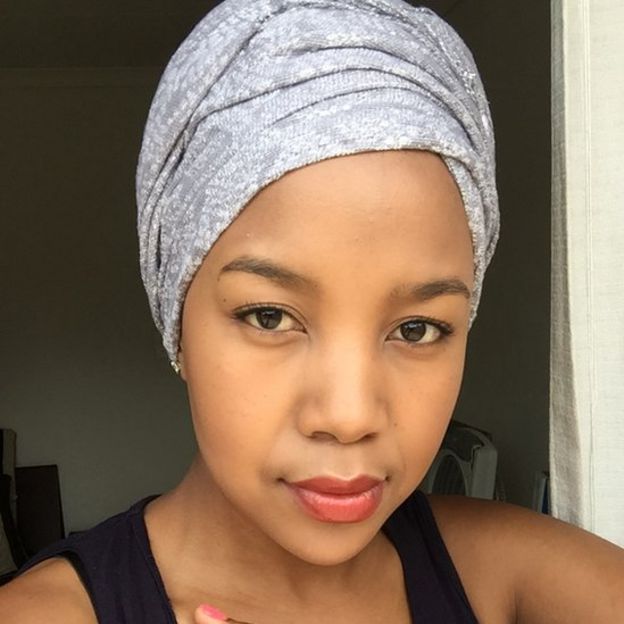
Wearing a headscarf, as a married woman, is a part of my Xhosa culture
In Xhosa culture, my culture, a married woman must wear iqhiya, which is what we call it, around her in-laws. This is seen as a sign of respect.
The in-laws will often show their makoti (daughter-in-law) how they'd like her to wear her scarf. In my case, mine needs to always cover my hair and ears.
My mother-in-law, who has been married for more than 40-years, wears it the same way.
For a while I had a love-hate relationship with the doek - it felt like a throwback to the past. It seemed like yet another way society was controlling how black women should look.
But a new generation of young women have now reclaimed the look - sporting a range of prints from all around Africa, they see the doek as an expression of what it is to be African.
And so I've grown to appreciate the delicate balance between ancient symbolism and modern identity - and made it my personal mission to celebrate its new-found power.
Kamogelo Seekoei, a Johannesburg writer, describes her headscarf as "a crown".
"Only a matriarch will know that a covered head means queen. We as black girls are out here celebrating our existence like never before," she says simply.
She says headscarves are a sign of "Queening" - a term used to refer to a social movement of black women from around the world who are embracing black beauty and power.
From oppression to power
A number of high-profile African women are often pictured in elaborate headscarves, such as Liberian President Ellen Johnson-Sirleaf, African Union (AU) head Nkosazana Dlamini-Zuma and Winnie Madikizela-Mandela.
But the doek here is also rooted in racial politics.
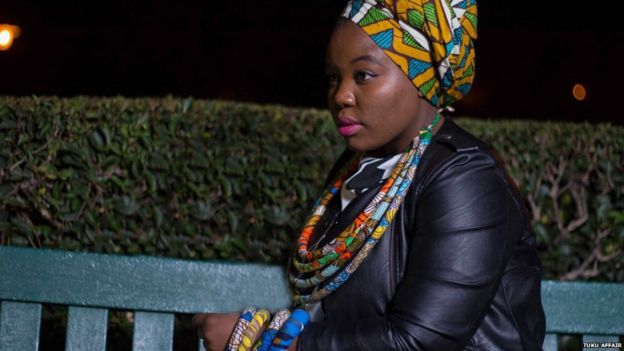
In South Africa, black domestic workers have worn it as part of their cleaning uniform for decades and it has served as a not-so-subtle reminder of that person's social standing.
It is a way of exerting control - an outward symbol of the gulf between servant and master.
This perhaps explains my reservations about headscarves at first.
Some say it is beginning to shed that image.
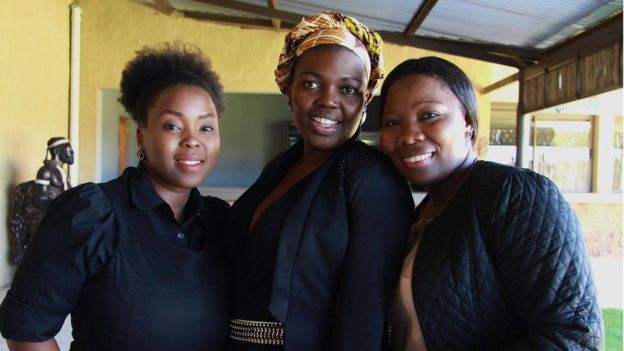
Kamogelo Seekoei (C) says wearing a headscarf is also about convinience
"Africans are going through a state of being woke [awakened]. Africans are coming back to themselves," says Tumi Ndaba, the owner of Tuku Affair, a Pretoria-based company that sells headscarves from materials bought all over Africa.
"The doek never left, it was just worn in a way that wasn't really appealing us, but the more we fall in love with ourselves, the more we work harder at perfecting and beautifying everything that belongs to us," she tells me.
South Africa, whose constitution is rooted in celebrating cultural diversity, is growing up and its people are now more than ever using their voice and asserting their identity.
And so on days when I wear a doek (which is admittedly sometimes on bad hair days), I feel regal.
Like many young people here, I now wear it as a statement, to celebrate Africa - with all its flaws and beauty and its journey to finding itself.
Latest Stories
-
Linking LEAP to productive inclusion could cut extreme poverty by 2030 – UNICEF
9 minutes -
Trade Ministry backs use of creative arts to rehabilitate prison inmates
10 minutes -
Negotiations with government to continue despite strike suspension – GNAT
14 minutes -
‘Ghana cannot afford to waste public resources; every cedi has a job’ – Ato Forson
17 minutes -
Ghana expects economic boost as World Assemblies of God Congress brings 10,000 delegates to Accra
23 minutes -
Joy in Nayilifong as Farouk Aliu Mahama donates 100kVA transformer to improve power supply
52 minutes -
Chief Justice urges employers to tackle mental health stigma in workplaces
2 hours -
Analysis: Ghana’s yellow fever numbers reveal a gap between vaccination and protection
2 hours -
Education Ministry welcomes suspension of teachers’ strike
2 hours -
Vice Chancellors Ghana appeal to striking university administrators to resume work
2 hours -
KNUST postpones 2026/2027 academic year reopening indefinitely amid GAUA strike
3 hours -
Fire destroys mattress factory at Sokoban in Kumasi
3 hours -
ECOM-SMS Ghana launches ‘Agriculture Our Future Clubs’ to address threat of ageing farmer population
3 hours -
Nicholas Atsu Kumi
3 hours -
Cherif Sarr: Economic participation needs more pathways, not one prescribed route
3 hours