

Audio By Carbonatix
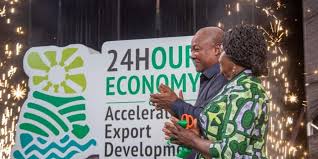
The Alliance for Development and Industrialisation (ADI) is urging the Government of Ghana to deepen collaboration with the Government of Germany and the KfW Development Bank, a member of the International Development Association (IDA), to accelerate the nation’s 24-Hour Economy through agriculture, agro-processing, and renewable power development.
According to ADI, Ghana’s 24-Hour Economy concept—designed to boost industrial productivity and job creation—can only be achieved sustainably when backed by reliable, low-cost, and renewable energy sources such as solar and biofuels, and supported by robust agro-industrial value chains.
“Germany and KfW have long been central to Ghana’s development story,” said Dr Richard Mensah, Convenor of ADI.
“They have helped modernise our agricultural sector, strengthen technical and vocational education, and establish key institutions such as the Development Bank Ghana (DBG) and the Outgrower and Value Chain Fund (OVCF). These are the right partners to lead Ghana’s next growth phase under the 24-Hour Economy.”
ADI is advocating for the expansion of Germany’s successful KfW OVCF programme, which has already provided innovative financing and support to smallholder farmers and agribusinesses. The organization proposes broadening this initiative to cover key high-potential commodities that can drive industrialization and export growth—specifically:
Palm and Coconut – for edible oils, cosmetics, and renewable biofuel production.
Citrus and Tropical Fruits – for juices, concentrates, and processed exports.
By-products and Waste – for organic fertilizers, feed, and bioenergy.
The expansion, ADI says, should include value addition, processing, and export linkages, ensuring farmers and local processors can benefit directly from global markets while creating sustainable jobs.
For Ghana to operate a 24-hour production and services system, renewable energy must form the base of industrial and rural power supply. ADI highlights that solar farms, distributed mini-grids, and biofuel systems can provide “free and clean” energy to agro-processing zones, cold-chain facilities, and rural industries—reducing cost pressures and ensuring continuous operation.
“The 24-Hour Economy must be powered by renewable and free energy sources that ensure factories, farms, and logistics hubs can operate round the clock,” he added. “This approach will make Ghana’s exports more competitive and environmentally sustainable.”
Germany remains one of Ghana’s most consistent and effective development partners. Over the decades, German cooperation has spearheaded programs in:
Agricultural modernization and value chain finance (via KfW and GIZ).
Technical and vocational education and training (TVET), equipping youth with employable skills.
Industrial financing through the establishment of the Development Bank Ghana (DBG).
Renewable energy projects, supporting Ghana’s energy transition towards sustainable growth.
ADI believes that building on this foundation through a formal Ghana–Germany–KfW partnership will create a unified framework to support agro-industrial zones, renewable energy infrastructure, and export-oriented manufacturing.
ADI is therefore calling on policymakers to prioritize the creation of a Ghana–Germany–KfW 24-Hour Economy Initiative, which would integrate:
Agriculture and value chain financing expansion through OVCF.
Agro-processing industrial parks powered by renewable energy.
Export facilitation for palm, coconut, citrus, and fruit-based products.
Youth training and enterprise support through TVET-linked programs.
“Germany and KfW have the expertise, capital, and technology to make Ghana’s 24-Hour Economy a reality,” ADI concluded. “With their partnership, Ghana can transition from raw commodity exports to a renewable-powered agro-industrial nation that operates efficiently, inclusively, and sustainably."
Latest Stories
-
Real Madrid beaten at home by Getafe for second successive loss
14 minutes -
‘Clubs refused to look at me after my crash’ – Antonio on Qatar move
25 minutes -
Mayweather to fight kickboxer before Pacquiao rematch
35 minutes -
India and Canada reset ties with ‘landmark’ nuclear energy deal
44 minutes -
Mahama should equally credit NPP for economic stability – Economist
47 minutes -
Interior Ministry releases funds to settle 2025 rent allowance arrears for security services
2 hours -
Ghana evacuates diplomatic staff from Iran; embassy shut indefinitely — Ablakwa
2 hours -
France to boost nuclear arsenal and extend deterrence to European allies
2 hours -
Chinese community in Ghana marks ‘Year of the Horse’ with grand new year festival
2 hours -
When regional instability becomes national risk: Ghanaian tomato traders killings
2 hours -
Photos: President Mahama meets Tanzania President Suluhu Hassan
2 hours -
Mahama calls for cessation of Iran-US-Israel conflict, urging return to dialogue
3 hours -
Fuel prices could rise if Middle East conflict escalates – ACEP Boss
3 hours -
Elsie Addo Awadzi: Leadership reflections, one year on; 7 lessons from 7 years in public office
3 hours -
Finance Minister announces expiration of DDEP-induced restrictions on domestic bond issuance
3 hours