

Audio By Carbonatix
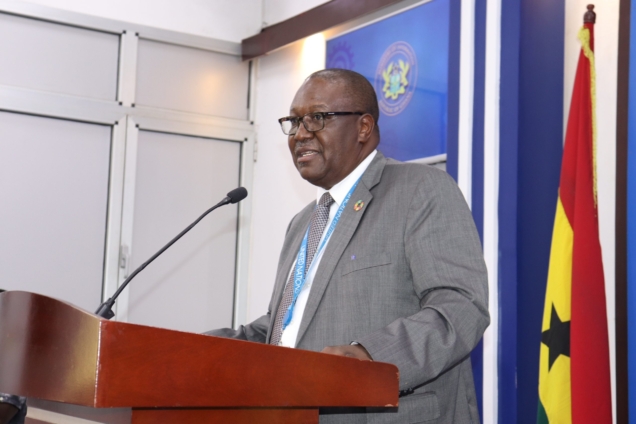
World Health Organisation (WHO) representative to Ghana, Dr Francis Kasolo, has dispelled the notion that “Artificial Intelligence will replace health care professionals.”
He, however, added there is “the need to leverage emerging technologies such as artificial intelligence to build a sustainable and healthy nation is more urgent now than ever.”
He said this in his address to health practitioners at the Ghana College of Physicians and Surgeons’ Medical Knowledge Fiesta 2023 themed “Leveraging Artificial Intelligence to Build a Sustainable & Healthy Nation; the Role of the Health Professional”.
Dr Kasolo indexed some of WHO’s activities to provide guidance and build capacity to ensure no country is left behind in efforts to attain universal health coverage in the AI revolution.
He specifically mentioned the availability of guidance materials on ethics and governance and the opportunity for countries to access free online courses through the WHO e-learning platform.
Dr Kasolo made a few recommendations for the effective implementation of Artificial Intelligence as he concluded his address.
He emphasised the need to expand Ghana’s digital health data system for wider access to digital health services and innovation throughout the country.
He also advocated for enhanced collaboration among stakeholders, including the government, partners, the private sector, healthcare providers, and technology partners, to facilitate the adoption of AI.
Additionally, he underscored the importance of promoting digital literacy to maximize AI's benefits, prioritizing data privacy and security, and standardising AI applications across the healthcare system to simplify training and utilization.
The Medical Knowledge Fiesta 2023 witnessed experts across the fields of Surgery, Obstetrics and Gynecology, Psychiatry, Emergency Medicine, Public Health, Global Health, One Health, and Artificial Intelligence.
Dr Kazia Malm, Planning Committee Chair for this year’s MKF, explained the reason behind the chosen theme.
“We chose this theme because we wanted to create a discussion around the topic. Artificial Intelligence is coming up quite high. It is in what we do and we need to understand it.
She continued; “Is it even already there in the system? What is being done? What can be done? What are the regulatory issues we should look at as a country? What are the things we should be looking at proactively to make sure we harness the benefits of this in terms of caring for people’s health?”
“We’ve had plenary sessions, track sessions, and workshops that give hands-on skills to doctors who participate.
“It has been a successful 2-and-a-half-day fiesta and we hope to be able to improve on it next year,” she said.
Professor Richard Adanu, the rector of the GCPS, was pleased to hear of the application of AI in Gastrointestinal Imaging, Epidemiology, and Radiology by Ghanaian health workers. He believes it has great potential.
“We think that Artificial Intelligence in health has great potential to be used to improve the efficiency of healthcare workers and also to improve the outcome of our health services.
He continued: “It is very important for us to get information from this conference to the Ministry of Health, to develop policy that will guide the use of Artificial Intelligence in Health and also to set standards within which people can work to take this forward. We think Ghana is ready to take advantage of Artificial Intelligence,” he announced.
Lecturer at the Department of Biomedical Engineering, KNUST, and AI healthcare specialist with the Global Health and Infectious Diseases research group at Kumasi Centre for Collaborative Research (KCCR), Prince Ebenezer Adjei, joined a panel of AI experts to discuss the theme of the conference in the context.
“For me what was notable was the concern about whether AI would replace the work of Doctors.
“I am glad we all left with the consensus that AI cannot replace the health professional, at least at this stage it will only complement their work and make them more efficient,” he explained.
“We also looked at basic tools that doctors and healthcare workers in general use for research. It was exciting to get feedback and to see the interest.
“I think AI has a strong potential in the healthcare industry and I’m excited our doctors are responding to it,” he said.
Latest Stories
-
Two arrested at Osu cemetery over illegal grave digging
1 hour -
Ticket Ghana explores new aviation connectivity options as demand for travel to Ghana grows
2 hours -
Applications open for 2026 Igniting dreams fellowship in Northern Ghana
3 hours -
AI Contracts: Fast, professional, but legally risky
3 hours -
Over 1,000 youth equipped as National Apprenticeship Programme starts in Ashanti region
3 hours -
See the areas that will be affected by ECG’s planned maintenance between February 8-13
4 hours -
Police arrest 53-year-old man for threat of death, unlawful possession of firearm
4 hours -
OSP probes NPP Presidential, NDC Ayawaso East parliamentary primaries over vote buying allegations
4 hours -
Gov’t launches nationwide training programme for coconut farmers
4 hours -
Borussia Dortmund launch first African academy in Ghana
5 hours -
Hamamat and Wiyaala land tourism ambassadorial roles
8 hours -
A singer’s tragic death highlights Nigeria’s snakebite problem
9 hours -
King Charles to host Nigeria’s first UK state visit in 37 years
10 hours -
Mikel Arteta: Arsenal’s 9-point lead at top of Premier League means ‘nothing’
10 hours -
Japan votes in snap election as PM Takaichi takes a gamble
11 hours